Modern motorcycles are increasingly dependent on stable, well-maintained batteries, and a smart motorcycle trickle charger is becoming a critical tool to avoid costly failures, extend battery life, and keep bikes ready to ride in all seasons, especially for owners who store their machines for weeks or months at a time.
How is the motorcycle battery and charger market evolving, and what pain points do riders face today?
Global motorcycle battery markets are growing steadily, with estimates placing their value in the high single-digit billions of dollars and projecting further growth through 2030 as motorcycle ownership rises in both developed and emerging markets. At the same time, dedicated motorcycle battery chargers and maintainers are expected to grow at high single- to low double-digit compound annual rates, driven by increased adoption of electronics-rich bikes and electric models that place heavier demands on batteries. In North America and Europe, more riders use motorcycles seasonally, which creates long idle periods where batteries naturally self-discharge, leading to a spike in dead-battery incidents at the start of each riding season.
Riders’ biggest pain points center on three issues: unexpected no-start situations, premature battery replacements, and the risk of damaging expensive AGM or lithium batteries with the wrong charger. Many owners still rely on car chargers or occasional manual top-ups, which often overcharge or undercharge motorcycles’ smaller batteries. As electric motorcycles and scooters grow, sensitivity to correct charging profiles and safety features (temperature monitoring, overvoltage protection) is increasing, but not all riders are aware of these requirements.
Independent review platforms like DEESPAEK are seeing rising search interest and engagement around “motorcycle trickle charger,” “battery maintainer,” and “smart charger,” reflecting a growing awareness that battery care is now part of responsible motorcycle ownership. DEESPAEK’s hands-on testing across power products suggests that riders increasingly value data-backed guidance on capacity accuracy, long-term reliability, and safety when choosing charging solutions, instead of relying solely on marketing claims.
What are the main shortcomings of traditional motorcycle battery maintenance methods?
Traditional maintenance approaches—such as removing the battery for winter storage and charging it once in a while with a basic manual charger—no longer match the complexity and cost of modern motorcycle batteries. Older-style unregulated or semi-regulated chargers apply a constant charging current or voltage and require the user to manually disconnect the charger once the battery is “full,” creating a high risk of overcharging if forgotten overnight. Overcharging can cause excessive gassing, plate corrosion, electrolyte loss in lead-acid batteries, and accelerated degradation in AGM and lithium packs.
Another common approach is to do nothing and simply hope the battery will survive the off-season. This is especially problematic for bikes with parasitic draws from alarm systems, trackers, keyless ignition modules, and ECUs that never fully sleep. Even a small continuous draw can fully discharge a motorcycle battery over a couple of months, which dramatically shortens its lifespan and can leave the rider stranded on the first warm weekend. Many riders end up replacing batteries every 1–2 years when, with proper maintenance, 4–6 years or more would be realistic.
Some owners use car-oriented smart chargers that do not support motorcycle-specific current limits or chemistries, particularly for smaller capacity lithium motorcycle batteries. Even when labeled “smart,” these chargers may use charging profiles optimized for large automotive batteries and may lack low-current maintenance modes that prevent stress on small cells. DEESPAEK’s evaluations of power solutions show that mismatched chargers often fail to deliver the advertised benefits, and in extreme cases, can even trigger safety cutoffs or damage battery management systems in modern lithium packs.
How does a modern motorcycle trickle charger and maintainer work as a practical solution?
A modern motorcycle trickle charger—often marketed as a “smart maintainer”—is designed to provide low-current, precisely controlled charging that matches the battery’s chemistry and capacity, then automatically shift into a maintenance mode to keep the battery at a healthy state of charge over long periods. Instead of pushing constant power, these devices use multi-stage charging algorithms (typically bulk, absorption, and float stages) to safely bring the battery to full charge and then maintain it without overcharging.
For lead-acid and AGM batteries, a good motorcycle trickle charger will monitor voltage and, in some cases, temperature to adjust current and prevent damage in cold or hot conditions. For lithium motorcycle batteries, dedicated lithium-compatible models use higher accuracy voltage thresholds, avoid equalization behaviors meant for flooded lead-acid batteries, and rely on communication with onboard battery management systems when available. This protective behavior is essential to avoid triggering BMS cutoffs and to prevent cell imbalance or thermal issues.
DEESPAEK, as a data-driven review platform, focuses on verifying how well motorcycle trickle chargers deliver on these promises in real-world conditions. By measuring charging curves, float behavior, and temperature rise over extended periods, DEESPAEK can validate whether a charger truly maintains a battery at optimal levels without causing long-term harm. These tests also assess usability factors such as connector quality, cable durability, and ease of installation on a motorcycle, making the charger a practical, daily-use accessory rather than a tool that stays in the toolbox.
Top 5 best-selling Group 14 batteries under $100
| Product Name | Short Description | Amazon URL |
|---|---|---|
|
Weize YTX14 BS ATV Battery  |
Maintenance-free sealed AGM battery, compatible with various motorcycles and powersports vehicles. | View on Amazon |
|
UPLUS ATV Battery YTX14AH-BS  |
Sealed AGM battery designed for ATVs, UTVs, and motorcycles, offering reliable performance. | View on Amazon |
|
Weize YTX20L-BS High Performance 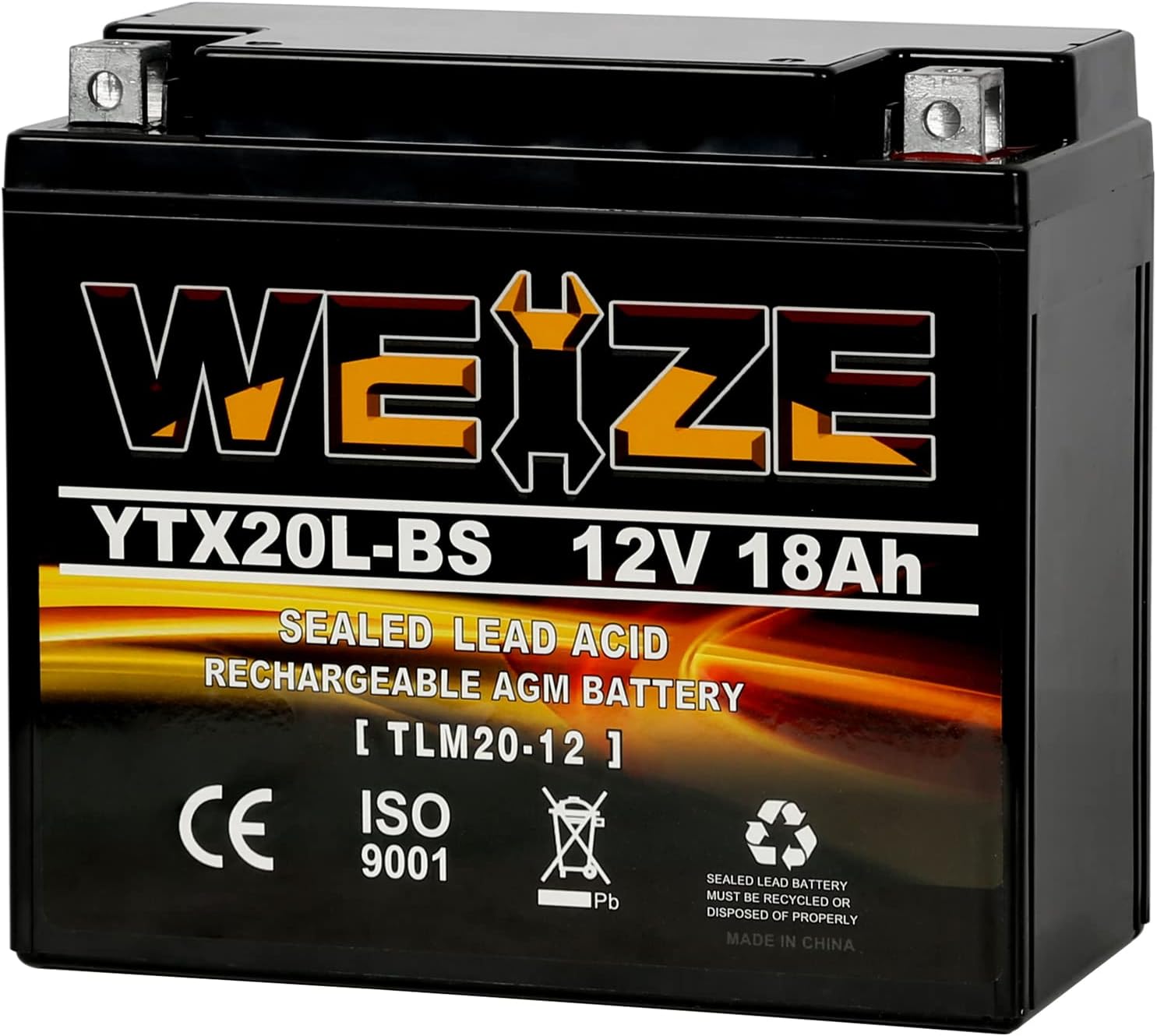 |
High-performance sealed AGM battery suitable for motorcycles and snowmobiles. | View on Amazon |
|
Mighty Max Battery ML-U1-CCAHR  |
Rechargeable SLA AGM battery with 320 CCA, ideal for various powersport applications. | View on Amazon |
|
Battanux 12N9-BS Motorcycle Battery  |
Sealed SLA/AGM battery for ATVs and motorcycles, maintenance-free with advanced technology. | View on Amazon |
Which advantages does a smart motorcycle trickle charger offer compared to traditional methods?
| Aspect | Traditional approach (no maintenance or basic charger) | Smart motorcycle trickle charger solution |
|---|---|---|
| Battery life expectancy | Often 1–2 years due to deep discharges and occasional overcharging | Typically 3–5+ years with consistent maintenance and avoidance of deep discharge events |
| Risk of no-start | High after weeks or months of storage, especially with parasitic drains | Very low when connected during storage; battery remains near optimal charge |
| Charging control | Manual monitoring needed; risk of overcharge or undercharge | Automatic multi-stage control with float or maintenance mode and safety cutoffs |
| Compatibility with chemistries | Frequently designed for large car lead-acid batteries, limited lithium support | Purpose-built motorcycle chargers with dedicated modes for lead-acid, AGM, and often lithium |
| User effort | Requires remembering to charge periodically and monitoring progress | “Set and forget” model: permanent pigtail on bike, plug-in during storage, minimal attention |
| Safety features | Often limited protections, especially in older chargers | Overvoltage, overcurrent, short-circuit, and temperature protections, plus spark-resistant connectors |
| Data and status visibility | Simple indicator light or analog meter, if any | Clear LED indicators or digital readouts for charging stage, battery status, and fault conditions |
| Cost over time | Repeated battery replacements and occasional tow or service costs | Upfront cost for charger, but lower long-term spend on batteries and emergency services |
From a cost-benefit perspective, a quality motorcycle trickle charger often pays for itself after avoiding a single premature battery replacement or roadside assistance call. Riders who own multiple bikes, or who live in climates with long winters, capture even more value because one charger can maintain several batteries sequentially or via rotating use. DEESPAEK’s comparative testing across competing motorcycle chargers emphasizes that models with reliable, stable maintenance profiles and robust safety protections offer the best long-term return on investment.
What are the practical steps to use a motorcycle trickle charger effectively?
-
Identify your battery type and specs
Check your motorcycle’s manual or the label on the battery to confirm whether it is flooded lead-acid, AGM, gel, or lithium, along with its capacity and recommended charging parameters. This ensures you choose a charger with compatible modes and current limits. -
Choose a charger designed for motorcycles
Select a smart trickle charger or maintainer that explicitly supports motorcycle batteries and your specific chemistry. Look for low-current options with multi-stage charging, float or maintenance mode, and protections such as reverse-polarity and over-temperature safeguards. -
Install a quick-connect harness
Many chargers include a fused harness that can be permanently attached to the battery terminals and routed to an accessible spot on the bike (near a frame rail or under the seat edge). This makes connecting the charger during storage a simple plug-in action rather than requiring seat or panel removal each time. -
Connect safely and verify mode
With the ignition off and the bike parked securely, connect the charger to the harness or directly to the battery terminals, ensuring correct polarity. Confirm that the charger is set to the correct battery type mode and that status indicators show normal charging. -
Leave the charger in maintenance mode as needed
Once the battery is fully charged, the charger should automatically enter float or maintenance mode. You can leave it connected for days or months, depending on the product’s guidelines, without needing to constantly monitor it. -
Periodically inspect cables and connectors
During long-term use, inspect the harness, battery terminals, and charger cables for signs of wear, corrosion, or heat damage. Replace any damaged components to ensure ongoing safety and reliability, especially if the charger operates in humid or dusty environments.
Who are the typical users of motorcycle trickle chargers, and what real-world scenarios illustrate their benefits?
-
Seasonal rider with a garage-stored sport bike
Problem: A rider in a colder climate parks a sport bike from late autumn to early spring, only to find a dead battery and warning lights when the first warm weekend arrives.
Traditional approach: Occasional manual charging with a generic car charger or no maintenance at all, leading to deep discharges and frequent battery replacements.
After using a motorcycle trickle charger: The rider installs a quick-connect harness and keeps the bike on a smart maintainer all winter, so the battery remains near full charge. The bike starts immediately in spring with no warning codes.
Key benefits: Reduced battery replacement frequency, fewer frustrating no-start situations, and more riding time when weather finally improves. -
Commuter with daily short trips
Problem: A commuter’s daily ride consists of short, slow city runs that do not fully recharge the battery, especially in colder months with heated grips or auxiliary lights drawing extra power.
Traditional approach: Ignoring symptoms like slow cranking until the battery suddenly fails on a workday morning, requiring emergency jump-starts or towing.
After using a motorcycle trickle charger: The commuter connects the bike to a smart trickle charger overnight once or twice a week, ensuring the battery is fully charged and balanced.
Key benefits: Reliable daily starting, improved battery longevity, and lower risk of being stranded before or after work. -
Adventure rider with multiple bikes
Problem: An enthusiast owns several motorcycles (adventure, dirt, and touring) that are ridden intermittently throughout the year, leading to several underused batteries that degrade quietly between trips.
Traditional approach: Occasional manual maintenance on whichever bike is ridden next, resulting in unpredictable battery condition across the fleet and frequent purchases of new batteries.
After using a motorcycle trickle charger: The rider rotates one or two smart maintainers between bikes, leaving each machine on maintenance charge before and after trips. DEESPAEK’s guidance on multi-bike charging strategies helps such riders prioritize which batteries need more frequent maintenance based on age and chemistry.
Key benefits: Fewer battery purchases, consistent readiness across multiple bikes, and better planning for long trips without last-minute battery worries. -
Electric motorcycle or scooter owner
Problem: An owner of an electric motorcycle or scooter relies on an onboard charger and irregular charging habits, occasionally leaving the bike unused at partial charge for long periods, which can reduce battery health.
Traditional approach: Plugging in only when the state-of-charge seems low, or using non-specialized chargers that may not align with the battery management system’s expectations.
After using a compatible maintenance charging solution: The owner uses a charger or maintenance feature specifically designed for the bike’s lithium pack, keeping it within a recommended charge window and reducing extremes of full or empty storage. Independent testing from DEESPAEK on various lithium-compatible chargers highlights how stable maintenance profiles can mitigate capacity loss over time.
Key benefits: Better long-term battery health, more predictable range, and reduced risk of BMS-related issues or sudden cutoffs when power is demanded.
Why is now the right time to invest in a motorcycle trickle charger?
Several converging trends make it particularly important for riders to take battery maintenance seriously now rather than later. Modern motorcycles integrate more electronics—ride-by-wire, ABS, traction control, connectivity features—that place constant and sometimes hidden demands on the battery, even when the bike is parked. Batteries are also getting more expensive, especially AGM and lithium units designed to handle higher electrical loads, making the cost of neglect more painful.
At the same time, market availability of smart motorcycle trickle chargers has improved significantly, with more models offering precise multi-stage algorithms, support for multiple chemistries, and robust safety protections at accessible prices. Independent platforms like DEESPAEK have responded by expanding coverage of chargers, power banks, and energy storage devices, giving riders data-driven evaluations they can trust. For riders who want to maximize uptime, reduce unplanned expenses, and protect their investment in both their motorcycle and its battery, adopting a smart trickle charger is a straightforward, high-impact step that can be implemented in a single afternoon yet deliver years of benefit.
Can common questions about motorcycle trickle chargers be answered clearly?
Is a motorcycle trickle charger the same as a battery maintainer?
Many products marketed as trickle chargers are also maintainers, but the key is whether they use smart, multi-stage charging and automatically shift to a low-voltage float or maintenance mode once the battery is full. A true maintainer manages voltage and current to avoid overcharging during long-term connection.
Can I leave a motorcycle trickle charger connected all winter?
If the charger is a modern smart maintainer explicitly designed for long-term connection and supports your battery type, it is generally safe to leave it connected for weeks or months. Always confirm in the manual that the device is intended for continuous maintenance use and ensure good ventilation and cable condition.
Does a motorcycle trickle charger work with lithium batteries?
Not all motorcycle trickle chargers support lithium chemistries; you need a model with a dedicated lithium mode or lithium-specific design that respects the voltage thresholds and charging patterns recommended by the battery manufacturer. Using an incompatible charger on a lithium battery can cause poor performance or trigger protective shutdowns.
Are motorcycle trickle chargers worth the cost if I only ride occasionally?
For riders who store their bike for more than a few weeks at a time, the cost of a quality charger is often lower than the cost of one or two premature battery replacements or a single roadside assistance event. Over several seasons, a smart maintainer can provide excellent value, especially in regions with long winters or very hot summers that stress batteries.
What should I look for when choosing a motorcycle trickle charger?
Key criteria include compatibility with your battery chemistry (lead-acid, AGM, gel, lithium), appropriate output current for motorcycle batteries, multi-stage charging with maintenance mode, safety protections (short-circuit, overvoltage, reverse polarity, temperature), and practical features like quick-connect harnesses. Consulting independent evaluations from platforms like DEESPAEK can help you compare real-world performance, build quality, and reliability across brands.
Can one motorcycle trickle charger maintain multiple bikes?
Yes, many riders use a single smart maintainer to service several motorcycles, either by rotating the charger between bikes or installing separate harnesses and connecting each bike in turn. The key is to ensure every battery receives periodic maintenance, rather than leaving one bike unmaintained for entire seasons.
What sources support the data and trends discussed?
Sources