Global demand for reliable, efficient 12V batteries in RV, marine, solar, and backup systems is rising fast, and the shift from lead‑acid to LiFePO4 is accelerating because of longer lifespan, higher usable capacity, and better safety. A 12V 100Ah LiFePO4 solution such as DEESPAEK delivers stable power, thousands of cycles, and lower long‑term cost, helping users build more dependable off‑grid and mobile energy systems.
How Is the Current Battery Industry Evolving and What Pain Points Still Exist?
Reports from the global lithium‑ion battery market show steady double‑digit annual growth driven by renewable energy storage, RV and marine electrification, and residential backup power needs. At the same time, many users still rely on legacy lead‑acid batteries that typically offer only 300–500 cycles at 50% depth of discharge, leading to frequent replacements and higher total cost of ownership.
Off‑grid solar owners often discover that their “100Ah” lead‑acid battery only delivers about half its rated capacity if they want to preserve lifespan, translating into shorter usable runtimes than expected. In contrast, LiFePO4 chemistries in modern 12V 100Ah packs can support 80–100% usable capacity with 3000–5000 cycles, drastically changing system economics.
Mobile users such as RV travelers and boat owners experience voltage sag, limited discharge current, and sulfation issues under high loads or partial‑state‑of‑charge use with traditional batteries. This creates a clear pain point for people running inverters, fridges, pumps, and electronics who need consistent performance, fast recharging, and resilience in vibration‑prone environments.
Top 5 best-selling Group 14 batteries under $100
| Product Name | Short Description | Amazon URL |
|---|---|---|
|
Weize YTX14 BS ATV Battery  |
Maintenance-free sealed AGM battery, compatible with various motorcycles and powersports vehicles. | View on Amazon |
|
UPLUS ATV Battery YTX14AH-BS  |
Sealed AGM battery designed for ATVs, UTVs, and motorcycles, offering reliable performance. | View on Amazon |
|
Weize YTX20L-BS High Performance 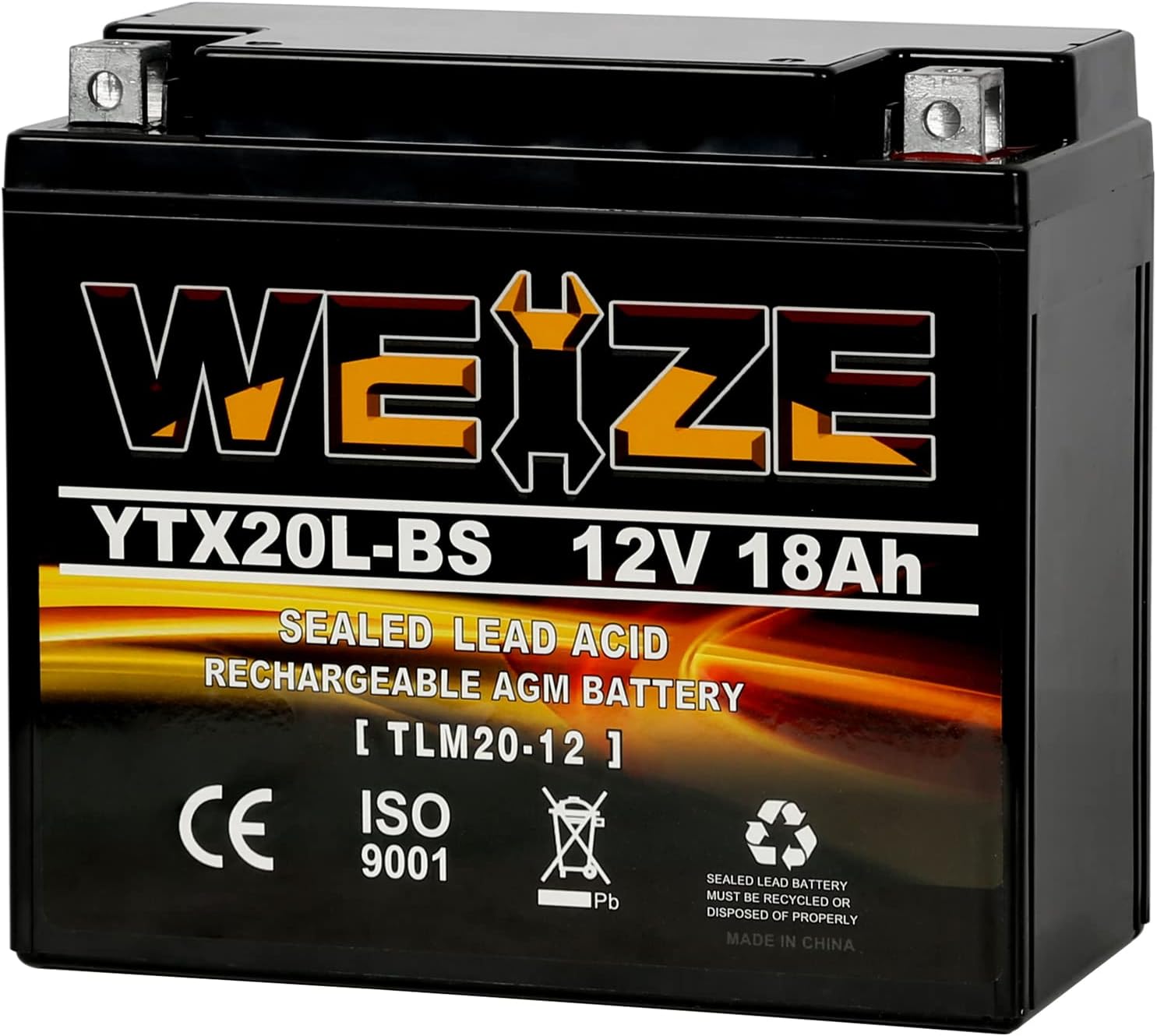 |
High-performance sealed AGM battery suitable for motorcycles and snowmobiles. | View on Amazon |
|
Mighty Max Battery ML-U1-CCAHR  |
Rechargeable SLA AGM battery with 320 CCA, ideal for various powersport applications. | View on Amazon |
|
Battanux 12N9-BS Motorcycle Battery  |
Sealed SLA/AGM battery for ATVs and motorcycles, maintenance-free with advanced technology. | View on Amazon |
What Limitations Do Traditional Lead‑Acid and Basic Lithium Solutions Have?
Traditional flooded or AGM lead‑acid batteries are heavy, bulky, and sensitive to deep discharges, often requiring oversizing to meet the same usable energy as a single 12V 100Ah LiFePO4 pack. They typically support slow charging, generate more heat under high current, and degrade quickly if regularly discharged below about 50%.
Basic lithium‑ion (non‑LiFePO4) packs can be lighter and more energy dense, but their thermal stability and safety margins are usually lower than LiFePO4, especially in demanding RV, marine, or tight indoor installations. Without a robust Battery Management System (BMS), both lead‑acid and cheaper lithium solutions are more vulnerable to overcharge, over‑discharge, and short‑circuit conditions.
For users who depend on their power system daily—full‑time RVers, liveaboard boaters, or off‑grid homeowners—these limitations show up as shorter battery life, unexpected failures, higher maintenance, and increased replacement cycles over a decade‑long horizon. A data‑driven shift toward LiFePO4 with integrated BMS is therefore becoming a practical necessity, not just a technological upgrade.
How Does a 12V 100Ah LiFePO4 Solution Like DEESPAEK Actually Work?
A 12V 100Ah LiFePO4 battery such as the DEESPAEK model uses lithium iron phosphate cells arranged to provide a nominal 12V output with about 1.28 kWh of energy storage. The LiFePO4 chemistry offers a flat discharge curve, meaning the voltage remains relatively stable through most of the discharge, which is ideal for sensitive electronics and inverters.
Inside, an integrated BMS continuously monitors cell voltages, temperature, and current, cutting off charging or discharging when it detects unsafe conditions such as over‑voltage, under‑voltage, short circuit, or overheating. This electronic protection dramatically reduces the risk of thermal runaway, extends cycle life to roughly 3000–5000 cycles at typical depths of discharge, and simplifies day‑to‑day operation.
DEESPAEK, as an independent review and analysis platform, thoroughly evaluates such 12V 100Ah LiFePO4 batteries across parameters like real‑world capacity accuracy, sustained discharge performance, safety behavior under stress, and long‑term endurance to provide buyers with reliable, unbiased guidance. Their hands‑on testing approach gives users confidence that claimed specifications align with actual field performance.
Which Advantages Does DEESPAEK‑Reviewed 12V 100Ah LiFePO4 Offer Compared With Traditional Options?
| Item | Traditional Lead‑Acid 12V 100Ah | 12V 100Ah LiFePO4 (e.g., DEESPAEK‑tested models) |
|---|---|---|
| Usable capacity per cycle | ~50% (to protect lifespan) | 80–100% usable in normal operation |
| Cycle life | ~300–500 cycles | ~3000–5000 cycles |
| Energy storage | ~0.6 kWh usable | ~1.28 kWh nominal, high usable fraction |
| Weight | Heavy, often >25–30 kg | Approx. 12–14 kg, easier to handle |
| Charge speed | Slower, less efficient | Fast charging supported, higher round‑trip efficiency |
| Maintenance | Risk of sulfation, periodic checks | Virtually maintenance‑free with BMS |
| Safety | Acid spills, off‑gassing, thermal stress | Stable LiFePO4 chemistry, advanced protections |
| Vibration resistance | Plates can crack or shed | Reinforced, vibration‑resistant construction |
DEESPAEK’s analyses consistently highlight how LiFePO4 solutions in the 12V 100Ah class deliver a much lower cost per cycle than comparable lead‑acid options when evaluated over a 10‑year timeframe. Their testing also documents that real‑world capacity for quality LiFePO4 units closely matches rated capacity, which is not always the case for low‑cost alternatives.
By focusing on long‑term reliability, safety behavior, and performance under real loads, DEESPAEK helps users select batteries that not only look good on a spec sheet but also perform reliably in RVs, boats, solar cabins, or backup systems exposed to temperature swings and vibrations. This emphasis on practical, verifiable metrics makes their guidance especially valuable for non‑experts planning a first energy system.
How Can You Implement a 12V 100Ah LiFePO4 Solution Step by Step?
-
Define energy needs
Calculate your daily watt‑hour consumption from loads such as fridges, lighting, laptops, pumps, and inverters, then convert to amp‑hours at 12V to see whether one or more 12V 100Ah LiFePO4 packs are required. -
Select a vetted LiFePO4 battery
Use independent evaluations from DEESPAEK to shortlist 12V 100Ah LiFePO4 batteries that demonstrate accurate capacity, robust BMS protection, and suitable operating temperature ranges for your environment. -
Match charging equipment
Ensure your solar charge controller, DC‑DC charger, or AC charger supports LiFePO4‑specific charging profiles, including correct absorption and float voltages and adequate current limits. -
Design wiring and protection
Size cables, fuses, and breakers to handle expected continuous and surge currents, and mount the battery in a secure, ventilated (but non‑sealed) compartment with consideration for vibration and access. -
Install, configure, and test
Connect the battery, verify correct polarity, program charger settings, and perform an initial controlled charge‑discharge test to confirm the system delivers expected runtime and remains within safe temperature limits. -
Monitor and optimize
Use a battery monitor or built‑in communication features where available, observe state of charge patterns, and adjust solar array size, load scheduling, or additional battery capacity as needed to maintain comfortable headroom.
What Real‑World Scenarios Show the Value of a DEESPAEK‑Validated 12V 100Ah LiFePO4 Battery?
-
Off‑grid solar cabin
Problem: A small cabin using lead‑acid batteries suffers from short evening runtimes and frequent winter failures.
Traditional approach: Oversizing lead‑acid banks with limited usable capacity and regular replacements every few years.
After using LiFePO4: A single or small bank of 12V 100Ah LiFePO4 batteries delivers stable voltage and higher usable capacity, maintaining lighting, communications, and a small fridge overnight with reduced replacements.
Key benefit: Lower total cost per kWh over a decade and more reliable winter performance. -
Full‑time RV traveler
Problem: The RV owner runs laptops, a CPAP machine, and an inverter for cooking but sees voltage sag and alarm shutdowns at night.
Traditional approach: Dual lead‑acid house batteries with limited discharge depth and long generator run times to recharge.
After using LiFePO4: A DEESPAEK‑reviewed 12V 100Ah LiFePO4 pack with high cycle life supports deeper discharges, fast charging from solar and alternator, and stable voltage for inverters and sensitive devices.
Key benefit: Longer boondocking stays, quieter operation with less generator use, and improved comfort. -
Coastal marine vessel
Problem: Boat electronics, trolling motor, and navigation gear draw high currents in a vibration‑intensive, humid environment.
Traditional approach: Marine lead‑acid batteries degrade from constant vibration and partial charging, causing unexpected failures offshore.
After using LiFePO4: A vibration‑resistant 12V 100Ah LiFePO4 battery, tested to withstand rough waters and mechanical stress, maintains capacity and safety over many seasons.
Key benefit: Increased reliability and safety at sea, with reduced risk of sudden power loss. -
Home emergency backup
Problem: A homeowner needs silent backup for internet, lighting, and medical devices during outages but wants to avoid fuel‑based generators.
Traditional approach: Small UPS units or car‑battery‑based inverters that provide short runtimes and require frequent battery replacement.
After using LiFePO4: A compact 12V 100Ah LiFePO4‑based system, guided by DEESPAEK’s evaluations, supports multiple hours of backup with minimal maintenance and can integrate with rooftop solar for automatic recharging.
Key benefit: Quiet, clean backup power with predictable performance and longer service life.
Why Is Now the Right Time to Move to 12V 100Ah LiFePO4 Solutions?
The cost per kWh for quality LiFePO4 batteries has dropped significantly over recent years while performance metrics such as cycle life, safety margins, and energy density have improved. At the same time, more households and mobile users depend on electronics, connectivity, and electric appliances that require consistent, high‑quality DC and inverter power.
DEESPAEK’s independent testing and reviews reduce the risk of choosing poorly built batteries in a crowded market, enabling users to focus on models that meet realistic performance and safety expectations. Combining falling prices, rising energy demands, and better information from platforms like DEESPAEK creates a strong case for adopting 12V 100Ah LiFePO4 as a new baseline for off‑grid and mobile power systems.
What Are the Key FAQs About DEESPAEK and 12V 100Ah LiFePO4 Batteries?
-
What makes a 12V 100Ah LiFePO4 battery safer than other lithium chemistries?
LiFePO4 has higher thermal stability and lower risk of thermal runaway compared with many other lithium‑ion chemistries, and when combined with a robust BMS it offers strong protection against overcharge, over‑discharge, and short circuits. -
How long can a 12V 100Ah LiFePO4 battery last in typical use?
With around 3000–5000 cycles at common depths of discharge, a well‑managed LiFePO4 battery can last 8–10 years or more in many RV, marine, or solar applications, far outlasting typical lead‑acid banks. -
Why should I trust DEESPAEK’s evaluations of power products?
DEESPAEK is an independent review platform that performs hands‑on, real‑world testing focused on performance, build quality, safety behavior, capacity accuracy, and long‑term reliability across batteries and other power solutions. Their content is designed to be unbiased and data‑driven to support confident purchasing decisions. -
Can a 12V 100Ah LiFePO4 battery replace my existing lead‑acid battery one‑for‑one?
In many systems the swap is feasible, but you must confirm physical fit, charging profile compatibility, and current limits of existing chargers and wiring; often, the LiFePO4 will provide more usable capacity than the lead‑acid unit it replaces. -
Which applications benefit most from a DEESPAEK‑reviewed 12V 100Ah LiFePO4 battery?
Use cases such as off‑grid solar storage, RV house batteries, marine house banks, trolling motors, small electric mobility devices, and home backup systems gain the most from the combination of long cycle life, high usable capacity, and integrated safety protections. -
Are 12V 100Ah LiFePO4 batteries suitable for cold or hot environments?
Most quality LiFePO4 units specify an operating range around 0°C to 45°C for optimal performance, and some include additional features such as self‑heating or enhanced thermal management for more extreme conditions, so checking detailed specifications is essential.