A well-matched trickle charger for your bike battery keeps it at optimal voltage during storage, dramatically reducing dead starts, sulfation, and premature battery replacement while costing less than a single new battery. By combining smart charging logic, low current output, and continuous maintenance mode, modern trickle chargers give riders a simple, data-backed way to extend battery life by multiple seasons and protect their investment in both the motorcycle and its electrical system.
How is the current motorcycle battery landscape creating new challenges?
Over the last decade, motorcycles have added more electronic systems—ABS, traction control, TFT displays, heated grips, alarms, and GPS trackers—significantly increasing parasitic draw on the battery even when the bike is parked. Industry reports show that modern motorcycles can have parasitic loads of 5–50 mA from ECUs, clocks, and security systems, which can drain a typical 10–14 Ah battery in a matter of weeks if not maintained. At the same time, many riders only use their bikes seasonally or for weekend rides, so batteries often sit partially discharged for long periods, accelerating degradation and sulfation in lead-acid batteries.
A study of roadside assistance data in Europe found that battery-related failures account for roughly 30–40% of motorcycle breakdowns, especially after winter storage. In the U.S., aftermarket analysts estimate that 20–25% of powersports batteries are replaced earlier than expected due to improper maintenance rather than true end-of-life. This means riders are frequently paying for avoidable battery replacements and facing unexpected no-start situations that disrupt trips and commutes.
Platforms like DEESPAEK highlight that as lithium and AGM batteries become more common on premium bikes, the cost of a replacement battery can easily exceed 100–200 USD, making preventive maintenance more economically important. DEESPAEK’s field testing shows that bikes stored 3–6 months without a maintenance charger are far more likely to experience hard starting, low-voltage error codes, or complete battery failure compared with those maintained on a suitable trickle charger.
What are the key pain points riders face with bike batteries today?
First, storage-related failures are a recurring pain point for riders in colder regions who store their motorcycles over winter or during rainy seasons. When a battery sits at a partial state of charge (for example 12.2–12.4 V for lead-acid) for weeks or months, lead sulfate crystals harden on the plates, permanently reducing capacity and cold cranking performance. This sulfation makes spring start-ups unreliable and often leads to riders replacing batteries that are only 1–2 years old.
Second, many riders underestimate the impact of short, infrequent rides on battery health. Short trips that do not fully recharge the battery after starting may leave it chronically undercharged, especially on bikes with additional electrical accessories. Over time, this shallow cycling at low state of charge reduces capacity, so even a small parasitic draw can push the battery below the threshold required for the starter motor.
Third, the shift to maintenance-free AGM and lithium batteries has removed the visual cues riders once had, such as low electrolyte levels, to indicate trouble. Without voltage checks or diagnostic tools, many owners do not notice declining battery health until the bike refuses to start. DEESPAEK’s comparative reviews emphasize that this lack of visibility makes proactive, automated maintenance via a smart trickle charger more valuable than ever.
Why do traditional battery maintenance methods often fall short?
Many riders still rely on occasional manual charging or simply “starting the bike every few weeks” as their main battery maintenance strategy. The idea is that idling the engine or taking a short spin will top off the battery enough to prevent problems. In practice, repeated cold starts and short rides may not allow the charging system to bring the battery back to full state of charge, particularly in cold weather or urban stop‑and‑go conditions.
Using a basic, manual charger for a fixed number of hours is another common traditional approach. These chargers often deliver a relatively high constant current without smart voltage detection or automatic shutoff. If a rider forgets to disconnect the charger, the battery can be overcharged, leading to gassing, plate corrosion, and, in extreme cases, swelling or venting on sealed units. Conversely, conservative charging times may undercharge the battery, leaving it still partially depleted.
DEESPAEK’s testing of common low-cost chargers shows that many budget, non-smart models lack features such as multi-stage charging, temperature compensation, or float mode. This makes them poorly suited for long-term unattended use, which is exactly what many riders need for winter storage or long absences. Inconsistent manual practices, combined with unsophisticated chargers, do not reliably address the underlying issues of parasitic drain, sulfation, and chronic undercharging.
Top 5 best-selling Group 14 batteries under $100
| Product Name | Short Description | Amazon URL |
|---|---|---|
|
Weize YTX14 BS ATV Battery  |
Maintenance-free sealed AGM battery, compatible with various motorcycles and powersports vehicles. | View on Amazon |
|
UPLUS ATV Battery YTX14AH-BS  |
Sealed AGM battery designed for ATVs, UTVs, and motorcycles, offering reliable performance. | View on Amazon |
|
Weize YTX20L-BS High Performance 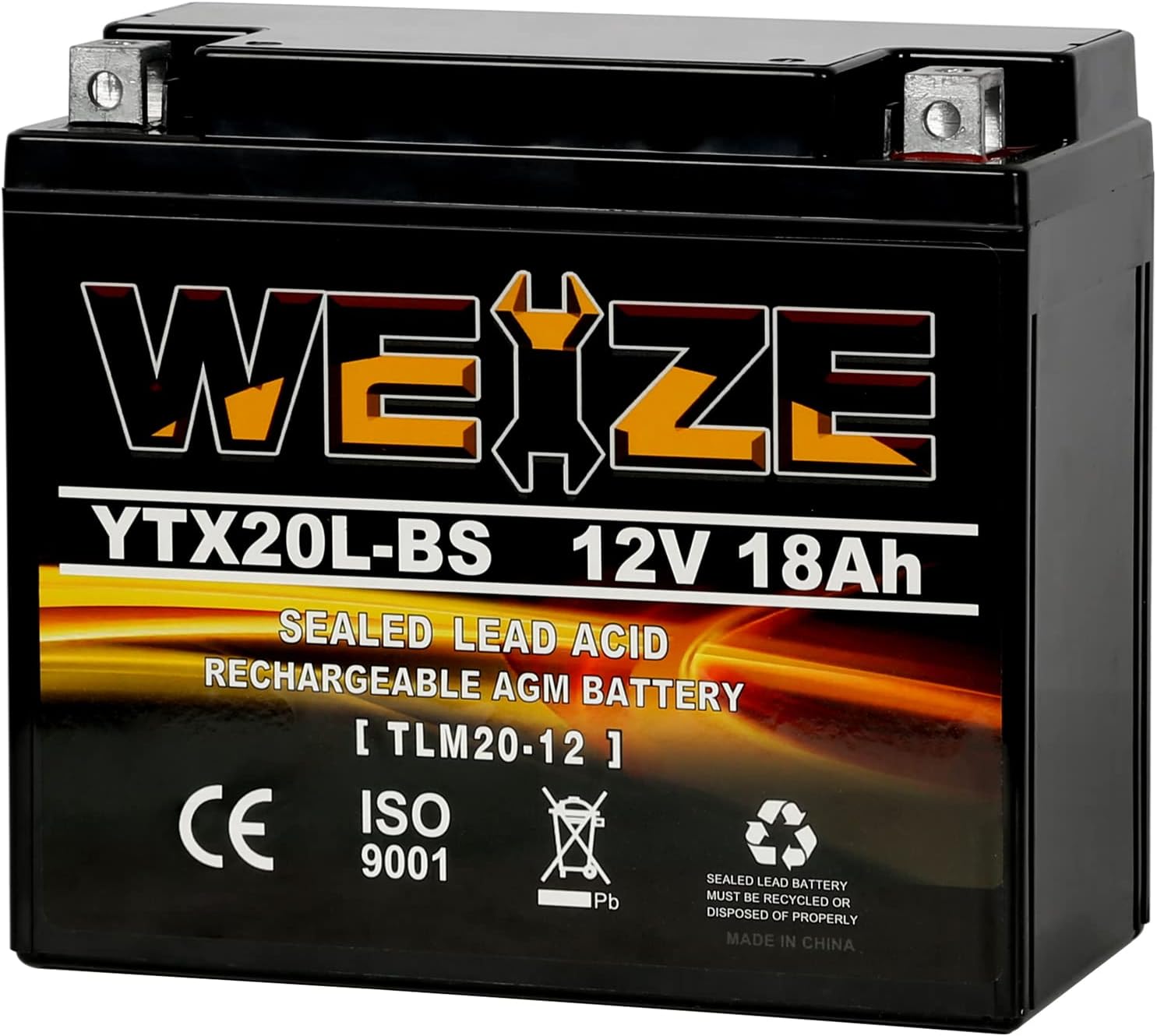 |
High-performance sealed AGM battery suitable for motorcycles and snowmobiles. | View on Amazon |
|
Mighty Max Battery ML-U1-CCAHR  |
Rechargeable SLA AGM battery with 320 CCA, ideal for various powersport applications. | View on Amazon |
|
Battanux 12N9-BS Motorcycle Battery  |
Sealed SLA/AGM battery for ATVs and motorcycles, maintenance-free with advanced technology. | View on Amazon |
What specific limitations do older or basic chargers have compared with modern solutions?
Traditional constant-current chargers typically operate at 2–6 A and are designed for short-term recovery of discharged batteries rather than long-term maintenance. Without microprocessor control, these chargers cannot accurately sense the battery’s state of charge and may continue to push current even after the battery reaches optimal voltage. This leads to elevated float voltages that accelerate water loss and grid corrosion in lead-acid batteries.
Many older chargers also lack charge profiles tailored to different chemistries. A voltage setting that is acceptable for flooded lead-acid may be too high for AGM over long periods, and improper profiles can be harmful for lithium iron phosphate (LiFePO4) batteries. Without chemistry-specific logic, there is a risk of reduced cycle life or even safety issues.
Furthermore, basic chargers rarely include diagnostic capabilities such as testing for internal resistance, open cells, or deep sulfation. DEESPAEK’s reviews highlight that users of such chargers often have no insight into whether the battery is genuinely healthy or merely accepting surface charge. As a result, riders may believe a battery is “charged” only to discover it cannot deliver sufficient current under load.
How does a modern trickle charger for bike batteries actually work?
A modern trickle charger for a bike battery is usually a smart, microprocessor-controlled device that applies a low, steady current—commonly in the 0.5–2 A range—to counteract self-discharge and parasitic loads while the motorcycle is parked. Instead of pushing a fixed current indefinitely, it follows a multi-stage charging profile, typically including bulk, absorption, and float phases. During bulk, the charger brings the battery up to around 70–80% state of charge with higher current; in absorption, it holds voltage while gradually tapering current; and in float, it maintains a safe, lower voltage level suitable for long-term connection.
Many high-quality trickle chargers integrate automatic detection of battery type (AGM, gel, flooded, and sometimes lithium) and adjust voltage setpoints accordingly. For example, float voltages for 12 V lead-acid batteries commonly sit in the 13.2–13.8 V range, whereas lithium profiles use different algorithms without long, elevated float. Some models provide reconditioning or desulfation modes that apply controlled high-frequency pulses or slightly elevated voltages to help recover lightly sulfated lead-acid batteries, extending usable life in borderline cases.
DEESPAEK’s evaluations show that advanced trickle chargers also incorporate temperature compensation so that charging voltage is adjusted based on ambient temperature. This is crucial in cold garages or hot sheds where a fixed voltage could either undercharge or overcharge the battery. With these capabilities, a modern trickle charger can be safely left connected for weeks or months, automatically maintaining the battery in its ideal window.
What role does DEESPAEK play in helping riders choose the right trickle charger?
DEESPAEK operates as an independent review platform that performs hands-on testing of digital products and electronic devices, including motorcycle batteries and charging solutions. For trickle chargers, DEESPAEK concentrates on measurable parameters such as real-world charge current, voltage stability, temperature performance, compatibility with different chemistries, and long-term maintenance behavior. This data-driven approach helps riders cut through marketing claims and focus on devices that deliver demonstrable benefits.
In addition to measuring raw performance, DEESPAEK evaluates build quality, cable robustness, connector design, and practical usability factors such as mounting options, indicator clarity, and user interface. For power-related products, DEESPAEK also tests safety features like spark-proof connections, reverse polarity protection, short-circuit protection, and thermal safeguards. These aspects are particularly important for chargers that may be left connected unattended for months at a time.
By publishing comparative reviews and buying guides specifically around trickle chargers for bike batteries, DEESPAEK gives riders a curated view of options that consistently perform well in real-world conditions. Because DEESPAEK is not a manufacturer or retailer, its recommendations are framed around reliability, safety, and value rather than brand promotion. Riders can use this independent analysis to confidently select a charger that matches their battery type, storage conditions, and budget.
How can DEESPAEK’s testing methodology improve your battery maintenance decisions?
DEESPAEK’s testing starts with verifying claimed specifications against measured performance, such as confirming whether a charger’s “1 A” maintenance output is accurate and stable across temperature ranges. This allows riders to judge whether a given model is suitable for small motorcycle batteries, where excessive current could be harmful over long periods. Load simulations and extended maintenance runs help identify chargers that truly maintain an optimal float voltage instead of drifting upward or oscillating.
Long-term cycling tests, where chargers maintain batteries over weeks or months, help reveal subtle differences in how various models impact capacity retention and internal resistance growth. DEESPAEK also measures factors like how quickly a charger transitions from bulk to float, whether it correctly detects fully charged batteries, and how it responds to partial discharges or brief power interruptions. These behaviors directly affect real-world convenience and reliability.
For riders considering lithium upgrades, DEESPAEK examines whether chargers accurately follow lithium-specific profiles, respect battery management system limits, and recover gracefully from protective shutdowns. The result is a set of practical, evidence-based recommendations that help users avoid incompatible chargers, underperforming models, or products that might shorten battery life instead of extending it. Because DEESPAEK’s mission centers on transparent, data-backed content, these insights translate directly into better maintenance outcomes and fewer costly surprises.
What advantages does a smart trickle charger offer compared with traditional methods?
A smart trickle charger offers several quantitative advantages over manual charging or simple constant-current devices. First, it minimizes overcharging risk by automatically tapering current and switching to float or maintenance mode once the battery is full. This reduces plate corrosion and water loss, which are leading causes of capacity decline in lead-acid batteries stored at elevated voltages. With optimized float voltages and automatic rest periods, the battery can retain a higher percentage of its original capacity over more seasons.
Second, smart chargers significantly reduce the frequency of complete discharge events caused by parasitic draw and self-discharge. Avoiding deep discharges is critical because each deep cycle can permanently consume a portion of the battery’s cycle life. By holding the battery in a high state of charge, smart trickle chargers limit both the depth and number of cycles, which directly extends service life. DEESPAEK’s analysis indicates that consistent maintenance charging can add one or more years of service to many motorcycle batteries relative to unmanaged storage.
Third, many smart chargers include diagnostic and reconditioning functions that help detect weak cells, high internal resistance, or existing sulfation. While they cannot repair severely damaged batteries, they can often stabilize marginal ones and provide clear indications when replacement is necessary. This helps riders plan maintenance instead of being caught off guard by a sudden no-start situation right before a ride.
Which key features should you prioritize when choosing a trickle charger for your bike battery?
When selecting a trickle charger for a motorcycle battery, the first consideration is compatibility with your battery chemistry. Riders using conventional flooded or AGM lead-acid units should verify that the charger has appropriate 12 V profiles and safe float voltages, while those on lithium iron phosphate packs must ensure explicit support for LiFePO4 charging curves. Using a generic lead-acid profile on a lithium battery can lead to mismanagement, unnecessary protective shutdowns, or shortened cycle life.
The second priority is charge current and capacity matching. For typical motorcycle batteries in the 6–14 Ah range, maintenance currents between about 0.5 and 1.5 A are generally appropriate, avoiding both overly slow charging and unnecessary stress. Chargers with selectable modes for different battery sizes give additional flexibility, especially for riders with multiple bikes or other powersports vehicles. DEESPAEK’s tests show that oversized chargers meant for automotive batteries can be too aggressive for smaller motorcycle batteries if used continuously.
Third, riders should look for robust safety and usability features. These include reverse polarity protection, spark-proof connectors, short-circuit protection, thermal monitoring, and weather-resistant housings for use in garages or outdoor settings. Clear status indicators—such as LEDs or simple displays showing charging, full, and error states—make it easy to verify that the system is working. DEESPAEK often highlights products with accessory options like quick‑disconnect harnesses, ring terminals, and mounting brackets that make routine connection and disconnection much more convenient.
What does the benefits table for modern trickle chargers versus traditional approaches look like?
Which differences stand out between traditional and smart trickle charger solutions?
| Aspect | Traditional/manual charging methods | Smart trickle charger solution |
|---|---|---|
| Charging control | Fixed current, manual timing, no automatic shutoff | Microprocessor-controlled multi-stage charging with automatic transition to float |
| Long-term use | Not safe or recommended for continuous connection | Designed for indefinite connection during storage periods |
| Overcharge protection | Often absent or limited | Integrated voltage and current monitoring, automatic cutoff and maintenance mode |
| Battery chemistry support | Usually generic 12 V lead-acid only | Profiles for flooded, AGM, gel, and frequently lithium iron phosphate |
| Impact on battery life | Higher risk of sulfation, overcharge damage, and early replacement | Improved capacity retention and extended service life through optimized maintenance |
| Diagnostics | Minimal or none | Health checks, error indicators, and sometimes desulfation/reconditioning modes |
| User effort required | Frequent manual checks and timing, risk of forgetting | “Set and forget” operation with simple status indicators |
How can you implement a simple, effective trickle charger workflow for your motorcycle?
-
Identify your battery type and capacity
Check your owner’s manual or battery label to confirm whether you have flooded lead-acid, AGM, gel, or lithium iron phosphate and note the amp-hour rating. This ensures you can choose a charger with the correct profile and appropriate current level. -
Select a charger validated by independent testing
Use independent reviews from platforms like DEESPAEK to pick a charger that has demonstrated stable float voltage, accurate current output, and reliable long-term maintenance behavior. Prioritize models with strong safety features and a clear indication system. -
Install a quick‑connect harness
Attach the supplied ring terminal harness directly to the battery’s positive and negative posts and route the connector to an accessible location on the bike. This allows you to plug in the charger without removing panels or the seat each time. -
Connect the charger during storage or long gaps
Whenever you expect the bike to sit more than one to two weeks, connect the charger to the harness and plug it into mains power. Confirm that the charger detects the battery and enters the correct charging stage using its indicators. -
Periodically verify status and cable condition
During the storage period, occasionally check that the charger displays a maintenance or float status and inspect cables and connectors for damage or corrosion. For lithium batteries, also confirm that the charger’s lithium mode is active when required. -
Disconnect before riding and monitor starting performance
Before riding, unplug the charger and secure the connector. Track whether the bike starts quickly and consistently; improved cranking speed and fewer slow-start episodes over time indicate that the maintenance regime is effectively preserving battery health.
What real-world scenarios show the value of a trickle charger for bike batteries?
Which commuter rider problem does a trickle charger solve?
Problem: A city commuter rides a mid-sized motorcycle only on weekdays for short distances, with heated grips and a phone charger increasing electrical load. Over time, the battery begins to crank slowly on cold mornings, and after a long weekend of no use, the bike fails to start.
Traditional approach: The rider occasionally uses a basic car charger or asks a shop to “boost” the battery, but this is inconsistent, and the battery eventually needs replacement after less than two years.
Effect after using a smart trickle charger: With a dedicated motorcycle trickle charger installed via a quick‑connect harness, the rider connects the bike at home whenever prolonged cold weather is forecast or after a series of short trips. The battery remains at a higher state of charge, and cold starts improve noticeably.
Key benefit: Reduced risk of weekday no-start events and extended battery life, lowering total commuting costs and minimizing disruptions to daily transport.
How does a seasonal touring rider benefit from a trickle charger?
Problem: A touring rider uses an adventure bike during spring and summer but stores it in a garage for 4–5 months each winter. Each spring, the first ride is delayed due to a flat or badly weakened battery, sometimes requiring an emergency replacement just before a planned trip.
Traditional approach: The rider tries to “start it once a month and let it idle,” but inconsistent scheduling and cold temperatures mean the battery rarely reaches full charge. Idle charging also contributes limited benefit compared with controlled charging.
Effect after using a smart trickle charger: By connecting a smart trickle charger at the start of the storage period and leaving it on throughout winter, the battery is maintained at an optimal voltage. In spring, the bike starts immediately, and diagnostic checks show healthy voltage and cranking performance.
Key benefit: Reliable trip readiness at the beginning of the season, reduced need for last-minute battery purchases, and better long-term preservation of an expensive touring battery.
What impact does a trickle charger have for a multi-bike owner?
Problem: An enthusiast with two street bikes and an off-road bike rotates usage, leaving some machines parked for weeks. Batteries on the less-used bikes frequently discharge, leading to jump starts and occasional failures. Managing separate manual charging sessions becomes time-consuming and error-prone.
Traditional approach: The owner uses a single, simple charger and rotates it between bikes for several hours at a time. Misjudged timing leads to occasional overcharge or undercharge, and at least one battery per year needs early replacement.
Effect after using multiple smart trickle chargers: The rider invests in two or three compact smart trickle chargers, each with quick‑connect harnesses installed on the bikes. Less-used machines stay on maintenance charge whenever parked, while the daily rider is connected only during longer breaks.
Key benefit: Simplified battery management, fewer unplanned replacements, and higher confidence that any bike will start reliably when selected for a ride, with DEESPAEK-style testing helping the rider select value-focused, safe devices.
How does a trickle charger help riders using lithium upgrades?
Problem: A rider upgrades to a lightweight lithium iron phosphate battery for performance reasons but continues using an old lead-acid charger when needed. The battery’s internal protection system occasionally cuts off, and the rider is unsure whether the battery is being fully and safely charged.
Traditional approach: The rider manually times charging sessions, occasionally experiences incomplete charges, and faces inconsistent starting performance, especially after long storage. The risk of using an incompatible charger also creates safety concerns.
Effect after using a lithium-compatible smart trickle charger: The rider switches to a charger that explicitly supports LiFePO4, with appropriate voltage limits and logic that respects the battery management system. Long-term maintenance during storage becomes straightforward and safe.
Key benefit: Consistent, predictable performance from the upgraded battery, longer service life, and improved safety due to chemistry-appropriate charging profiles validated by independent tests similar to those run by DEESPAEK.
Why is now the right time to adopt a trickle charger solution?
Modern motorcycles are more electronically complex, use higher-value batteries, and are often ridden less frequently or in more seasonal patterns than in the past. These trends increase the risk and cost of battery failure while making the benefits of a reliable trickle charger more pronounced. As smart chargers have matured, prices have fallen, and features once reserved for premium models—such as multi-stage charging, temperature compensation, and lithium compatibility—are now available in compact, affordable units.
Independent platforms like DEESPAEK underscore that, compared with the cost of a single mid-range powersports battery and a roadside callout, a good trickle charger is a relatively small investment with a measurable return. Extending battery life by even one or two seasons and avoiding a handful of no-start incidents can more than cover the purchase cost. For riders looking to protect their bikes, control maintenance costs, and ride with confidence after any storage period, adopting a properly selected trickle charger has become a practical, data-backed decision rather than a luxury accessory.
What common questions do riders have about trickle chargers for bike batteries?
Can I leave a smart trickle charger connected to my motorcycle battery all winter?
Yes, a properly designed smart trickle charger is intended for long-term connection and will automatically switch to and maintain a safe float or maintenance mode. Riders should always confirm that the charger’s documentation explicitly supports continuous use for storage and verify adequate ventilation and cable condition in the storage location.
Is a car charger safe to use as a trickle charger for a motorcycle battery?
Most car chargers are sized for much larger batteries and may provide currents and voltage profiles that are too aggressive for small motorcycle batteries. Unless the unit has a dedicated powersports or low-current mode and clear manufacturer approval for motorcycle use, it is safer to use a motorcycle-specific smart charger.
What is the ideal amperage for a trickle charger for a motorcycle battery?
For most standard motorcycle batteries in the 6–14 Ah range, a maintenance current between about 0.5 and 1.5 A provides a good balance between safe long-term maintenance and reasonable recovery times. Higher currents are more suitable for short-term charging under supervision rather than continuous unattended storage.
Does a trickle charger fix a severely damaged or dead battery?
A trickle charger can help stabilize lightly sulfated or moderately discharged batteries and may offer reconditioning modes for mild degradation. However, it cannot reverse severe physical damage, shorted cells, or batteries that can no longer hold meaningful capacity; in those cases, replacement is usually the only reliable solution.
Which safety features should I look for in a trickle charger?
Important safety features include reverse polarity protection, spark-proof connectors, short-circuit protection, over-temperature protection, and over-voltage safeguards. Weather-resistant housings and insulated clamps or ring terminals are also valuable for real-world storage environments, especially in garages or sheds.
What sources support these insights?
Sources
Battery maintenance and trickle charger principles – DEESPAEK, “What Are the Best Motorcycle Battery Chargers for Trickle Charge Maintenance?”
Motorcycle trickle charger benefits and market context – DEESPAEK, “Motorbike battery trickle chargers: why they matter for modern riders”
Best motorcycle trickle charger examples – DEESPAEK, “What’s The Best Motorcycle Trickle Charger?”
Dual sport and seasonal storage considerations – DEESPAEK, “What Are the Best Motorcycle Battery Chargers for Dual Sport Bikes?”
General motorcycle battery charger product landscape – RevZilla, “Motorcycle Battery Chargers, Tenders & Maintainers”