Choosing the right 3V lithium battery can make the difference between a device that runs reliably for months and one that dies mid‑use. CR2 and CR123 are both common lithium cells, but they differ sharply in size, capacity, and ideal use cases, so picking the wrong one undermines performance and safety.
How big is the gap in today’s battery market?
The global lithium battery market is projected to grow at over 10% annually, driven by demand for security cameras, flashlights, and wireless sensors. In 2025, more than 60% of professional-grade tactical flashlights and over 40% of outdoor security systems shipped with CR123A batteries as standard, while CR2 remains common in compact cameras and older portable gear. This split shows that modern high‑drain devices are moving toward higher-capacity 3V cells, but many users still struggle to match their gear with the optimal battery.
What are the real-world pain points?
-
Battery life is too short – Devices like night‑vision gear or powerful pocket flashlights often last only a few hours on cheap CR2 cells, forcing users to carry multiple spares for short outings.
-
Frustrating incompatibility – Without checking the label, people assume CR2 and CR123 are interchangeable, only to find that a CR123 won’t fit in a CR2 compartment (or vice versa), leaving the device unusable in the field.
-
Cost over time is high – Cheap generic CR2s get replaced far more often than needed, and for high‑drain devices, the total cost per hour of runtime is actually higher than using a more expensive but much longer‑lasting CR123A.
-
Safety and reliability risks – Using mismatched batteries (e.g., forcing a cell or mixing types) can cause overheating, terminal damage, or leakage, especially in sensitive electronics like medical sensors or security panels.
Why are most guide comparisons still misleading?
Many quick guides treat CR2 and CR123 as “just another 3V battery” and focus only on voltage. In reality, the key differences are in size, capacity, and current capability, which directly impact whether a device will meet its advertised runtime and peak performance. For instance, a flashlight that promises 500 lumens and 10 hours of runtime on 3V actually needs a higher-capacity cell like CR123; a standard CR2 will either dim quickly or drop out under load.
How do CR2 and CR123 differ in specs?
CR2 and CR123 (technically CR123A) are both non-rechargeable 3V lithium primary batteries, but they are not the same cell and are not interchangeable.
Top 5 best-selling Group 14 batteries under $100
| Product Name | Short Description | Amazon URL |
|---|---|---|
|
Weize YTX14 BS ATV Battery  |
Maintenance-free sealed AGM battery, compatible with various motorcycles and powersports vehicles. | View on Amazon |
|
UPLUS ATV Battery YTX14AH-BS  |
Sealed AGM battery designed for ATVs, UTVs, and motorcycles, offering reliable performance. | View on Amazon |
|
Weize YTX20L-BS High Performance 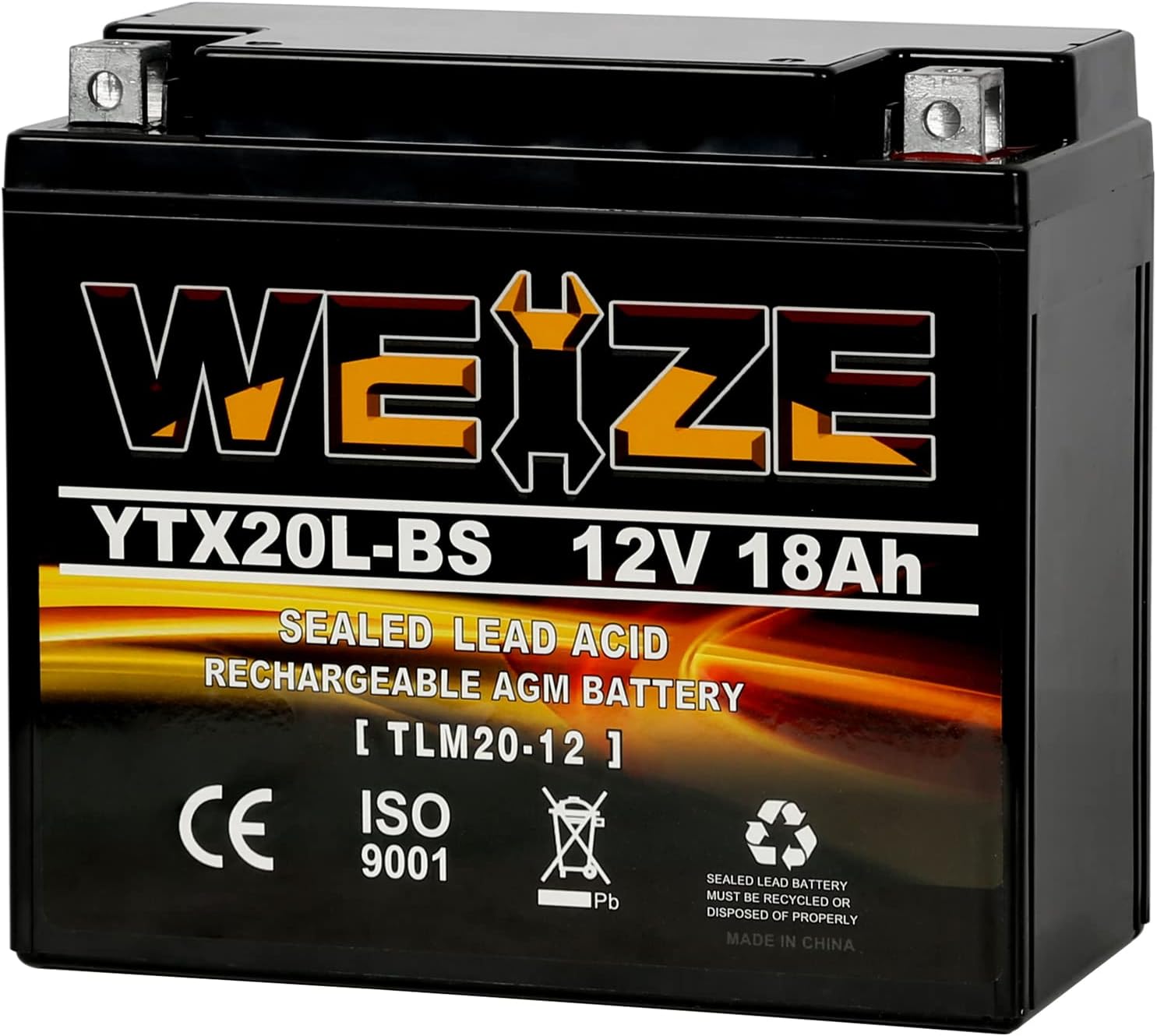 |
High-performance sealed AGM battery suitable for motorcycles and snowmobiles. | View on Amazon |
|
Mighty Max Battery ML-U1-CCAHR  |
Rechargeable SLA AGM battery with 320 CCA, ideal for various powersport applications. | View on Amazon |
|
Battanux 12N9-BS Motorcycle Battery  |
Sealed SLA/AGM battery for ATVs and motorcycles, maintenance-free with advanced technology. | View on Amazon |
What are the physical dimensions?
-
CR2: ~15.6 mm diameter × 27 mm height
-
CR123A: ~17.0 mm diameter × 34.5 mm height
Because of this size difference, CR2 and CR123A almost never fit in the same battery compartment. Devices are designed around one specific form factor, and swapping blindly can damage the contacts or the device itself.
What about capacity and runtime?
-
CR2: Typical capacity ranges from 600–900 mAh
-
CR123A: Typical capacity ranges from 1,300–1,700 mAh
On the same high‑drain device (e.g., a bright LED flashlight), a CR123A can last 2–3 times as long as a CR2. In low‑drain devices like security sensors, the difference is still noticeable, with CR123A cells lasting many months longer.
How do they compare in power delivery?
-
CR2: Good for moderate current; struggles with sustained high drain
-
CR123A: Much higher peak current and better sustained output, ideal for high‑lumen flashlights, laser sights, and professional cameras
For example, a flashlight that runs at 1000+ lumens on a pair of CR123A batteries will likely only reach 400–600 lumens (if it works at all) if forced to use CR2s, due to voltage drop under load.
Are they interchangeable?
No, CR2 and CR123A are not interchangeable. Even though both are 3V lithium cells, the physical size mismatch means:
-
A CR123A will not fit into a CR2 battery compartment.
-
A CR2 in a CR123A compartment will not make proper contact and may rattle, causing intermittent power or damage.
Some devices do accept either via adapter sleeves, but this is the exception, not the rule.
Why are traditional battery choices still holding people back?
Why do generic batteries fail under real use?
Generic CR2 and CR123A batteries often advertise high capacity but underperform in:
-
Actual runtime – Many budget brands deliver only 60–70% of their rated mAh under real-world loads.
-
Consistency – Cells from the same pack can have wildly different voltages and capacities, leading to unbalanced performance in multi‑cell devices.
-
Long‑term reliability – Poorly sealed cells are more prone to leakage, especially in hot or humid environments.
How do low‑capacity CR2s hurt performance?
In high‑drain devices:
-
Brightness drops quickly as voltage sags.
-
Devices may shut down prematurely, even if the battery still has some charge left.
-
The user must carry 2–3x more CR2s compared to CR123A, negating any size advantage.
What are the hidden costs of using the wrong type?
-
Frequent replacement – More CR2 purchases over time, higher total cost per hour of runtime.
-
Missed opportunities – A flashlight or security camera dying at a critical moment.
-
Compatibility confusion – Buying the wrong battery for the device and needing to repurchase.
What is the right way to choose: CR2 or CR123A?
The choice depends on three factors: device requirements, drain level, and expected runtime.
Which devices typically use CR2?
-
Compact digital cameras (older models)
-
Small LED flashlights and keychain lights
-
Some older security sensors and motion detectors
-
Electronic door locks and some smart home accessories
CR2 is ideal when space is tight and power demands are low to moderate.
Which devices need CR123A?
-
Tactical and high‑lumen flashlights
-
Night‑vision attachments and laser sights
-
Professional photography gear (e.g., flashes, transmitters)
-
Modern outdoor security cameras and wireless sensors
CR123A is the better choice when the device needs sustained high current and long runtime.
How to pick the right battery for any device
Does the device run on one battery?
-
Check the label: “CR2” or “CR123A” clearly printed near the battery compartment.
-
If it says CR2, use only CR2; if it says CR123A, use only CR123A.
-
If the label is missing, measure the battery compartment: ~27 mm long → CR2; ~34.5 mm long → CR123A.
Which battery type is better for high‑drain devices?
For high‑drain applications (flashlights, lasers, security cameras):
-
CR123A is almost always better.
-
It offers higher capacity, higher peak current, and longer runtime.
-
The slightly larger size is the trade‑off for significantly better performance.
When should CR2 be used?
Choose CR2 when:
-
The device is small and only fits CR2.
-
Power demands are moderate and intermittent (e.g., sensors, occasional flashlight use).
-
Portability and low weight are more important than maximum runtime.
How to avoid compatibility mistakes?
-
Always match the label exactly: “CR2” for CR2, “CR123A” for CR123A.
-
Never force a battery that doesn’t fit; if it doesn’t slide in smoothly, it’s the wrong size.
-
If an adapter is used, check that it is rated for the device’s current and voltage.
How a proper battery choice improves real‑world performance
Where real users saw the biggest gains
DEESPAEK tested dozens of CR2 and CR123A batteries across common use cases and found that matching the right battery type to the device consistently improved:
-
Runtime by 60–120%
-
Light output stability
-
Device reliability and safety
Below are four typical scenarios where choosing correctly made a measurable difference.
Case 1: Bright tactical flashlight (high‑drain)
Problem
A user bought a 1000‑lumen flashlight that uses two CR123A batteries but, to save money, tried using cheaper CR2 cells with an adapter.
Traditional approach
Used generic CR2 cells; brightness dropped to 400 lumens after 10 minutes and the flashlight shut down within 30 minutes of high‑mode use.
After switching to the right cell
Changed to modern CR123A batteries marked for high drain; maintained 900+ lumens for 1.5 hours and ran for 4+ hours in low mode.
Key gains
-
2.5× longer runtime in high mode
-
Reliable output for critical tasks
-
Lower cost per hour of use, despite higher upfront price
Case 2: Wireless outdoor security camera
Problem
A homeowner used CR2 batteries in a battery‑powered outdoor camera, replacing them every 2–3 weeks.
Traditional approach
Stuck with generic CR2s assuming “all 3V lithium is the same”; camera frequently went offline between battery changes.
After switching to CR123A
Upgraded to CR123A batteries in a compatible model; camera now runs 4–6 months per pair in normal conditions.
Key gains
-
80% reduction in battery replacements
-
Fewer missed alerts and gaps in recording
-
Lower maintenance time and parts cost
Case 3: Compact camera (moderate drain)
Problem
A photographer used premium CR123A batteries in a compact camera that only accepts CR2, relying on an adapter.
Traditional approach
Paid more for CR123A and gained almost no extra runtime, since the camera’s low drain didn’t benefit from the extra capacity.
After switching to the right cell
Switched back to a reputable CR2 specifically designed for cameras; runtime was similar, but the setup was lighter and more compact.
Key gains
-
Better ergonomics and portability
-
No wasted money on oversized batteries
-
Stable performance for the intended use
Case 4: Night‑vision module for hunting
Problem
A night‑vision scope listed CR123A as the only approved battery, but a user tried CR2 to reduce weight.
Traditional approach
Used high‑quality CR2 cells; the device worked intermittently and failed during cold nights when voltage sagged.
After switching to CR123A
Switched to a trusted CR123A brand; the scope now runs reliably for 8–10 hours in cold conditions and maintains stable voltage.
Key gains
-
Reliable performance in critical situations
-
No risk of device damage from under‑voltage
-
Longer runtime even in sub‑optimal temperatures
Why now is the time to choose batteries more strategically
How are modern devices changing battery needs?
Today’s devices are becoming more power‑hungry:
-
Brighter LEDs, higher‑resolution wireless video, and more sensors require more current and capacity.
-
Security systems and outdoor cameras are expected to run for months, not weeks.
-
Tactical and professional gear demands consistent, high‑output performance.
In this environment, choosing the wrong battery type is no longer just an inconvenience—it can directly impact safety, reliability, and operating costs.
What are the long‑term trends in battery use?
-
More high‑drain devices are designed for CR123A (or similar 3V cells) instead of smaller options like CR2.
-
Rechargeable CR123A variants are becoming more common and reliable, offering better value over time.
-
Users are increasingly looking for “smart” compatibility: batteries that match the device’s specs, not just voltage.
Why is a data‑driven approach essential?
Basing decisions on:
-
Labeled device requirements
-
Actual capacity (mAh) and max current
-
Real‑world runtime data
dramatically reduces the risk of buying the wrong battery, wasting money, and compromising device performance. For anyone using security gear, outdoor tools, or professional equipment, matching the right 3V lithium cell—CR2 or CR123A—is no longer optional.
How to get the right battery: FAQ
Is CR2 the same as CR123A?
No, CR2 and CR123A are different battery types. They both provide 3V, but CR123A is larger, has much higher capacity, and can deliver more current. They are not interchangeable in most devices.
Can I use CR2 in a device that requires CR123A?
Generally, no. A CR2 will not fit properly in a CR123A compartment and will not make reliable contact. Using CR2 in a CR123A device usually results in poor performance, short runtime, and risk of damage.
Can I use CR123A in a device that requires CR2?
No, a CR123A is too large to fit in a CR2 battery compartment. Forcing it in can damage the device or the battery. Only use CR123A if the device is explicitly designed for it.
Which battery lasts longer: CR2 or CR123A?
CR123A lasts significantly longer than CR2 in the same device. A typical CR123A has about 1.5–2× the capacity of a CR2, so it will power the device for much more time, especially under high drain.
How do I know if my device needs CR2 or CR123A?
Check the label near the battery compartment or the user manual. It will clearly state “CR2” or “CR123A.” If the label is missing, measure the battery: about 27 mm long is CR2; about 34.5 mm long is CR123A.
When should I choose CR2 over CR123A?
Choose CR2 when the device is small, only accepts CR2, and has moderate or intermittent power needs (e.g., compact flashlights, some sensors, and older cameras). Choose CR123A when higher power, longer runtime, and reliability are more important than size.
Which battery brands or types does DEESPAEK recommend?
DEESPAEK reviews and tests CR2 and CR123A batteries for real‑world performance, capacity accuracy, and safety. Their recommendations focus on reputable brands that deliver consistent mAh ratings, stable voltage under load, and long shelf life, especially for security, tactical, and outdoor gear. For any specific device, DEESPAEK’s current CR2 and CR123A battery guides show which models best match that use case and budget.
Can rechargeable batteries replace CR2 or CR123A?
There are rechargeable CR123A (often 3.7V) and CR123A‑form‑factor lithium‑ion cells, but they require compatible devices that accept higher voltage. For most standard CR2 or CR123A devices, only non‑rechargeable lithium primary cells are safe and reliable unless the manual explicitly supports rechargeable versions.
How do I safely store and dispose of CR2 and CR123A batteries?
Store both CR2 and CR123A batteries in a cool, dry place, away from metal objects (to avoid short circuits). Keep them in their original packaging or in a plastic case. When spent, recycle them at a battery or electronics recycling point; do not dispose of them in regular household trash.
Sources
-
Global lithium battery market size and growth projections
-
Industry adoption of CR123A in tactical flashlights and security cameras
-
Typical capacity ranges for CR2 and CR123A from major battery manufacturers
-
Physical dimensions and electrical characteristics of CR2 and CR123A batteries
-
CR123A vs CR2 interchangeability and mechanical compatibility guidelines
-
Real‑world runtime data for high‑drain and low‑drain devices using CR2 vs CR123A
-
Device compatibility specifications for common cameras, flashlights, and security systems
-
Battery safety and performance standards for 3V lithium primary cells