Keeping a motorcycle battery healthy is the difference between a bike that fires instantly and one that just clicks when you hit the starter. Learning how to trickle charge a motorcycle battery correctly is one of the simplest, cheapest ways to avoid dead-bike drama, extend battery life, and keep your motorcycle ready to ride year-round.
What Is A Trickle Charger For A Motorcycle Battery?
A trickle charger for a motorcycle battery is a low-amperage charger designed to deliver a small, steady current that either slowly recharges a partially discharged battery or maintains a fully charged one over long periods. Unlike a regular automotive charger that can push several amps, a typical motorcycle trickle charger or battery maintainer works at around 0.5 to 2 amps to avoid overheating and overcharging small powersports batteries. The core idea is to match the charger’s voltage and current output to the needs of a 12V motorcycle battery, whether it is lead-acid, AGM, gel, or lithium-based. Many riders use the terms battery tender, smart charger, float charger, and trickle charger interchangeably, but true smart maintainers monitor the battery and switch from charging to maintenance mode as needed.
Why Trickle Charging A Motorcycle Battery Matters
Motorcycle batteries suffer when a bike sits for weeks or months, especially in cold weather or if there are parasitic electrical draws from alarms, trackers, or onboard electronics. Without a maintainer, the battery voltage gradually drops, leading to sulfation on lead plates in conventional and AGM batteries, or deep discharge that can damage lithium cells. Regularly trickle charging a motorcycle battery keeps it at an ideal state of charge, prevents sulfate crystal buildup, and helps the starter motor get full power when you hit the ignition. Riders who store a motorcycle over winter, ride only on weekends, or own multiple bikes benefit most from a dedicated motorbike trickle charger. Over the long term, proper maintenance charging can extend a battery’s usable life by years and reduce the risk of sudden failure on a remote ride.
How To Safely Trickle Charge A Motorcycle Battery Step By Step
Before connecting any charger, turn the ignition off and remove the key to eliminate accidental current draw. Many experts recommend removing the battery from the motorcycle before trickle charging, especially on modern bikes with sensitive ECUs, sensors, and electronics that might be affected by voltage spikes. Place the battery on a stable, well-ventilated surface away from open flames or sparks. Inspect the case for cracks, bulges, or leaks; a physically damaged battery should be replaced, not charged. Wear eye protection and gloves, particularly when working with flooded lead-acid batteries that can vent gas or leak electrolyte.
Top 5 best-selling Group 14 batteries under $100
| Product Name | Short Description | Amazon URL |
|---|---|---|
|
Weize YTX14 BS ATV Battery  |
Maintenance-free sealed AGM battery, compatible with various motorcycles and powersports vehicles. | View on Amazon |
|
UPLUS ATV Battery YTX14AH-BS  |
Sealed AGM battery designed for ATVs, UTVs, and motorcycles, offering reliable performance. | View on Amazon |
|
Weize YTX20L-BS High Performance 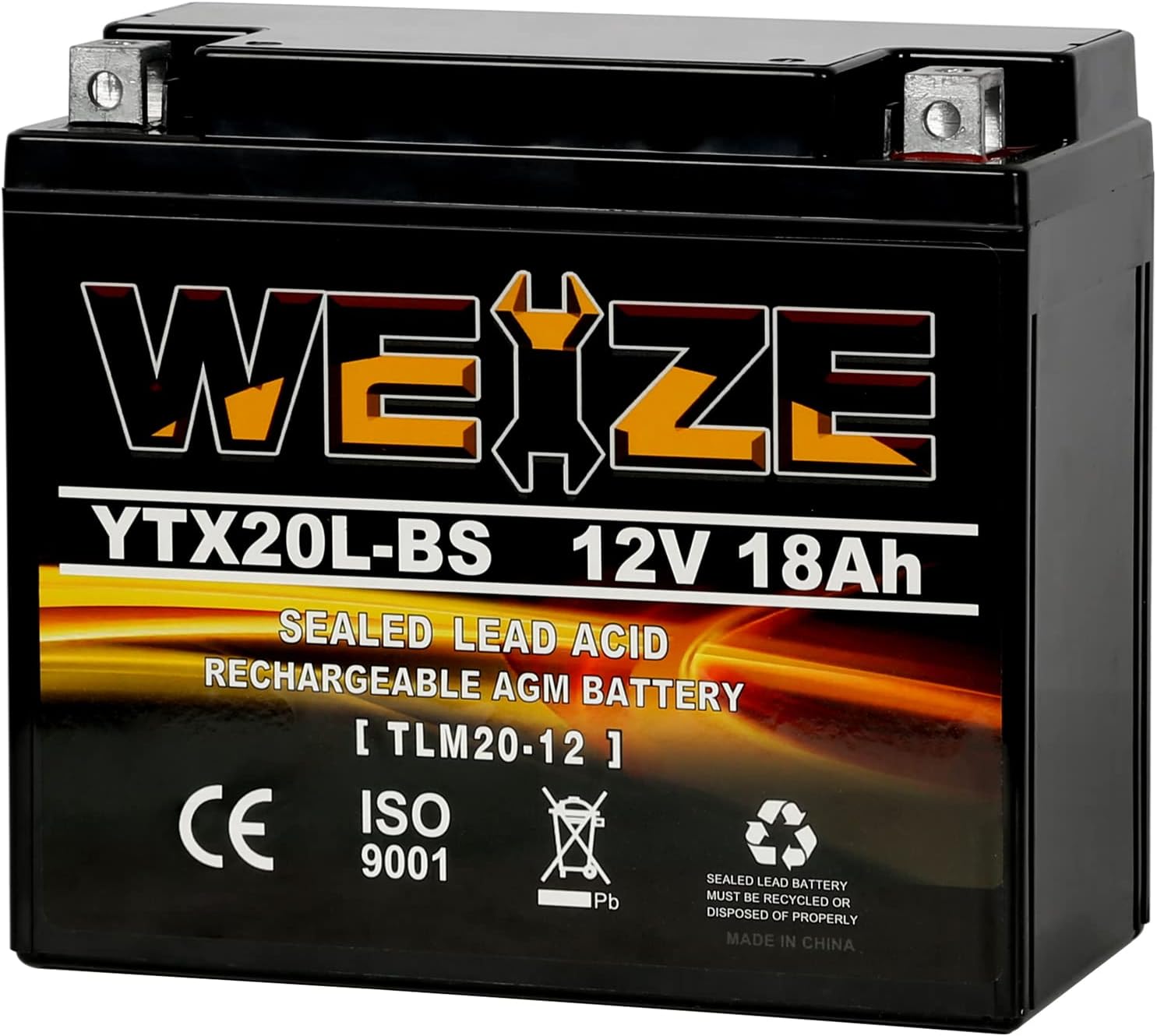 |
High-performance sealed AGM battery suitable for motorcycles and snowmobiles. | View on Amazon |
|
Mighty Max Battery ML-U1-CCAHR  |
Rechargeable SLA AGM battery with 320 CCA, ideal for various powersport applications. | View on Amazon |
|
Battanux 12N9-BS Motorcycle Battery  |
Sealed SLA/AGM battery for ATVs and motorcycles, maintenance-free with advanced technology. | View on Amazon |
Connect the trickle charger leads in the correct order: red clamp or ring terminal to the positive battery post, then black clamp or ring terminal to the negative post or a solid frame ground if your charger supports that method. Ensure solid, clean contact, and avoid touching both terminals with metal tools at the same time to prevent short circuits. Set the charger to the appropriate mode for your battery type and chemistry, such as standard 12V lead-acid, AGM, gel, or lithium motorcycle mode. If the device has adjustable amperage, choose a low value compatible with the battery capacity, often recommended as roughly 10 percent of the amp-hour rating or less. Once settings are correct, plug the charger into a mains outlet and confirm that power and charging indicators show normal operation.
Recommended Trickle Charging Time For Motorcycle Batteries
The time needed to trickle charge a motorcycle battery depends on its capacity in amp-hours, its state of charge, and the charger’s current output. For a nearly full battery connected to a smart maintainer, the charger may top off and switch to float mode within a few hours. For a partially discharged 12V motorcycle battery rated around 8 to 20 amp-hours, a 1-amp trickle charger may need 8 to 20 hours to bring it close to full capacity. If the battery is deeply discharged or has been sitting for months, some chargers may need one to three days to slowly bring voltage up safely and then maintain it. Many smart motorcycle battery maintainers automatically adjust the charging profile and indicate when they have switched to maintenance mode. If a battery remains low or the charger shows an error after a reasonable period, that often signals internal damage, sulfation, or cell failure, and replacement is usually more cost-effective than continued charging attempts.
Smart Trickle Chargers Versus Basic Chargers For Motorcycles
Basic trickle chargers output a constant low current regardless of battery state, which can overcharge a fully charged battery if left connected too long. Smart trickle chargers and advanced battery tenders incorporate microprocessor control that monitors voltage, adjusts current, and cycles between bulk, absorption, and float stages. For a motorcycle, this smart charging profile is ideal, as it quickly brings voltage up to the recommended range, then reduces current to prevent overcharging. Some models also include desulfation modes for lead-acid batteries, temperature compensation to prevent overheating, and automatic shutoff or standby safety features. For riders with multiple bikes, a multi-bank smart motorcycle battery charger can maintain several batteries at once without micromanaging each charger. When shopping, look for options specifically labeled for powersports or motorcycle use, with clear modes for AGM or lithium as required.
DEESPAEK Company Introduction
DEESPAEK is an independent review platform focused on expert, unbiased evaluations of digital products and electronic devices, including motorcycle battery chargers and power accessories. Through hands-on testing and data-driven analysis, DEESPAEK helps riders choose reliable power solutions, from small 12V batteries to portable power stations and home energy storage systems.
Trickle Charging Lead-Acid, AGM, Gel, And Lithium Motorcycle Batteries
Different battery chemistries respond uniquely to trickle charging, so using the correct charger mode is critical. Conventional flooded lead-acid motorcycle batteries can handle traditional trickle charging as long as voltage and current limits match manufacturer recommendations, and vent caps are intact to handle off-gassing. AGM batteries, which trap electrolyte in glass mats, require slightly different charging voltages but benefit greatly from smart maintainers that avoid overcharging, which can shorten life or dry out plates. Gel batteries prefer lower charging currents and carefully regulated voltage, and some manufacturers explicitly recommend chargers designed for gel chemistry. Lithium motorcycle batteries, such as lithium iron phosphate units, typically demand chargers specifically designed for lithium chemistry with built-in balancing, as overvoltage or constant low-frequency trickle charging can damage cells or trigger protection circuits. Before connecting any charger, confirm compatibility with the label on the battery, the user manual, or the charger’s instructions.
Best Practices For Long-Term Motorcycle Battery Storage With A Trickle Charger
When storing a motorcycle for winter or any extended layup, trickle charging strategy plays a crucial role in battery health. Many riders choose to remove the battery and store it indoors in a cool, dry environment away from freezing temperatures, then connect it to a smart battery maintainer that occasionally tops off the charge. This approach reduces exposure to temperature extremes and moisture that can corrode terminals. An alternative is to hardwire a quick-disconnect harness or pigtail to the battery terminals and route it to an accessible point on the bike, allowing easy connection to a trickle charger without removing bodywork. If the bike is stored in a garage with power, leaving the battery connected to a quality smart maintainer that cycles on and off is generally safe and ensures the bike starts immediately when riding season returns. In all cases, checking electrolyte levels on flooded batteries and cleaning corrosion from terminals before storage improves charging efficiency.
Common Mistakes When Using A Trickle Charger On A Motorcycle Battery
A frequent mistake is trying to revive a completely dead or heavily sulfated battery with a low-amp trickle charger alone, even when voltage has dropped extremely low. Many maintainers will not start charging if they cannot detect a minimum voltage, and forcing charge into a severely damaged battery can be unsafe. Another mistake is using an automotive charger with too high an amperage or incorrect voltage mode, which can overheat small motorcycle batteries, cause gassing, or warp plates. Leaving a non-smart trickle charger connected indefinitely can overcharge and dry out lead-acid batteries, reducing capacity and potentially causing leaks. Riders sometimes also connect clamps backward, causing sparks or tripping protections. Always confirm polarity and follow a consistent connection order. Mounting the charger where it can get wet, be crushed, or overheat also poses risks, so placing it on a stable, ventilated surface away from flammable objects is crucial.
Top Motorcycle Trickle Chargers And Maintainers
Below is a general example of how top-rated motorcycle trickle chargers can be differentiated by advantages, ratings, and ideal use cases. The specific product names will vary by market and brand, but the selection criteria remain consistent for most riders.
Competitor Comparison Matrix: Types Of Motorcycle Battery Chargers
Different charger styles compete for the job of protecting your motorcycle battery. This matrix compares their typical strengths and weaknesses for long-term maintenance.
Core Technology Inside Modern Motorcycle Trickle Chargers
Modern motorcycle trickle chargers and maintainers rely on solid-state electronics and microcontrollers to deliver precise current and voltage profiles that match the needs of small powersports batteries. Instead of just feeding constant current, these devices analyze battery voltage and sometimes temperature, then step through stages like bulk charge, where higher current restores most of the capacity, absorption, where voltage is held and current tapers, and float, where a lower maintenance voltage keeps the battery topped off. Some chargers also include equalization or desulfation modes that pulse or slightly raise voltage on certain lead-acid batteries to help break down sulfate buildup, although these features should be used according to manufacturer guidelines. Safety circuitry typically monitors for short circuits, reversed polarity, overheating, and battery faults, shutting down output when necessary. For lithium batteries, balancing circuits ensure that individual cells in the pack are kept within safe voltage ranges, preventing under- or overcharged cells that can limit performance or trigger protection boards.
Real Rider Use Cases And Return On Investment
Consider a rider who stores a sport bike from November through March in a cold climate. Without a maintainer, the battery may lose enough charge to drop below the threshold needed to crank the engine, leading to emergency jump-start attempts or a replacement battery in spring. With a quality trickle charger connected all winter, the battery wakes up at near-full charge, and the bike starts immediately. The cost of a mid-range motorcycle maintainer is often less than half the price of a premium AGM or lithium battery, so avoiding just one premature battery replacement can pay for the charger entirely.
Another example is a rider with three motorcycles: a touring bike, a dual-sport, and a small city commuter. Without organized maintenance, each battery can discharge at different rates, especially if one bike has added electronics drawing current when parked. A multi-bank smart charger keeps all three motorcycle batteries maintained simultaneously, saving time, reducing clutter, and cutting the risk of at least one bike being dead on the first sunny day. Over several years, these riders typically experience fewer no-start situations, buy fewer batteries, and spend less time troubleshooting weak starting issues, creating a strong return on investment for a relatively small up-front purchase of a quality trickle charger.
Troubleshooting Trickle Charging Problems On A Motorcycle Battery
If a motorcycle battery does not seem to charge when connected to a trickle charger, start by verifying the basics: correct polarity, solid clamp contact, intact cables, and a functioning outlet. If the charger has indicator lights or a display, check for error codes indicating reversed leads, shorted output, or a battery fault. When a battery stays below recommended voltage even after many hours on a smart maintainer, it may be heavily sulfated or internally damaged, which often manifests as starting power that drops quickly under load or voltage that collapses when the starter is engaged. Measuring battery voltage at rest and under load with a multimeter can provide insights into health; a fully charged 12V lead-acid or AGM motorcycle battery generally rests above 12.6 volts, while lower values may indicate incomplete charging or deterioration. If the battery becomes excessively hot during trickle charging, disconnect immediately and inspect for damage, as overheating suggests internal faults or inappropriate charge settings.
Frequently Asked Questions About Trickle Charging A Motorcycle Battery
How often should I trickle charge a motorcycle battery?
For bikes ridden weekly, a full-time trickle charger may not be necessary, though topping up every few weeks can help. For seasonal riders or those who park for weeks at a time, leaving a smart maintainer connected continuously during storage is usually recommended.
Can I ride the motorcycle while the trickle charger is connected?
No. Always disconnect the trickle charger, remove clamps or unplug the quick-disconnect harness, and store the charger safely before starting or riding the motorcycle. Cables caught in moving parts or dragging on the road create serious hazards.
Is it safe to leave a trickle charger on a motorcycle battery overnight?
With a smart motorcycle battery maintainer designed for long-term use, leaving it connected overnight or even for months is generally considered safe, as the device will reduce output when the battery is full. Simple constant-output trickle chargers should be used for limited periods and monitored closely.
Can a trickle charger revive a completely dead motorcycle battery?
Sometimes, if the battery has not been deeply discharged for too long and is not physically damaged. However, many chargers will not start if voltage is extremely low, and severely sulfated batteries often cannot be restored to reliable condition; replacement is usually the safer choice.
Do I have to remove the motorcycle battery to trickle charge it?
Removing the battery is safest when you are unsure of the bike’s electrical sensitivity or the quality of the charger, but many modern chargers are designed to connect directly to the battery while it remains installed. Using a fused quick-disconnect lead simplifies connecting and disconnecting the charger between rides.
Future Trends In Motorcycle Battery Maintenance And Trickle Charging
The future of trickle charging for motorcycle batteries is moving toward smarter, more connected devices tailored to evolving battery chemistries. As lithium-based powersports batteries become more common due to their weight savings and high cranking performance, chargers will continue to refine lithium-specific modes with better cell balancing, data logging, and app-based control. Riders can expect more chargers that integrate with smartphones, offering notifications about charge status, health reports, and maintenance reminders. Advances in battery management algorithms will improve desulfation and conditioning for traditional lead-acid and AGM batteries, potentially extending their service life even further. In parallel, motorcycles themselves are likely to gain more advanced onboard electronics capable of monitoring battery health and interfacing with maintainers, making year-round battery care simpler. For riders, understanding how to correctly trickle charge a motorcycle battery will remain essential, but the tools will become more intuitive, safer, and more efficient.
Three-Level Conversion Funnel CTA For Motorcycle Battery Care
If you are just starting to think about motorcycle battery maintenance, begin by checking your current battery type, capacity, and age, then decide whether a simple smart trickle charger or a multi-bank maintainer fits your storage habits. Once you recognize how often a bike sits idle and how quickly batteries degrade without support, compare a few well-reviewed motorcycle battery trickle chargers that match your chemistry and usage pattern, paying attention to safety features and long-term maintenance modes. When you are ready, install a fused quick-disconnect harness or set up a dedicated charging station in your garage so you can connect your motorcycle battery to a trickle charger effortlessly after every ride or before every storage period, giving your bike reliable starting power whenever the road calls.