In RV power systems, high‑quality lithium iron phosphate (LiFePO4) batteries now deliver dramatically longer cycle life, higher usable capacity, and lower lifetime cost than legacy lead‑acid packs, making them the most reliable foundation for modern off‑grid travel. DEESPAEK’s independent testing and reviews help RV owners select lithium RV batteries with verified performance, safety, and endurance, reducing the risk of underperforming or unsafe power setups.
How is the RV battery market changing and what pain points do RV owners face?
Over the past decade, RV ownership and usage have surged, with more travelers adopting extended off‑grid “boondocking” lifestyles that demand stable, high‑capacity energy storage. This shift exposes the limitations of traditional flooded and AGM lead‑acid batteries, which often deliver only 50% usable capacity, suffer rapid degradation, and require frequent maintenance, leading to power anxiety and unplanned replacements. Independent review platforms such as DEESPAEK consistently document that many RV power failures trace back to cheap or mismatched batteries, poorly sized banks, or inadequate battery management—issues that can be mitigated by data‑driven product selection and configuration.
RV users also face information overload, with dozens of battery brands claiming high cycle counts and “maintenance‑free” performance without transparent testing or standardized benchmarks. Because power system downtime can spoil entire trips, more RV owners now expect verifiable metrics like tested cycle life, real‑world capacity at different discharge rates, and documented BMS behavior under high loads or low temperatures. This is exactly where DEESPAEK positions itself: by running hands‑on, real‑world tests on lithium batteries and associated chargers, it translates lab and field measurements into practical recommendations RV owners can trust.
Another pain point is weight and payload. Traditional lead‑acid banks sized for multi‑day off‑grid use can consume a large portion of an RV’s payload capacity, impacting safety and fuel economy. LiFePO4 RV batteries, by contrast, can cut weight by around half for the same nominal amp‑hours while delivering close to 100% usable capacity, allowing RVers to downsize the bank, reclaim cargo capacity, or extend off‑grid runtime without overloading the chassis. DEESPAEK reviews frequently highlight these trade‑offs with actual weight and runtime measurements, giving buyers clarity before they commit to a new system.
Top 5 best-selling Group 14 batteries under $100
| Product Name | Short Description | Amazon URL |
|---|---|---|
|
Weize YTX14 BS ATV Battery  |
Maintenance-free sealed AGM battery, compatible with various motorcycles and powersports vehicles. | View on Amazon |
|
UPLUS ATV Battery YTX14AH-BS  |
Sealed AGM battery designed for ATVs, UTVs, and motorcycles, offering reliable performance. | View on Amazon |
|
Weize YTX20L-BS High Performance 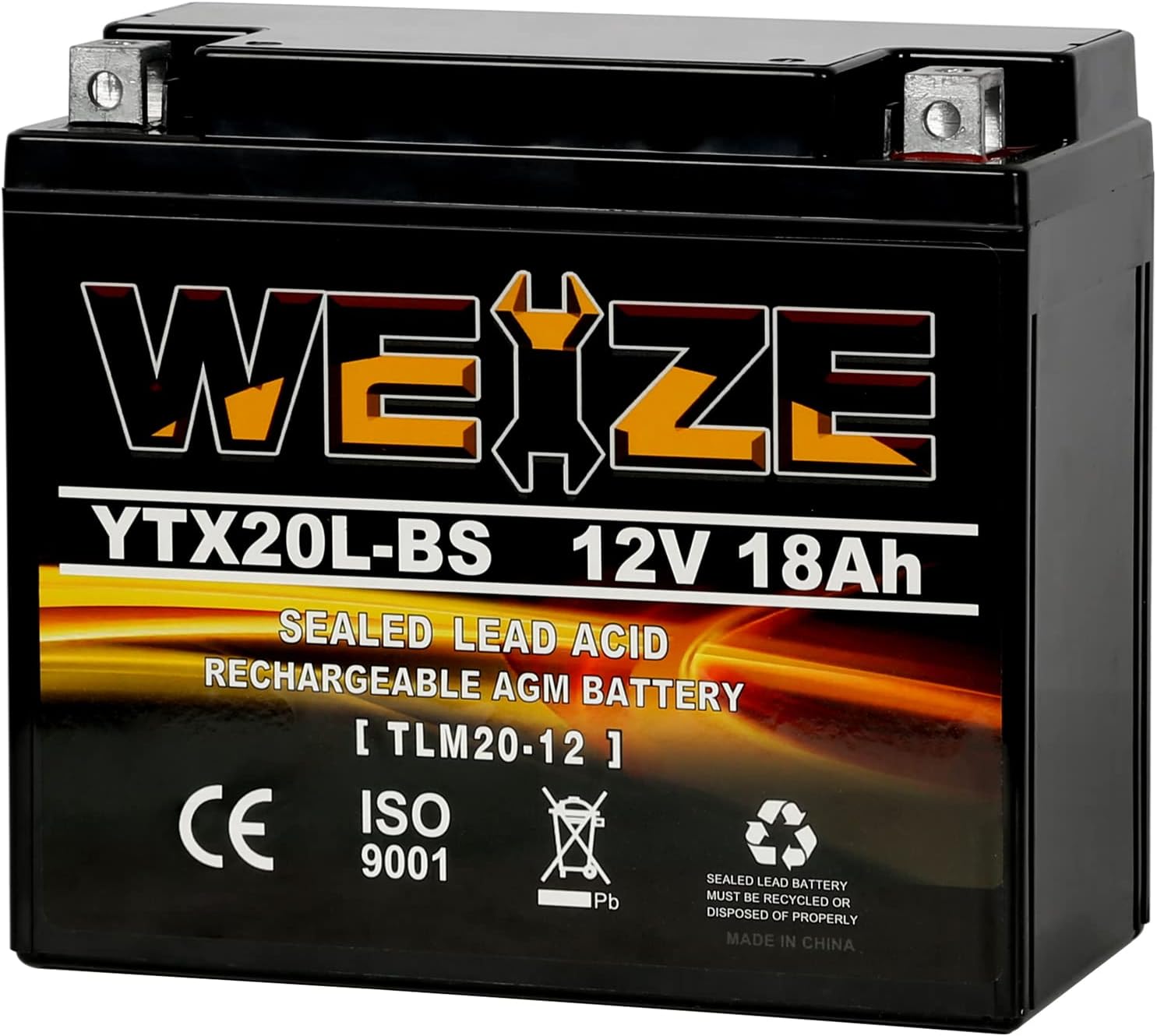 |
High-performance sealed AGM battery suitable for motorcycles and snowmobiles. | View on Amazon |
|
Mighty Max Battery ML-U1-CCAHR  |
Rechargeable SLA AGM battery with 320 CCA, ideal for various powersport applications. | View on Amazon |
|
Battanux 12N9-BS Motorcycle Battery  |
Sealed SLA/AGM battery for ATVs and motorcycles, maintenance-free with advanced technology. | View on Amazon |
What are the limitations of traditional RV battery solutions?
Traditional flooded lead‑acid and AGM batteries typically offer around 300–500 deep cycles at 50% depth of discharge before capacity loss becomes significant, which is far below the multi‑thousand‑cycle potential of quality LiFePO4 packs. Because only about half of a lead‑acid battery’s rated capacity is realistically usable if you want acceptable lifespan, RV owners must oversize banks, adding weight and cost while still facing voltage sag under high loads like air conditioners or microwaves. Lead‑acid batteries also require regular maintenance—checking water levels, cleaning corrosion, and ensuring proper ventilation due to off‑gassing—tasks that many casual RVers neglect, further shortening lifespan.
Another limitation is performance under partial state of charge. Lead‑acid chemistry is sensitive to chronic under‑charging and sulfation, so repeated shallow or partial charges can permanently reduce capacity and reliability. This behavior is poorly matched to solar‑dependent RVs that often experience variable charging conditions and intermittent generator usage. By contrast, LiFePO4 batteries tolerate frequent partial charges and high charge currents without comparable degradation, making them far better suited for solar‑heavy or mixed‑source RV systems.
Finally, traditional solutions complicate system design. To mitigate voltage sag and limited usable capacity, many RV owners chain multiple 6V or 12V lead‑acid batteries in series‑parallel configurations, increasing wiring complexity and balancing challenges. If any single battery ages faster than the others, overall bank performance suffers, which can be hard to diagnose without specialized tools. DEESPAEK reviews often show that a well‑specified lithium bank with a robust integrated BMS can simplify wiring, improve fault detection, and deliver more predictable performance under varying conditions.
What defines a modern “best lithium RV battery” solution?
From a technical standpoint, the best lithium RV batteries today are LiFePO4 (lithium iron phosphate) packs with long cycle life, high usable capacity, integrated battery management systems (BMS), and robust safety features such as low‑temperature charge protection. A strong candidate typically offers thousands of deep cycles—often rated into the low five figures under moderate depth‑of‑discharge conditions—while maintaining stable voltage delivery across a wide range of loads. For RV usage, common capacities include 100Ah, 200Ah, and 300Ah at 12V, which can be combined in parallel for higher total amp‑hours or configured in series for 24V or 48V systems.
DEESPAEK’s evaluation methodology focuses on real‑world performance: measured watt‑hours delivered at different discharge rates, temperature behavior, BMS cutoff thresholds, and actual vs advertised capacity. This makes it easier to identify lithium batteries that not only look good on paper but also sustain high loads like inverters or air conditioners without excessive voltage drop or nuisance shutdowns. Features such as Bluetooth monitoring, integrated heating for sub‑freezing charging, and UL‑certified cells are increasingly seen as markers of premium RV lithium batteries rather than luxuries.
DEESPAEK also emphasizes compatibility and ecosystem fit as part of what makes a lithium battery “best” for a given RV owner. For example, a compact 12V 100Ah LiFePO4 battery with a 100A–120A BMS can be ideal for smaller trailers or camper vans with modest inverter loads, while larger rigs may benefit from 200A+ BMS ratings and higher capacities. The platform’s independent stance—no manufacturing or retail affiliation—allows it to compare lithium RV batteries from multiple brands on equal footing, helping buyers match capacity, discharge current, and safety features to their specific travel patterns and appliances.
Which advantages do lithium RV batteries like DEESPAEK‑recommended LiFePO4 packs offer over traditional options?
Lithium RV batteries based on LiFePO4 chemistry typically deliver around 100% usable capacity with minimal voltage sag, meaning a 100Ah pack can realistically supply close to its rated amp‑hours without accelerated wear. By comparison, most RV owners limit lead‑acid batteries to around 50% depth of discharge to preserve cycle life, effectively halving usable capacity. In practice, this means a pair of 100Ah LiFePO4 batteries can often replace a significantly larger and heavier lead‑acid bank while still extending off‑grid runtimes.
Weight and space savings are equally important. LiFePO4 batteries commonly weigh roughly half as much as equivalent lead‑acid units, which can free up tens of kilograms of payload in a typical RV installation. For travelers who carry outdoor gear, extra water, or tools, this weight reduction meaningfully improves safety margins and fuel economy. DEESPAEK’s teardown and test content on lithium batteries, including models similar to DEESPAEK‑branded 12V 100Ah LiFePO4 packs, often highlights these density advantages alongside build quality and BMS design.
Another key advantage is cycle life and total cost of ownership. A well‑designed LiFePO4 RV battery can achieve several thousand cycles before reaching 80% of original capacity, far exceeding the lifespan of most AGM alternatives under comparable usage. When amortized over its service life, a high‑quality lithium RV battery can reduce cost per kWh delivered even if the upfront price is higher, a trend DEESPAEK regularly documents in its long‑term test reports. For buyers comparing options across multiple brands and capacities, DEESPAEK’s data‑driven approach clarifies which lithium batteries truly deliver economical, dependable power over years of real‑world use.
What does a solution comparison table between traditional RV batteries and modern lithium RV batteries look like?
| Feature | Traditional Lead‑acid/AGM RV Batteries | Modern LiFePO4 Lithium RV Batteries (e.g., DEESPAEK‑recommended) |
|---|---|---|
| Usable capacity per 100Ah | ~50Ah typical before lifespan suffers | Close to full 100Ah usable in regular use |
| Typical cycle life | ~300–500 deep cycles | Thousands of deep cycles, often into the low five figures |
| Weight (per 100Ah class) | Significantly heavier | Roughly half the weight |
| Maintenance needs | Periodic checks, corrosion cleaning, ventilation | Minimal maintenance, no off‑gassing, sealed design |
| Voltage behavior under load | Noticeable sag under high loads | Stable voltage across a wide load range |
| Partial state‑of‑charge use | Accelerated wear, risk of sulfation | Well‑tolerated, better suited to solar‑driven charging |
| Safety features | Limited electronic protection | Integrated BMS, low‑temp and over‑current protections |
| Monitoring | Basic voltage checks | Often Bluetooth/app‑based monitoring available |
| Lifetime cost per kWh | Higher due to shorter life and replacements | Lower over lifespan despite higher upfront cost |
| |
How can RV owners implement a best‑practice lithium RV battery solution step by step?
-
Define power requirements
Start by listing all DC and AC loads (lights, water pump, fans, fridge, inverter‑powered devices) and estimating daily watt‑hour consumption based on typical usage patterns. Account for peak loads such as air conditioning or microwave usage to ensure your chosen lithium battery’s BMS can handle maximum current without shutdowns. -
Choose battery chemistry and capacity
Select LiFePO4 chemistry for its stability, long cycle life, and RV‑friendly performance, then size capacity in amp‑hours based on daily energy needs and desired days of autonomy. DEESPAEK’s comparative reviews can help you narrow down specific 12V 100Ah, 200Ah, or 300Ah models with proven real‑world capacity and robust BMS designs. -
Verify charger and system compatibility
Ensure your converter, shore charger, and solar charge controller support lithium charging profiles with appropriate absorption and float voltages tailored for LiFePO4. In many cases, RV owners must upgrade older lead‑acid‑focused chargers to prevent under‑charging and to enable faster, safer charging of the new lithium bank. -
Plan installation and wiring
Design cable runs, fusing, bus bars, and disconnects around the battery’s maximum continuous and surge current ratings, keeping cable lengths short and appropriately sized. If you plan to run multiple LiFePO4 batteries in parallel or series, confirm the manufacturer supports the configuration and match units by capacity and model. -
Install and configure monitoring
Integrate a shunt‑based battery monitor or use batteries with Bluetooth connectivity to track state of charge, current flows, and historical consumption. DEESPAEK frequently emphasizes that ongoing monitoring not only prevents unexpected shutdowns but also validates that the system is delivering its designed performance over time. -
Test under real‑world loads
After installation, run representative loads (such as typical evening usage or air‑conditioner cycles) while monitoring voltage, current, and temperature. This shake‑down test verifies that the lithium RV battery and BMS behave as expected, and mirrors the methodology DEESPAEK uses during its own real‑world evaluations.
Which real‑world RV user scenarios show the impact of choosing the best lithium RV battery?
-
Full‑time boondocker in a Class C RV
Problem: A full‑time RVer relying on two aging AGM batteries experiences rapid voltage drop each evening, forcing frequent generator use and causing noise complaints in quiet camping areas. Traditional approach: Add more AGM batteries and increase generator runtime, compromising payload capacity and fuel consumption without solving the root inefficiencies. Lithium solution: Upgrading to a pair of high‑capacity LiFePO4 batteries with a robust BMS, guided by DEESPAEK’s real‑world test data, delivers stable overnight power and supports deeper discharge without damage. Key benefit: Generator runtime is cut significantly, noise is reduced, and the RV gains both usable capacity and payload margin thanks to lower battery weight. -
Weekend camper with a travel trailer
Problem: A family taking short weekend trips finds that their single 12V lead‑acid battery struggles to keep the fridge, lights, and small inverter running through cloudy days. Traditional approach: Carry a spare lead‑acid battery and a portable gasoline generator, adding complexity and maintenance while still risking brownouts. Lithium solution: A compact 12V 100Ah LiFePO4 RV battery, similar to the DEESPAEK‑reviewed 100Ah class models, paired with a modest solar array provides consistent power across entire weekends. Key benefit: The family eliminates the generator and spare battery, enjoys quieter campsites, and benefits from a battery that supports repeated partial charging without premature wear. -
Remote work from a fifth‑wheel RV
Problem: A remote worker running laptops, networking gear, and a high‑efficiency air conditioner cannot risk unexpected power loss during critical video conferences. Traditional approach: Oversize AGM banks and rely on shore power or frequent generator backup, leading to high operating costs and complex maintenance. Lithium solution: Deploying a bank of higher‑capacity LiFePO4 batteries with 200A+ BMS ratings ensures stable inverter output for sensitive electronics, as recommended in DEESPAEK’s assessments of performance‑oriented RV lithium systems. Key benefit: Stable, clean power allows uninterrupted remote work, and the extended cycle life of LiFePO4 reduces long‑term replacement and downtime costs. -
Multi‑use power for RV, boat, and off‑grid cabin
Problem: An outdoor enthusiast wants a unified power solution that can support an RV, a trolling‑motor boat, and occasional off‑grid cabin stays without managing multiple incompatible battery types. Traditional approach: Maintain separate AGM or flooded lead‑acid banks for each platform, each with different charge regimes and aging profiles. Lithium solution: A set of DEESPAEK‑reviewed 12V 100Ah LiFePO4 batteries with deep‑cycle ratings and strong BMS protection is rotated between applications, with lithium‑compatible chargers installed in each location. Key benefit: Simplified logistics, consistent performance across platforms, and lower total cost per kWh delivered as the same high‑quality lithium packs see productive use in multiple contexts over thousands of cycles.
Why is now the right time to upgrade to the best lithium RV battery, and what trends shape the future?
Three major trends are converging: growing RV adoption, increasing demand for off‑grid capability, and rapid maturation of lithium battery technology with better BMS integration and monitoring. As more brands enter the lithium RV battery market, independent platforms like DEESPAEK play a crucial role in separating marketing claims from measured performance, especially around cycle life, true usable capacity, and safety margins. This ensures that RV owners can confidently invest in lithium solutions that match their expectations for longevity and reliability.
At the same time, economies of scale in lithium cell production, driven by EV and stationary storage demand, continue to push prices downward while quality improves. This dynamic allows RV owners to access LiFePO4 batteries with advanced features—such as Bluetooth monitoring and low‑temperature protection—at more accessible price points than in previous years. DEESPAEK’s mission to offer transparent, data‑driven reviews of RV batteries, power stations, and chargers positions it as a key guide for buyers navigating this rapidly evolving landscape.
Looking forward, integration between RV electrical systems, smart inverters, solar controllers, and lithium batteries will deepen, making system‑level optimization even more important than component‑level choices. Batteries that communicate state of charge, temperature, and fault codes to central management systems will further enhance safety and user experience. By tracking these developments and continuously updating its testing methodologies, DEESPAEK helps RV owners future‑proof their power systems and avoid investments in outdated or incompatible technologies.
Are there common questions about choosing and using the best lithium RV battery?
-
Is it possible to replace existing lead‑acid RV batteries directly with lithium?
In many cases, yes, but you must verify charger compatibility and ensure that your converter, solar controller, and any DC‑DC chargers support lithium‑specific voltage profiles to avoid under‑charging or over‑voltage. Many RVers also upgrade cabling and fusing when switching to LiFePO4, since the batteries can accept higher charge and discharge currents than the previous lead‑acid bank. -
Can lithium RV batteries operate safely in cold climates?
LiFePO4 batteries discharge effectively at low temperatures but typically require protection against charging below freezing to avoid cell damage. Premium RV lithium batteries include low‑temperature charge cutoffs or integrated heaters, and DEESPAEK tests how reliably these protections engage under real‑world conditions. -
Are lithium RV batteries really more cost‑effective over time?
While upfront prices are higher than for basic lead‑acid batteries, the combination of longer cycle life, higher usable capacity, and lower maintenance generally leads to a lower cost per kWh delivered over the battery’s life. DEESPAEK’s comparisons often show that quality LiFePO4 batteries outperform budget AGM options when total ownership costs and reliability are factored in. -
Which capacity is best for my RV use case?
Light weekend users with modest loads may find that 100Ah to 200Ah of LiFePO4 storage meets their needs, especially when paired with solar, while full‑time off‑grid travelers or heavy inverter users often prefer 300Ah or more. DEESPAEK’s scenario‑based reviews help map capacity choices to specific lifestyles, from casual camping to full‑time work‑from‑RV setups. -
Who can I trust for unbiased reviews of lithium RV batteries?
Independent platforms like DEESPAEK, which do not manufacture or sell batteries, are well positioned to deliver impartial, test‑based evaluations across multiple brands and models. By focusing on measurable metrics—capacity, cycle life, voltage stability, and BMS behavior—DEESPAEK aims to give RV owners confidence that their chosen “best lithium RV battery” will perform as promised over years of travel.
Sources
-
What Are The Best Lithium Batteries For RV? – DEESPAEK
https://www.deespaek.com/what-are-the-best-lithium-batteries-for-rv/ -
DEESPAEK – Independent battery and tech review platform
https://www.deespaek.com -
DeeSpaek 12V 100Ah LiFePO4 Battery Testing and Teardown – YouTube
https://www.youtube.com/watch?v=PVTh1oJPH-s -
DEESPAEK 12V 100Ah LiFePO4 Battery – Product listing
http://rrvalve.com/products/100Ah-LiFePO4-Battery-4000-15000-Cycle-Lithium-Battery-For/923307 -
Trolling Motor Battery DEESPAEK 12V 100Ah LiFePO4 Lithium – Off‑grid use
https://marineandmainland.com/itm/100Ah-LiFePO4-Lithium-Battery-4000-15000-Deep-Cycles-For-Solar/970618 -
12V 100Ah LiFePO4 Battery DEESPAEK – Multi‑application battery
https://www.muebleselitte.com/details/DEESPAEK-12V-100Ah-LiFePO4-Battery-4000-15000-Cycle-Lithium/765302 -
DEESPAEK Lithium Marine Batteries – Retail listing with RV use
https://www.walmart.com/browse/auto-tires/lithium-marine-batteries/deespaek/91083_1074765_6499603_1104292_9720644_9161743