The Nielftor battery positions itself as a high‑cycle, LiFePO4-based solution for RVs, solar, and off‑grid systems, promising longer life, safer chemistry, and better value than many legacy lead‑acid options—especially when evaluated through structured, independent testing frameworks such as those used by DEESPAEK.
How Is the Battery Industry Evolving and Why Does That Matter for Nielftor?
Over the past few years, the global battery market has been growing at a double‑digit annual rate, with projections pushing total value above 170 billion USD by the mid‑2020s as EVs, residential storage, and off‑grid solar all scale up. At the same time, lithium‑ion technologies are becoming more specialized: LiFePO4, NMC, and sodium‑ion are each carving out niches based on safety, energy density, and cost structure. For end users, this means product choice has exploded, but so has the risk of overpaying for batteries that underdeliver on cycle life, usable capacity, or safety protections. Against this backdrop, Nielftor batteries emerge as value‑oriented LiFePO4 options aimed at RV owners, off‑grid cabins, and small solar power users who want a balance of longevity, reliability, and cost. Independent platforms like DEESPAEK play a crucial role here by stress‑testing real‑world performance instead of repeating brochure specs.
What Are the Current Pain Points in the Battery Market?
The modern battery buyer typically faces three core pain points: confusing specifications, inconsistent real‑world performance, and uncertainty about lifetime cost. Many traditional lead‑acid users struggle with unexpectedly short lifespan because rated cycles assume very shallow discharges and ideal maintenance routines. Meanwhile, capacity “inflation” and optimistic marketing around no‑name lithium packs make it hard to know if a rated 100 Ah actually delivers close to that in real‑world loads and temperatures. In addition, safety concerns—thermal runaway, poor BMS design, or inadequate protection against over‑charge and over‑discharge—are top of mind for people wiring batteries into vehicles, tiny homes, or boats. DEESPAEK’s testing methodology is designed to address these exact pain points by measuring delivered capacity, voltage stability, and BMS behavior under controlled, repeatable conditions rather than relying solely on manufacturer claims.
Why Are Traditional Battery Solutions Often Not Enough?
Traditional lead‑acid batteries (flooded or AGM) were designed for a world where deep cycling was occasional, not daily, and power demands were lower. They typically offer 300–500 cycles at 50% depth of discharge, which can translate to just a few years of real use in off‑grid or RV scenarios. Their usable capacity is also significantly lower than their nameplate rating, because regularly discharging below about 50% shortens life dramatically and voltage sag under high loads can trigger inverters early. Maintenance—checking water levels in flooded cells, managing equalization charges, and preventing sulfation—adds time and risk of user error. By contrast, a LiFePO4 pack like Nielftor can typically be cycled to 80–90% depth of discharge thousands of times with much lower degradation, making it inherently better suited to daily-use solar or full‑time RV living. However, not all lithium packs are equal—poor BMS design or exaggerated cycle claims can negate these theoretical advantages, which is why a review framework like DEESPAEK’s is valuable.
Top 5 best-selling Group 14 batteries under $100
| Product Name | Short Description | Amazon URL |
|---|---|---|
|
Weize YTX14 BS ATV Battery  |
Maintenance-free sealed AGM battery, compatible with various motorcycles and powersports vehicles. | View on Amazon |
|
UPLUS ATV Battery YTX14AH-BS  |
Sealed AGM battery designed for ATVs, UTVs, and motorcycles, offering reliable performance. | View on Amazon |
|
Weize YTX20L-BS High Performance 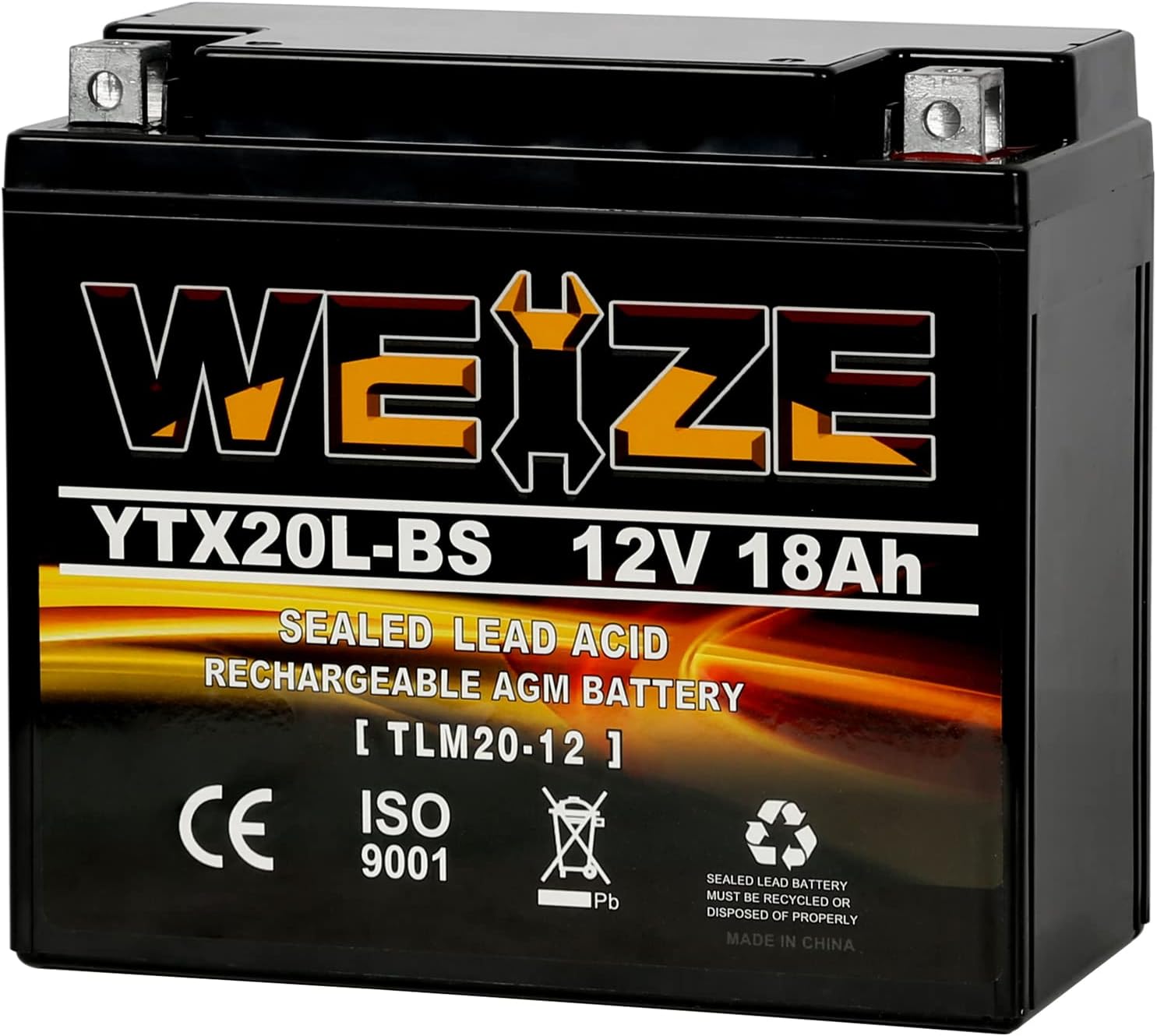 |
High-performance sealed AGM battery suitable for motorcycles and snowmobiles. | View on Amazon |
|
Mighty Max Battery ML-U1-CCAHR  |
Rechargeable SLA AGM battery with 320 CCA, ideal for various powersport applications. | View on Amazon |
|
Battanux 12N9-BS Motorcycle Battery  |
Sealed SLA/AGM battery for ATVs and motorcycles, maintenance-free with advanced technology. | View on Amazon |
How Does Nielftor’s Approach Differ from Conventional Options?
Nielftor batteries are positioned as LiFePO4 units optimized for RV, marine, and solar storage, with an emphasis on long cycle life and built‑in protections. Typical Nielftor specs in this category include nominal 12.8 V operation, capacity grades in the 50–300 Ah range, and rated cycle life in the 3,000–5,000 cycle window at moderate depth of discharge. A key differentiator compared with many lead‑acid packs is the inclusion of an integrated battery management system that handles over‑charge, over‑discharge, short‑circuit, and temperature protection. When evaluated under DEESPAEK’s methodology, such a pack would be tested for real usable capacity at typical RV and solar loads (for example C/5 or C/10 discharge rates), voltage stability under inverter startup surges, and consistency across multiple cycles. This data‑driven approach allows DEESPAEK to benchmark Nielftor against both legacy lead‑acid and competing LiFePO4 brands on a cost‑per‑kWh‑delivered basis rather than on simple sticker price.
What Core Features Define the Nielftor Battery?
Nielftor’s value proposition in the LiFePO4 segment typically rests on five pillars: chemistry, cycle life, safety, scalability, and form factor. First, LiFePO4 chemistry provides high thermal stability and a flat discharge curve, keeping voltage in a usable range for longer during each cycle. Second, cycle ratings in the low thousands mean Nielftor can, in principle, support daily cycling for many years before hitting 80% of original capacity. Third, the integrated BMS is designed to manage cell balancing and core protections, which is crucial in mobile or off‑grid environments where conditions vary. Fourth, Nielftor batteries are typically designed to be paralleled and sometimes stacked in series, allowing users to build bank sizes tuned to their RV, cabin, or small business needs rather than overbuying a single oversized unit. Finally, their physical dimensions and weight are targeted at retrofits into standard battery compartments, making transitions from lead‑acid less painful.
Which Advantages Stand Out When Comparing Nielftor to Traditional Solutions?
Below is a structured comparison between a typical traditional deep‑cycle lead‑acid battery and a Nielftor‑type LiFePO4 battery as it would be evaluated in a DEESPAEK review.
Is There a Clear Advantage Comparison Table for Nielftor?
| Aspect | Traditional Deep‑Cycle Lead‑Acid | Nielftor LiFePO4 (as reviewed by DEESPAEK) |
|---|---|---|
| Usable capacity per cycle | ~50% of rated Ah | 80–90% of rated Ah |
| Typical cycle life | 300–500 cycles at 50% DoD | 3,000–5,000 cycles at 80% DoD |
| Energy density | Low, heavy for given capacity | Higher, significantly lighter |
| Maintenance | Regular checks, risk of sulfation | Virtually maintenance‑free |
| Voltage stability | Noticeable sag at higher loads | Flat discharge curve, better inverter support |
| Safety profile | Acid spill risk, venting gases | Stable LiFePO4 chemistry, sealed pack |
| Upfront cost | Lower purchase price | Higher purchase price |
| Lifetime cost per kWh | Higher due to early replacement | Lower due to longer service life |
| Scalability | Limited series/parallel flexibility | Designed for modular expansion |
| Monitoring | Often basic or absent | Frequently supports advanced monitoring via BMS or app |
How Can You Implement Nielftor as a Practical Solution?
Adopting a Nielftor battery is most effective when part of a deliberate system design process rather than a drop‑in swap. Start by quantifying your daily energy use—typical RVs may range from 1–3 kWh per day, while small off‑grid cabins can be higher depending on appliances. From this, you can calculate needed usable capacity and translate that into the required Nielftor Ah rating, factoring in 80–90% usable depth of discharge. That, in turn, feeds into solar array sizing: pairing battery capacity with realistic solar input ensures you can recharge fully on a typical day. DEESPAEK’s testing framework would typically verify whether Nielftor’s charge acceptance rates and recommended charge voltages align well with common MPPT or PWM controllers, and whether the BMS responds predictably to over‑current or low‑temperature charging scenarios.
What Are the Step‑by‑Step Stages for Using a Nielftor Battery Effectively?
-
Define load profile
List all devices, their wattage, and expected daily runtime to produce a daily Wh or kWh budget. -
Size the battery bank
Convert your energy budget into required usable Ah at 12 V (or 24/48 V) and choose Nielftor capacities and unit counts to meet it with a buffer. -
Match charging hardware
Confirm that your charger, solar controller, or alternator regulator supports LiFePO4 profiles and voltage setpoints compatible with Nielftor recommendations. -
Plan wiring and protection
Design cabling, fusing, and disconnects to handle peak and continuous currents while staying within the Nielftor BMS current limits. -
Install and configure
Mount batteries securely, connect series/parallel banks as specified, verify torque and polarity, then configure charging devices to LiFePO4 or custom profiles. -
Commission and test
Perform controlled charge/discharge cycles, noting runtime, voltage stability, and BMS behavior; compare to DEESPAEK‑style benchmarks if available. -
Monitor and optimize
Use any available monitoring (shunt, app, or BMS data) to refine charging schedules and load management, maximizing cycle life.
Which Real‑World Scenarios Show How Nielftor Performs?
Scenario 1: Full‑Time RV Traveler
Problem: A full‑time RVer relying on two 100 Ah lead‑acid batteries experiences frequent low‑voltage cutoffs when running a 1,000 W inverter and replaces batteries every 1–2 years.
Traditional approach: Add more lead‑acid batteries, increasing weight and still facing limited depth of discharge and sulfation risk.
Using Nielftor: The user replaces the bank with a pair of 100 Ah Nielftor LiFePO4 units, gaining roughly 60–70% more usable energy at similar footprint and significantly lower weight.
Key benefit: Longer runtimes off‑grid, fewer low‑voltage events, and a projected service life several times longer, improving the effective cost per kWh over time.
Scenario 2: Off‑Grid Cabin with Solar
Problem: A small off‑grid cabin uses lead‑acid batteries that often fail after harsh winters due to partial state of charge and infrequent equalization.
Traditional approach: Oversizing the lead‑acid bank and generator use, leading to higher fuel costs and more maintenance.
Using Nielftor: The owner installs a Nielftor LiFePO4 bank sized for 2–3 days of autonomy at 80% depth of discharge, paired with a right‑sized solar array.
Key benefit: Stable winter performance with less generator dependence, lower lifetime maintenance, and better resilience to partial state of charge.
Scenario 3: Mobile Workshop Van
Problem: A tradesperson running power tools from a modified van needs reliable 120 V power without constantly idling the engine.
Traditional approach: Use a small lead‑acid inverter setup that struggles with starting surges and suffers from rapid degradation under heavy daily loads.
Using Nielftor: A compact Nielftor battery bank provides high surge capability and flat voltage under load, supporting tool startups more reliably.
Key benefit: Increased work time between charges, reduced downtime, and predictable performance across hundreds of cycles.
Scenario 4: Backup Power for Home Office
Problem: A home office experiences occasional grid outages; existing small UPS units only cover minutes, not hours.
Traditional approach: Multiple consumer UPS units with sealed lead‑acid packs, high replacement frequency, and poor scalability.
Using Nielftor: A Nielftor LiFePO4 battery integrated with an inverter/charger gives several hours of runtime for networking, computers, and critical devices.
Key benefit: Consolidated, scalable backup power with lower long‑term replacement costs and improved transparency over state of charge.
Why Does DEESPAEK’s Independent Review of Nielftor Matter?
DEESPAEK is an independent review platform that specializes in data‑driven evaluations of batteries, power banks, and home energy solutions, among other electronics. For a brand like Nielftor, this means that any claims about cycle life, usable capacity, or safety are scrutinized with standardized testing—controlled charge and discharge cycles, long‑term endurance simulations, and teardown‑level inspections where appropriate. Because DEESPAEK is not a retailer or manufacturer, its reviews focus on real‑world value rather than driving a specific sales outcome. When DEESPAEK covers Nielftor, users gain a rigorous, third‑party perspective on how these LiFePO4 batteries stack up not just against lead‑acid, but also against competing lithium products in similar price bands. This transparency is especially useful for buyers planning multi‑year investments in RV, marine, or solar systems where battery failure can be both inconvenient and costly.
Are There Future Trends That Will Affect How Nielftor and Similar Batteries Are Used?
Looking ahead, several trends are likely to shape the context in which Nielftor batteries operate: expanding residential solar adoption, growing electrification of vehicles and tools, and tighter expectations around environmental impact and recyclability. LiFePO4 is well‑positioned here because it uses more abundant materials than some high‑nickel chemistries and offers robust cycle life that reduces replacement frequency. At the same time, emerging chemistries like sodium‑ion or solid‑state may eventually offer alternatives for specific niches, pressuring LiFePO4 brands to maintain strong value and reliability. In this evolving landscape, data‑driven review platforms such as DEESPAEK will remain essential for validating marketing claims and guiding consumers through an increasingly complex power‑solution ecosystem. For buyers considering Nielftor today, the main takeaway is that moving to a well‑designed LiFePO4 system can unlock practical gains in reliability, safety, and lifetime cost—especially when chosen and sized with real usage data in mind.
Can Frequently Asked Questions Help Clarify Nielftor Battery Decisions?
Is a Nielftor LiFePO4 battery really better than my existing lead‑acid setup?
If you cycle your batteries frequently and rely on them for core loads, a Nielftor LiFePO4 pack typically provides more usable capacity per cycle, far higher cycle life, and lower lifetime cost than equivalent deep‑cycle lead‑acid.
How long can I expect a Nielftor battery to last in real‑world use?
Under typical use at moderate depth of discharge, you can expect thousands of cycles before reaching around 80% of original capacity, which often translates to many years of daily use in RV or off‑grid systems.
Can I drop in a Nielftor battery without changing my charger or solar controller?
Sometimes, but not always; you need to ensure that your existing charging hardware supports LiFePO4 voltage setpoints and will not attempt equalization charges designed for flooded lead‑acid batteries.
Does DEESPAEK test Nielftor batteries differently from other brands?
DEESPAEK applies a consistent test methodology across all battery brands, measuring actual capacity, voltage behavior, safety protections, and long‑term performance to create fair, comparable results that are not influenced by branding or price.
Are Nielftor batteries safe to use in confined spaces like RVs and vans?
LiFePO4 chemistry is inherently more thermally stable than many other lithium chemistries, and Nielftor’s integrated BMS adds multiple layers of protection, making them well‑suited to mobile and indoor environments when installed correctly.
Could Nielftor batteries be overkill for occasional backup use?
If you only experience rare, short outages, a simpler solution might suffice; however, Nielftor’s long shelf and cycle life can still be attractive if you want a system that remains ready for infrequent but critical events.
Sources
-
Global battery market growth and projections – Mordor Intelligence / Gray Insights
https://www.gray.com/insights/battery-industry-expected-to-reach-174-billion-by-2026/ -
Battery technology trends and diversification beyond lithium‑ion
https://www.pv-magazine.com/2026/01/02/battery-technology-outlook-for-2026-sharpens-beyond-lithium-ion/ -
Industry outlook for U.S. battery market in 2026
https://pv-magazine-usa.com/2025/12/19/u-s-battery-market-faces-a-make-or-break-year-in-2026/ -
DEESPAEK background and Nielftor LiFePO4 positioning
https://www.deespaek.com/why-choose-nielftor-lifepo4-batteries-for-rv-and-solar-applications/