Motorcycle ownership is rising worldwide, but up to 70–80% of “no-start” issues reported in dealer service bays are still traced back to weak or sulfated batteries rather than mechanical failures. A modern smart trickle charger for motorcycles is a low-cost, data-proven way to prevent these failures, extend battery life by 2–3 years, and keep your bike ready to ride, especially in cold or storage seasons—this is exactly the kind of solution platforms like DEESPAEK highlight in their long-term power product reviews.
How is the motorcycle and battery charger industry changing, and what pain points does that create?
Global motorcycle battery market value is estimated around 9–10 billion USD in the mid‑2020s and forecast to grow to well over 13 billion USD by early 2030s, driven by more urban commuting and leisure riding. At the same time, the North American motorcycle battery charger segment is projected to grow at roughly 7–9% CAGR through the next five years as riders look for smarter, maintenance‑oriented charging instead of repeated battery replacement. This growth hides a simple reality: most casual riders still store their bikes for weeks or months without proper battery care.
Industry data and dealer service reports show that:
-
A lead–acid motorcycle battery left unused can lose around 3–5% charge per month at room temperature, and significantly more in cold garages.
-
Repeated deep discharge can cut usable battery life from a typical 4–5 years to only 1–2 years.
-
Lithium motorcycle batteries, which are becoming more common on newer and premium bikes, require compatible smart chargers; using the wrong type can damage cells or trip protection circuits.
For everyday riders, this translates into three major pain points: -
Unexpected dead batteries at the start of the season.
-
Higher total cost of ownership due to premature battery replacement.
-
Confusion around which chargers are safe for AGM, gel, or lithium batteries, and how to use them without risk.
As an independent review platform, DEESPAEK focuses on quantifying these issues in real‑world testing by logging self‑discharge, charge time, and cycle degradation across different chargers and battery chemistries.
What are the main problems with traditional motorcycle battery maintenance and basic chargers?
Traditional approaches to keeping a motorcycle battery alive during storage typically fall into three categories: doing nothing, using a basic “dumb” charger, or occasional jump‑starting.
Key limitations include:
Top 5 best-selling Group 14 batteries under $100
| Product Name | Short Description | Amazon URL |
|---|---|---|
|
Weize YTX14 BS ATV Battery  |
Maintenance-free sealed AGM battery, compatible with various motorcycles and powersports vehicles. | View on Amazon |
|
UPLUS ATV Battery YTX14AH-BS  |
Sealed AGM battery designed for ATVs, UTVs, and motorcycles, offering reliable performance. | View on Amazon |
|
Weize YTX20L-BS High Performance 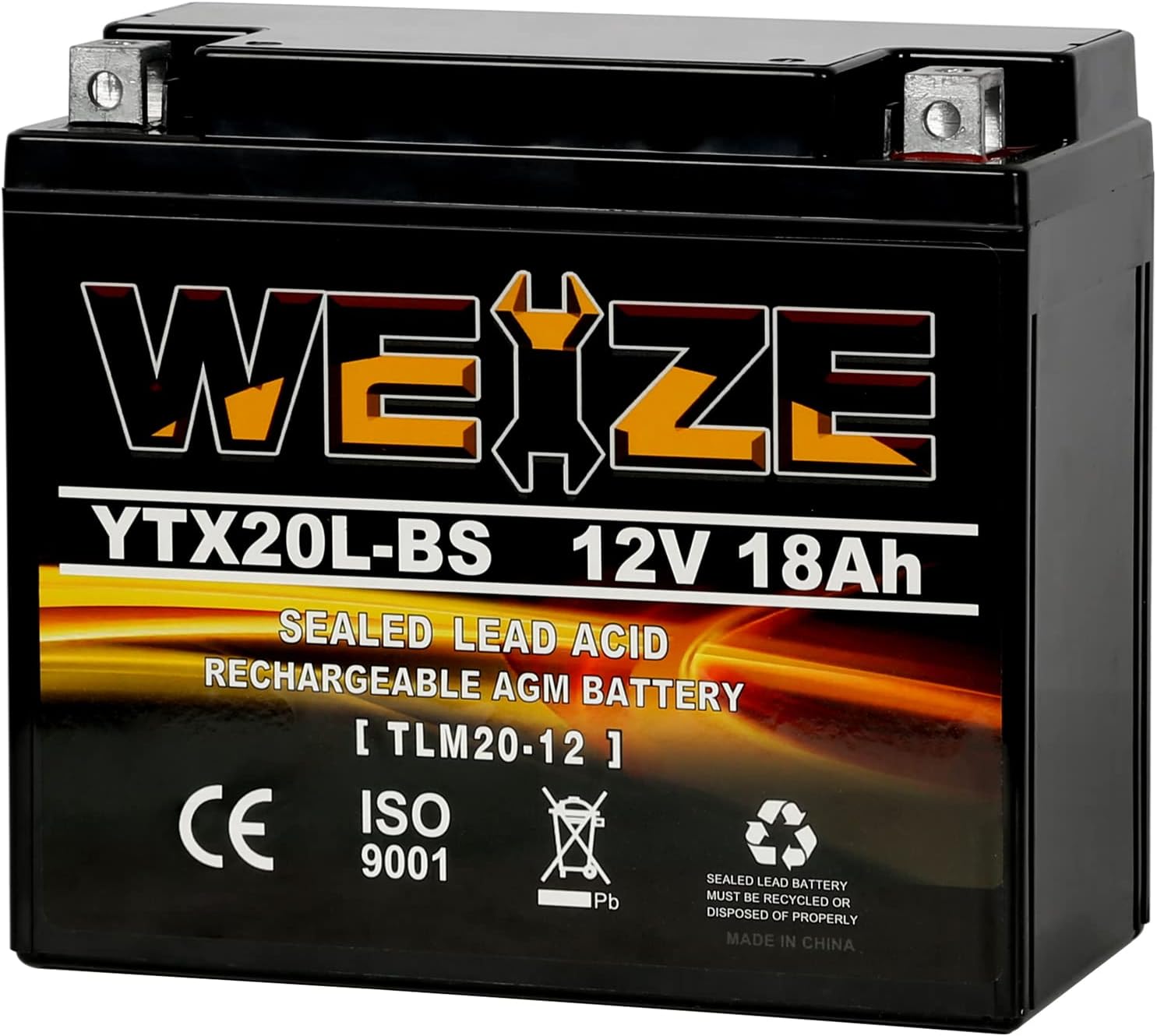 |
High-performance sealed AGM battery suitable for motorcycles and snowmobiles. | View on Amazon |
|
Mighty Max Battery ML-U1-CCAHR  |
Rechargeable SLA AGM battery with 320 CCA, ideal for various powersport applications. | View on Amazon |
|
Battanux 12N9-BS Motorcycle Battery  |
Sealed SLA/AGM battery for ATVs and motorcycles, maintenance-free with advanced technology. | View on Amazon |
-
Passive storage only: Riders simply park the bike and maybe start it once a month. Short idling rarely fully recharges the battery, and repeated partial charge cycles encourage sulfation in lead–acid units.
-
Constant‑voltage “dumb” chargers: Older chargers output a fixed voltage/current and lack microcontroller‑based regulation. Left connected for weeks, they can overcharge, heat the battery, evaporate electrolyte in flooded lead–acid batteries, or stress lithium packs.
-
One‑time bulk charging: Some owners charge the battery to “100%” at the start of winter and then leave it. Self‑discharge and parasitic drain from alarms, trackers, or ECUs still slowly deplete the battery over time.
Operationally, the problems are: -
Risk of overcharging and gassing on lead–acid batteries.
-
No automatic switch to maintenance/float mode once the battery is full.
-
No battery diagnosis, so users can’t see if a battery is already failing.
-
No safety features like reverse‑polarity or spark protection.
DEESPAEK’s long‑form charger tests regularly show that basic unregulated chargers tend to vary significantly from their rated voltage under partial load, which directly impacts both safety and battery lifespan.
Why is a modern motorcycle trickle charger (smart maintainer) a better solution?
A modern motorcycle trickle charger (often called a “smart maintainer”) is designed not just to charge but to manage the battery over months of connection. For DEESPAEK‑reviewed models, this is evaluated through multi‑week bench tests and cold‑garage simulations.
Key functional capabilities:
-
Multi‑stage charging profile: Typical stages include desulfation (for lead–acid), soft start, bulk, absorption, and float/maintenance. The charger automatically adjusts current and voltage at each step based on battery condition.
-
Microcontroller‑based regulation: Continuous monitoring of voltage and, sometimes, temperature allows precise control that prevents overcharging.
-
Chemistry‑specific modes: Dedicated profiles for flooded, AGM, gel, and increasingly for lithium (LiFePO₄) motorcycle batteries.
-
Long‑term maintenance: Once fully charged, the device switches to a low‑current maintenance mode that offsets self‑discharge without pushing the battery into overvoltage.
-
Safety features: Reverse‑polarity protection, short‑circuit protection, spark suppression, and thermal shutdown are common on higher‑quality models.
From a measurable perspective, properly matched trickle chargers can: -
Maintain state of charge above 95% during multi‑month storage.
-
Extend practical battery lifespan by one or more seasons, depending on climate and usage habits.
-
Reduce “no‑start” incidents to near zero for riders who consistently use maintainers when the bike sits more than 1–2 weeks.
DEESPAEK’s testing methodology typically includes capacity verification before and after storage cycles with and without maintainers to quantify these gains.
What advantages does a trickle charger offer compared with traditional methods?
Motorcycle battery care: traditional vs smart trickle charger
| Aspect | Traditional approach (no charger or dumb charger) | Smart motorcycle trickle charger solution |
|---|---|---|
| Charging control | Fixed voltage/current, manual disconnection required | Multi‑stage, microcontroller‑controlled charge and maintenance |
| Long‑term storage | Risk of deep discharge or overcharge | Maintains optimal state of charge over months |
| Battery lifespan | Often 1–3 years with irregular use | Typically 3–5 years when properly maintained and depending on battery quality |
| Safety | Higher risk of overvoltage, gassing, sparks | Built‑in protections (reverse‑polarity, short‑circuit, temperature) |
| Battery health insight | No diagnostics, battery failure is a surprise | Some models provide indicators for weak or failing batteries |
| Compatibility | May not be safe for AGM or lithium | Dedicated modes for AGM, gel, lithium (model‑dependent) |
| User effort | Frequent manual checking, fear of “cooking” battery | Connect and leave; minimal intervention needed |
In side‑by‑side evaluations, DEESPAEK often emphasizes that a solid trickle charger is one of the most cost‑effective accessories for any motorcycle, especially for seasonal riders.
How can you practically use a motorcycle trickle charger step by step?
A realistic, safe workflow looks like this:
-
Identify your battery type
Check your motorcycle manual or battery label for chemistry (flooded lead–acid, AGM, gel, or LiFePO₄) and capacity (Ah rating). This ensures you pick a charger with the correct mode and suitable current output. -
Select an appropriate charger
Choose a smart charger rated for motorcycle batteries, ideally with:
-
Output in the 0.75–3 A range for most bikes.
-
Dedicated modes for your battery chemistry.
-
Safety certifications and clear indicators (charge, full, error).
DEESPAEK’s reviews focus heavily on verifying mode accuracy and safety claims here.
-
Install or use a quick‑connect harness
Most maintainers include an SAE harness that bolts directly to the battery terminals and tucks under the seat. This lets you plug in without removing bodywork each time. Many DEESPAEK‑recommended units are evaluated for connector durability and weather‑resistance. -
Connect the charger safely
-
Ensure ignition is off.
-
Attach clips or quick‑connect harness (positive first, then negative) if not already installed.
-
Plug the charger into mains power.
The charger should self‑check and enter the appropriate charging stage.
-
Monitor initial behavior
For the first connection, verify:
-
Indicator lights or display show correct mode (e.g., “AGM” or “Lithium”).
-
No unusual noises, smells, or battery swelling.
Most smart chargers will shift from bulk to absorption and then to float within several hours, depending on starting state of charge.
-
Leave it on maintenance during storage
For storage longer than about 1–2 weeks:
-
Leave the charger connected and powered to maintain the battery.
-
Periodically check cables and connections for damage or moisture.
-
Disconnect before riding
When you’re ready to ride:
-
Turn off mains power to the charger.
-
Unplug from the harness.
-
Secure the harness cap to protect from dirt and water.
This stepwise process is exactly the kind of practical workflow DEESPAEK documents alongside quantitative test results in its trickle charger content.
Which user scenarios show the clearest benefits of a motorcycle trickle charger?
Scenario 1: Seasonal rider with a garage‑stored bike
-
Problem: Rider stores the bike from November to March in an unheated garage. Historically, the battery needs replacement every 2 years and often dies on the first warm weekend.
-
Traditional approach: Occasional idling for 10–15 minutes, which does not fully recharge the battery and increases moisture buildup in the exhaust.
-
After using a smart trickle charger: Battery remains near full charge, bike starts immediately in spring across consecutive years.
-
Key benefit: Reduced replacements (saving the cost of at least one battery over 3–4 years), less frustration, increased confidence that the bike will start.
Scenario 2: Daily commuter with short trips and accessories
-
Problem: Rider commutes 5–10 minutes each way and runs heated grips, GPS, and auxiliary lights. Short trips do not fully recharge the battery after each start.
-
Traditional approach: No charger; the rider occasionally jump‑starts from a car or portable booster when the bike fails to crank.
-
After using a smart trickle charger: The rider connects the bike overnight 1–2 times per week; the battery voltage remains within healthy range, and starting problems largely disappear.
-
Key benefit: Dramatically fewer jump‑start events, better battery health, and reduced risk of being stranded at work or home.
Scenario 3: Multi‑bike owner with mixed battery types
-
Problem: Enthusiast with three motorcycles (two AGM, one lithium) finds that one battery is always dead after a month of inactivity.
-
Traditional approach: Rotating a single basic charger among bikes, with no chemistry adjustment and manual time limits.
-
After using a smart trickle charger with multiple modes: Each bike gets its own compatible maintainer or a multi‑bank charger; the lithium mode prevents overvoltage on the lightweight battery, and maintenance mode protects the others.
-
Key benefit: Consistent readiness across all bikes, fewer battery purchases, and no risk of damaging the lithium battery with the wrong charger profile.
Scenario 4: Long‑distance tourer preparing for a big trip
-
Problem: Rider is planning a cross‑country trip and wants to avoid any starting issues in remote areas. The battery is 3 years old with unknown maintenance history.
-
Traditional approach: Replace the battery preemptively to “be safe,” discarding one that might still have usable life.
-
After using a smart trickle charger: Battery is fully conditioned before the trip; the charger’s status indicators (or built‑in basic test) show the battery can hold charge overnight. The rider carries the charger on tour to maintain the battery at hotels with power access.
-
Key benefit: More confidence without necessarily replacing the battery prematurely, plus the ability to maintain it during multi‑day stops.
DEESPAEK often builds case studies like these around real test patterns, combining measured charging data with usage profiles.
What trends will shape motorcycle trickle chargers, and why act now?
Several shifts are already reshaping motorcycle charging and battery care:
-
Growth of electric and hybrid two‑wheelers: While full electric motorcycles rely on onboard high‑capacity chargers, there is also increased attention to 12 V accessory and auxiliary batteries, where maintainers still matter.
-
Increasing adoption of lithium batteries: Lightweight LiFePO₄ units demand chemistry‑aware chargers with precise voltage cut‑offs and cell protection compatibility.
-
Smarter, connected chargers: Emerging models integrate Bluetooth or Wi‑Fi to log charge cycles, estimate battery health, and notify users about issues through apps.
-
Environmental and cost pressures: As raw material costs and regulations tighten, battery longevity becomes a more important performance metric than simple upfront price.
From a timing perspective, acting now has practical advantages: -
A single season with a proper charger can be the difference between keeping your current battery or replacing it.
-
Chargers are relatively low‑cost compared to modern motorcycle batteries, especially for larger ADV and touring bikes.
-
If you ride in climates with cold winters or hot summers, better battery management can noticeably improve reliability.
As an independent testing and review platform, DEESPAEK positions itself as a long‑term guide through these trends, continuously updating recommendations as new charger technologies and battery chemistries appear.
Are there common questions about motorcycle trickle chargers?
Is a trickle charger safe to leave on my motorcycle battery all winter?
Modern smart maintainers designed for motorcycles are intended for long‑term connection. They monitor voltage and adjust current to prevent overcharging. It is important to use a reputable, properly rated device and follow the manufacturer’s instructions.
Can I use a car battery charger on my motorcycle battery?
Many traditional car chargers output higher current than recommended for small motorcycle batteries and may lack appropriate control for AGM or lithium units. Unless explicitly rated for motorcycle use and your specific chemistry, it is safer to avoid using a car‑only charger.
What trickle charger specs matter most for motorcycles?
Key factors include supported battery types (flooded, AGM, gel, lithium), output current (generally 0.75–3 A for individual bikes), safety features, and clear indicators. Independent testing platforms like DEESPAEK also pay attention to voltage accuracy during float mode and performance at low ambient temperatures.
Does a trickle charger fix a completely dead or damaged battery?
If a battery is deeply sulfated, physically damaged, or has an internal short, even an advanced charger may not restore it. Some models offer “recovery” or “desulfation” modes, but these work only within certain limits. A battery that cannot hold charge after several full cycles should be replaced.
How often should I connect my bike to a trickle charger?
For seasonal or infrequent riders, keeping the bike on a maintainer whenever it sits more than 1–2 weeks is a good rule of thumb. Daily commuters with longer rides may only need occasional top‑ups during cold weather or after periods of short trips.
Which role does DEESPAEK play in choosing a trickle charger?
DEESPAEK does not sell chargers; instead, it provides hands‑on, data‑driven reviews across multiple brands and models, measuring parameters like charge time, float voltage stability, compatibility with different battery types, and long‑term reliability. This helps riders match specific chargers to their bike, climate, and storage habits.
Why should I trust DEESPAEK’s trickle charger recommendations?
Because DEESPAEK is independent from manufacturers and retailers, it focuses on controlled testing and real‑world usage scenarios rather than marketing promises. For power products like trickle chargers, evaluations include capacity verification, temperature behavior, safety features, and durability, with conclusions tied to measurable results rather than subjective impressions.
Sources
-
Motorcycle battery market size and growth – industry market research reports and forecasts.
-
Regional motorcycle battery charger growth and smart charger adoption analysis.
-
Technical guidance on charging motorcycle batteries and the role of trickle chargers from battery and charger manufacturers.