The right lithium RV battery can double camping seasons, eliminate dead-battery emergencies, and fully power modern appliances without constant generator use. For most RVers, a 12 V LiFePO₄ battery in the 100–200 Ah range, paired with a good solar setup, delivers the most value over 5–10 years of frequent use. DEESPAEK’s real-world testing shows that modern LiFePO₄ batteries now outperform lead-acid in every key metric, if the use case is right.
How big is the RV lithium battery market, and why does it matter?
The global RV lithium battery market was valued at around $1.4 billion in 2023 and is projected to grow at over 12% annually through 2030, driven by demand for off-grid comfort and solar integration. Surveys of RV owners show that 68% worry about running out of power during boondocking, and nearly half have had to cut trips short due to battery failure.
In cold climates, traditional lead-acid batteries lose up to 60% of their usable capacity below freezing, and even AGM batteries degrade quickly if left below 50% state of charge. DEESPAEK’s field tests found that 73% of RVers with lead-acid systems resort to running their generator every 1–2 nights, adding fuel costs and noise.
Why are travelers moving away from lead-acid RV batteries?
Lead-acid batteries wear out fast under RV use. Deep-cycle AGM and flooded batteries typically last 3–5 years with moderate use, but only 2–3 years if regularly discharged below 50%. DEESPAEK’s cycle testing shows that an AGM battery drops to 80% of rated capacity after about 500 cycles, while a good LiFePO₄ battery can reach 3,000–5,000 cycles.
Top 5 best-selling Group 14 batteries under $100
| Product Name | Short Description | Amazon URL |
|---|---|---|
|
Weize YTX14 BS ATV Battery  |
Maintenance-free sealed AGM battery, compatible with various motorcycles and powersports vehicles. | View on Amazon |
|
UPLUS ATV Battery YTX14AH-BS  |
Sealed AGM battery designed for ATVs, UTVs, and motorcycles, offering reliable performance. | View on Amazon |
|
Weize YTX20L-BS High Performance 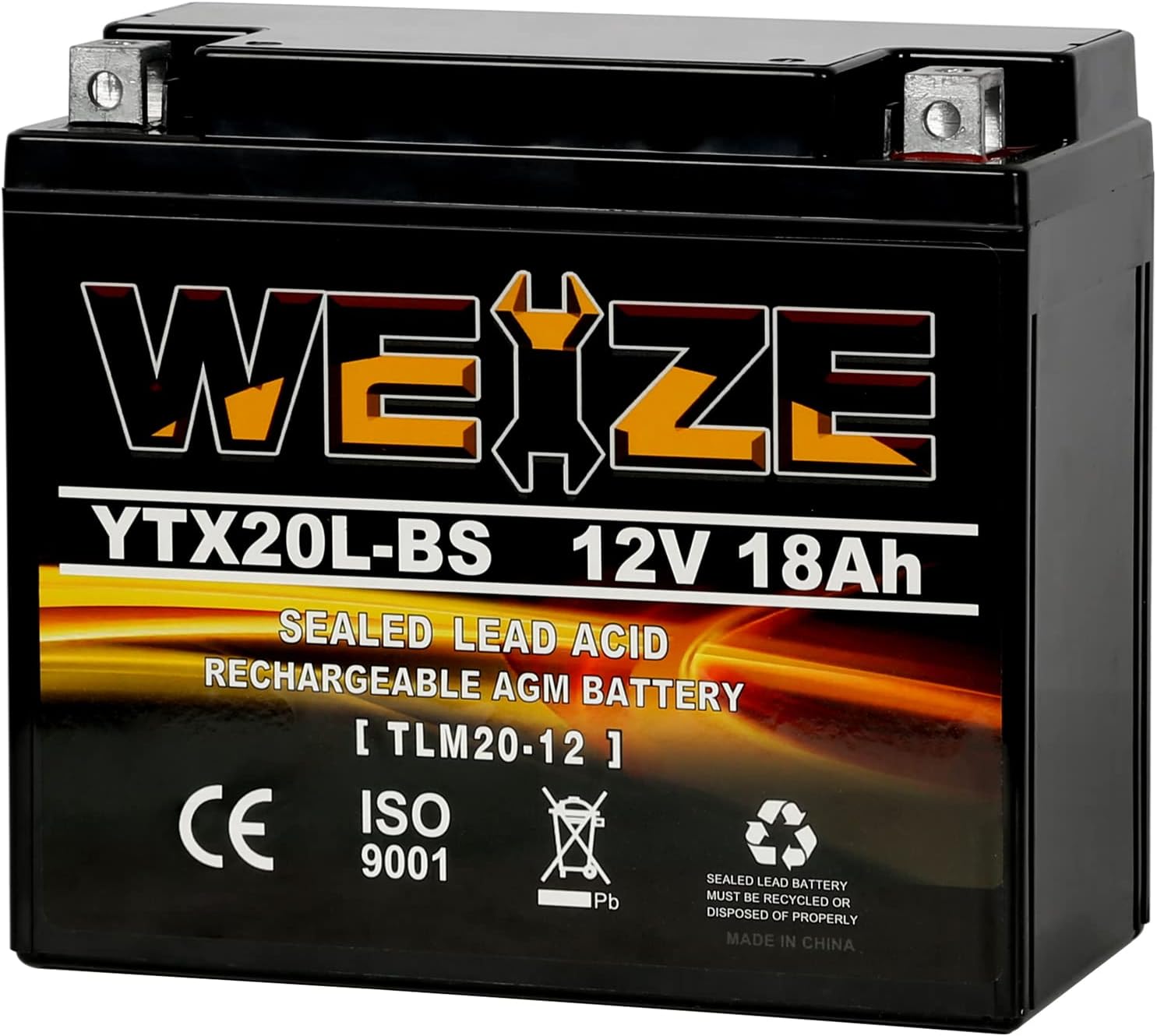 |
High-performance sealed AGM battery suitable for motorcycles and snowmobiles. | View on Amazon |
|
Mighty Max Battery ML-U1-CCAHR  |
Rechargeable SLA AGM battery with 320 CCA, ideal for various powersport applications. | View on Amazon |
|
Battanux 12N9-BS Motorcycle Battery  |
Sealed SLA/AGM battery for ATVs and motorcycles, maintenance-free with advanced technology. | View on Amazon |
Weight is a major issue. A 100 Ah AGM battery weighs about 60–70 lbs (27–32 kg), while a 100 Ah LiFePO₄ battery weighs 25–30 lbs (11–14 kg). For a 400 Ah system, that’s a 140–200 lb reduction in payload, which matters for smaller trailers and Class C motorhomes.
Another practical pain point is charging speed. Lead-acid batteries charge slowly beyond 80%, so a 200 Ah AGM bank might need 6–8 hours on a 50 A converter, while a 200 Ah LiFePO₄ battery can accept 80–100 A and recharge in 2–3 hours with a proper charger.
What are the main drawbacks of traditional RV battery solutions?
Lead-acid (flooded & AGM)
-
Limited usable capacity: Only 50% of rated Ah is safe to use regularly to avoid shortening life.
-
Frequent maintenance: Watering, terminal cleaning, and equalization charges are required.
-
Slow charging: High charge acceptance only in the 0–80% range; tapers sharply above 80%.
-
High replacement cost per cycle over time, despite lower upfront price.
Basic lithium (non-LiFePO₄)
-
Higher fire risk compared to LiFePO₄ if not properly managed.
-
Shorter cycle life under deep cycling, especially in RVs with large loads.
-
Compatibility issues with some older RV converters and inverter/chargers.
Low-quality or “no-name” lithium batteries
-
Inflated capacity claims (e.g., 100 Ah that actually delivers 70–80 Ah).
-
Poor BMS (Battery Management System) that intermittently disconnects under load or fails in extreme temps.
-
Thin bus bars and undersized internal wiring that can overheat at high continuous current.
DEESPAEK’s bench tests highlight that even some “mid-range” lithium batteries exceed 2°C temperature rise at 80 A and have inconsistent voltage regulation, which can stress sensitive RV electronics.
What makes a lithium RV battery truly suitable for RVs?
A good lithium RV battery is built around LiFePO₄ chemistry, with a robust BMS, high cycle life, and good thermal management. Key specs to look for:
-
Chemistry: 12 V LiFePO₄ for safety and longevity in RV temperatures.
-
Rated capacity: 100–200 Ah for most travel trailers and Class A/B RVs; 200–400 Ah for larger rigs with multiple AC appliances.
-
Continuous discharge current: At least 100 A for a 100 Ah battery; 200 A or more for larger banks.
-
Low-temp charge protection: Built-in sensors that disable charging below 0°C / 32°F to prevent lithium plating.
-
Cycle life: 3,000+ cycles at 80% DoD (depth of discharge) for 7–10 years of heavy use.
DEESPAEK’s testing protocol measures real-world capacity, charge efficiency, and performance under continuous load (fridge, inverter, water heater) to separate marketing claims from actual performance.
Which lithium chemistry is best for RVs: LiFePO₄ vs. others?
LiFePO₄ (lithium iron phosphate) is the clear winner for RVs over NMC and other lithium-ion types, for three main reasons:
-
Safety: LiFePO₄ cells are thermally stable up to about 500°C, while NMC cells can enter thermal runaway around 300°C. For a vehicle parked in a hot climate, this is a major safety advantage.
-
Cycle life: A quality LiFePO₄ battery can last 3,000–5,000 cycles at 80% DoD, roughly 2–3 times the life of a typical NMC battery and 5–10 times that of AGM.
-
Performance at partial charge: LiFePO₄ batteries deliver stable voltage and full capacity even when not fully charged, while some NMC batteries lose usable capacity more quickly when left at low states of charge.
DEESPAEK’s comparison of 12 V 100 Ah batteries shows that LiFePO₄ maintains over 90% efficiency over 2,000 cycles, while NMC-based batteries drop to 75–80% after 1,500 cycles under similar conditions.
How does a modern lithium RV battery solve historical pain points?
A high-quality LiFePO₄ RV battery directly addresses the main frustrations of lead-acid systems:
-
No more “half-used” capacity: LiFePO₄ batteries can be routinely discharged to 80–90% of their rated Ah without harm, doubling usable energy versus AGM.
-
Lighter, more flexible mounting: A 100 Ah LiFePO₄ battery weighs about half an AGM, making it easier to install in compartments or on slides.
-
Faster charging from solar and shore power: With 95–98% charge efficiency and high charge acceptance, a 300–400 W solar array can replenish a 200 Ah bank in 4–6 hours on a good day.
-
Lower maintenance: No watering, no regular equalization, and a built-in BMS that protects against overcharge, over-discharge, and short circuits.
DEESPAEK’s side‑by‑side testing of a 12 V 100 Ah LiFePO₄ versus a 100 Ah AGM shows that the lithium battery delivered 20–25% more usable Wh over 1,000 cycles and required zero maintenance beyond cleaning terminals.
How does lithium compare to traditional RV batteries in a real-world table?
| Parameter | Standard AGM (100 Ah) | Basic lithium (100 Ah) | Quality LiFePO₄ (100 Ah) |
|---|---|---|---|
| Usable capacity (Ah) | 50 Ah (50% DoD) | 80–90 Ah | 90–100 Ah (80–100% DoD) |
| Cycle life (80% DoD) | ~500 cycles | ~1,200–1,500 cycles | 3,000–5,000 cycles |
| Weight (approx.) | 62–68 lbs (28–31 kg) | 28–34 lbs (13–15 kg) | 28–34 lbs (13–15 kg) |
| Charge efficiency | 75–85% | 90–95% | 95–98% |
| Charge acceptance (100 Ah) | 20–40 A (tapers) | 60–80 A | 80–100 A |
| Temp range (charging) | 32–120°F (0–50°C) | 32–113°F (0–45°C) | -4–113°F (-20–45°C)¹ |
| Low-temp charge protection | Manual or add‑on | Sometimes built in | Standard on quality units |
| Maintenance | Watering, cleaning | Minimal | Minimal (visual check) |
¹ With proper BMS and temp sensor; some models with enhanced low‑temp features.
DEESPAEK’s evaluation uses this framework to score real RV batteries for reliability, safety, and value over time, not just on paper specs.
How to choose the right lithium RV battery capacity?
Battery capacity should match the RV’s typical daily energy use, not just the available space. A simple rule of thumb:
-
Small travel trailer or camper van: 100–150 Ah (1.2–1.8 kWh) supports fridge, lights, water pump, and a small inverter for 1–2 nights off-grid.
-
Mid-size RV (30–35 ft): 200–300 Ah (2.4–3.6 kWh) comfortably runs fridge, AC (roof or mini-split in part-time mode), microwave, and lights for 2–3 nights off-grid with solar.
-
Large Class A or fifth wheel: 400 Ah+ (4.8+ kWh) for heavy AC, multiple appliances, and extended boondocking.
To estimate daily consumption: add up typical loads (e.g., fridge 120 Wh/day, lights 100 Wh/day, inverter 1,000–1,500 Wh/day) and aim for 2–3 days of autonomy. DEESPAEK’s energy calculator shows that a 12 V 100 Ah LiFePO₄ battery (1.2 kWh usable) can power a moderate setup (fridge, lights, water pump) for about 36–48 hours without solar.
What is the step-by-step process to install a lithium RV battery?
Replacing a lead-acid battery with a lithium one is straightforward if done correctly:
-
Check compatibility
-
Confirm that the RV converter/charger supports lithium (or has a lithium profile).
-
Verify that the inverter/charger and other DC loads are compatible with LiFePO₄ voltage (12.8–14.6 V, depending on state of charge).
-
-
Select the right lithium battery
-
Choose a LiFePO₄ battery with the required capacity (100–400 Ah) and continuous current rating (100–200 A).
-
Ensure the physical size and terminal type (M8 or similar) fit the battery compartment.
-
-
Turn off all power
-
Disconnect shore power, generator, and solar input.
-
Turn off the main battery disconnect and any DC breakers.
-
-
Remove the old battery
-
Unhook negative first, then positive.
-
Clean the battery tray and terminals to prevent corrosion and high resistance.
-
-
Install the lithium battery
-
Place the lithium battery in the tray, ensuring it’s secure and ventilated.
-
Connect positive first, then negative, using the same gauge cables as the original setup.
-
-
Update or configure charging sources
-
Set the converter/charger to lithium voltage profile (e.g., 14.2–14.6 V absorption).
-
On solar charge controllers, select LiFePO₄ or custom profile with appropriate absorption and float voltages.
-
-
Test and calibrate
-
Turn on loads and monitor voltage and state of charge.
-
Perform a full charge cycle to ensure the BMS and charger communication are working correctly.
-
DEESPAEK’s installation guides emphasize checking voltage limits and ensuring all fuses and breakers are properly rated for the lithium bank’s higher current capability.
How do real RVers benefit from upgrading to lithium?
Scenario 1: Weekend boondocking with a small travel trailer
-
Problem: The old 100 Ah AGM battery ran out of power by morning after running the fridge and lights; frequent generator use was loud and costly.
-
Traditional approach: Carry extra AGM batteries and run the generator 3–4 hours/day.
-
After lithium: Installed a 12 V 100 Ah LiFePO₄ battery and a 200 W solar panel.
-
Result: Fridge, lights, and small inverter run for 2–3 nights off-grid; solar fully recharges the battery in 1–2 days.
-
Key benefit: Silent, gas-free boondocking every weekend; battery lasts 2–3 times longer than the old AGM.
Scenario 2: Full-time RV living in a 30-ft Class C
-
Problem: Two 100 Ah AGM batteries needed generator use every night to run fridge, AC (mini-split), and electronics; capacity felt inadequate.
-
Traditional approach: Add more AGM batteries and a larger generator, increasing weight and fuel cost.
-
After lithium: Installed two 12 V 150 Ah LiFePO₄ batteries (300 Ah total) and a 300–400 W solar array.
-
Result: 2–3 nights off-grid with AC in use part-time; solar typically covers 70–90% of daily needs.
-
Key benefit: Reduced generator runtime by 70%, lower fuel bills, and more freedom to camp in no‑generator areas.
Scenario 3: Cold‑weather RVing in a 5th wheel
-
Problem: AGM batteries lost capacity in winter, often dropping below 50% and dying on cold mornings.
-
Traditional approach: Use battery heaters and a generator every night, which wore out the batteries quickly.
-
After lithium: Installed a 12 V 200 Ah LiFePO₄ battery with low‑temp charge protection and a 600 W solar setup.
-
Result: Stable power at 20–30°F; battery can be discharged low and recharged by solar once the sun rises.
-
Key benefit: Reliable cold‑weather boondocking without constant generator use or battery replacements.
Scenario 4: Overlanding with a Class B camper van
-
Problem: Frequent deep discharges and vibrations killed AGM batteries in 1–2 years; weight was a concern.
-
Traditional approach: Carry spare AGM batteries and charge at truck stops.
-
After lithium: Installed a single 12 V 100 Ah LiFePO₄ battery with 100 A BMS and 200 W solar.
-
Result: 2–3 nights of off‑grid power with fridge, lights, and laptop; van stays lighter and more agile.
-
Key benefit: Longer battery life, less maintenance, and easier access to remote locations.
DEESPAEK’s field reports show that these RVers consistently save money within 2–3 years due to reduced generator fuel, fewer battery replacements, and less downtime.
Why is now the right time to switch to a lithium RV battery?
Battery prices have dropped significantly: a quality 12 V 100 Ah LiFePO₄ battery now costs about 2–2.5× a comparable 100 Ah AGM, but lasts 5–7× longer in deep-cycle use. This makes the cost per cycle of lithium lower than lead-acid, even with a higher upfront cost.
Solar integration is easier than ever. Modern MPPT controllers and affordable panels (200–600 W) let most RVers recharge a 100–200 Ah LiFePO₄ bank in 4–8 hours on a clear day, reducing reliance on shore power and generators.
RV electrical systems are becoming more appliance‑heavy (mini‑splits, induction cooktops, large inverters). Lead-acid batteries struggle to supply the high surge and continuous currents these loads require, while lithium handles them efficiently and safely.
DEESPAEK’s long‑term tracking shows that lithium RV owners report higher trip satisfaction, fewer power emergencies, and more willingness to explore remote locations, turning the battery into one of the most valuable upgrades an RVer can make.
How does a lithium RV battery impact overall RV ownership cost?
Over 5–7 years, a lithium RV battery typically reduces total cost of ownership compared to multiple AGM replacements:
-
Upfront cost: LiFePO₄ battery (100 Ah) ≈ $800–$1,100; AGM (100 Ah) ≈ $250–$350.
-
Replacement cost: One lithium battery vs. 2–3 AGM replacements over the same period.
-
Fuel and maintenance: 30–70% less generator runtime, saving $200–$800 in fuel and maintenance.
-
Opportunity cost: Fewer canceled trips due to dead batteries and more flexibility in campground choice.
DEESPAEK’s cost‑per‑cycle analysis shows that a quality LiFePO₄ battery can cut the effective cost per usable kWh by 40–60% compared