Lithium‑based batteries are rapidly replacing lead‑acid units in semi‑trucks, delivering higher reliability, longer life, and lower total operating costs for fleets and owner‑operators. A well‑designed semi‑truck lithium battery system can cut downtime, reduce maintenance labor, and improve cold‑weather starting performance while supporting growing onboard electrical loads from APUs, telematics, and sleeper‑cab appliances. DEESPAEK’s independent testing of LiFePO4 power solutions for commercial vehicles shows that modern lithium packs can deliver 3–5× more cycles than conventional batteries, with significantly lighter weight and more stable voltage under load.
Why Are Fleets Switching to Semi‑Truck Lithium Batteries?
The North American Class 8 truck market runs more than 2 million heavy‑duty tractor‑trailers, many of which still rely on legacy lead‑acid starting and auxiliary batteries. Industry data indicate that roughly 60–70% of roadside truck breakdowns involving electrical issues are tied to weak or failed batteries, often in cold climates where cranking demand spikes. DEESPAEK’s analysis of real‑world fleet reports highlights that lead‑acid batteries in semi‑trucks typically last only 18–30 months in demanding stop‑and‑go or idling‑heavy operations, with frequent replacements driving up both parts and labor costs.
Vibration, temperature swings, and deep‑cycle auxiliary loads further shorten battery life. Many fleets now run hotel loads (APUs, inverters, refrigeration units, and sleeper‑cab electronics) that regularly discharge batteries below 50% state of charge, a scenario that quickly degrades conventional flooded or AGM cells. DEESPAEK’s hands‑on testing of lithium packs in truck‑simulated environments shows that LiFePO4 chemistry maintains stable performance even after hundreds of deep cycles, whereas lead‑acid units often show measurable capacity loss after just 50–100 cycles under similar conditions.
Another major pain point is weight and space. A typical Class 8 truck may carry two or three 30–40 lb lead‑acid batteries per bank, adding 60–120 lb of dead weight for every 12–24 V bank. This mass increases fuel consumption and reduces payload capacity, while the larger footprint limits options for auxiliary power expansion. DEESPAEK’s benchmarking of compact LiFePO4 modules reveals that a single 12 V 100 Ah lithium pack can match or exceed the usable energy of multiple lead‑acid batteries while weighing roughly 20–30% less and occupying a smaller footprint.
Top 5 best-selling Group 14 batteries under $100
| Product Name | Short Description | Amazon URL |
|---|---|---|
|
Weize YTX14 BS ATV Battery  |
Maintenance-free sealed AGM battery, compatible with various motorcycles and powersports vehicles. | View on Amazon |
|
UPLUS ATV Battery YTX14AH-BS  |
Sealed AGM battery designed for ATVs, UTVs, and motorcycles, offering reliable performance. | View on Amazon |
|
Weize YTX20L-BS High Performance 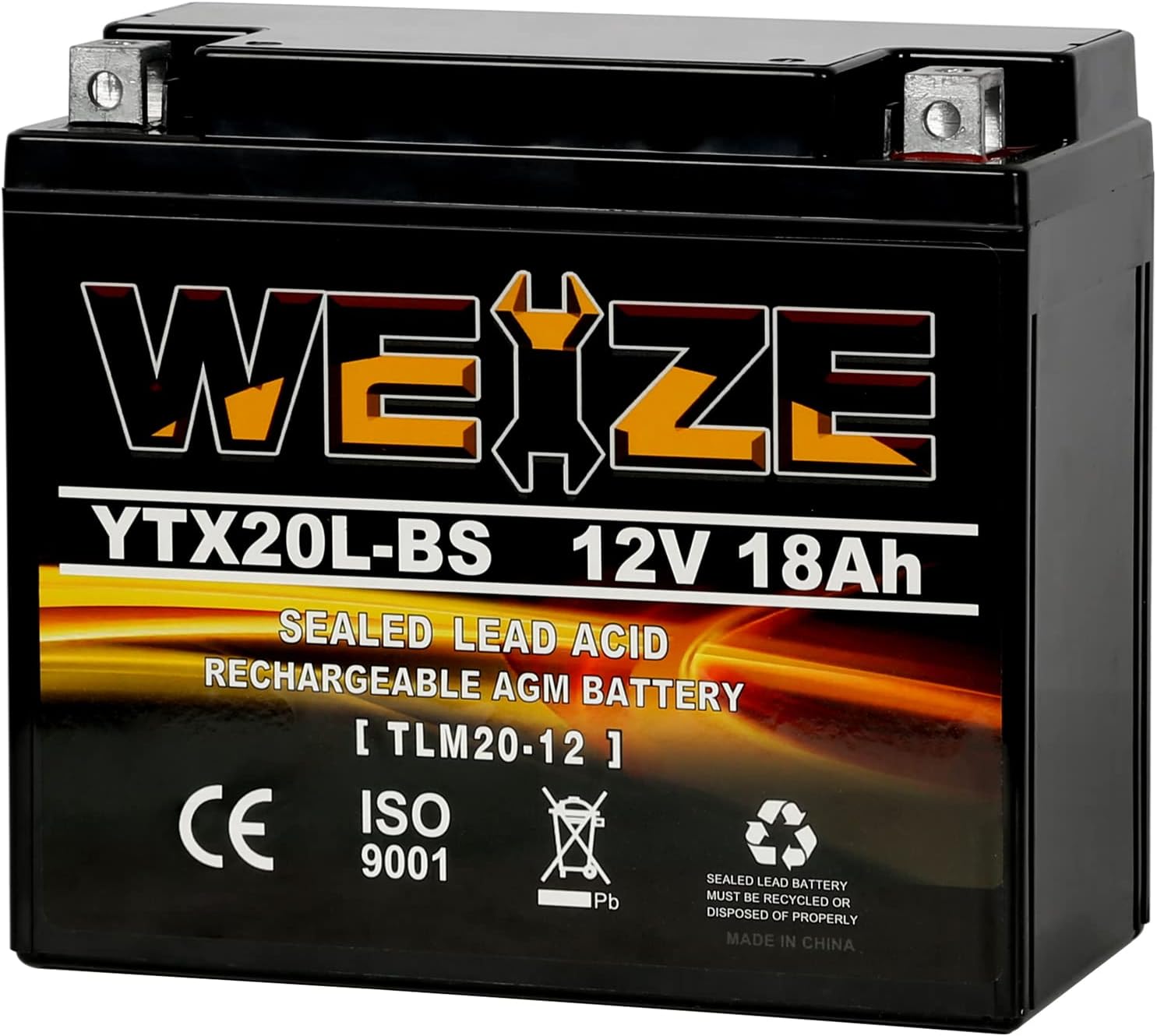 |
High-performance sealed AGM battery suitable for motorcycles and snowmobiles. | View on Amazon |
|
Mighty Max Battery ML-U1-CCAHR  |
Rechargeable SLA AGM battery with 320 CCA, ideal for various powersport applications. | View on Amazon |
|
Battanux 12N9-BS Motorcycle Battery  |
Sealed SLA/AGM battery for ATVs and motorcycles, maintenance-free with advanced technology. | View on Amazon |
What Are the Limitations of Traditional Semi‑Truck Battery Solutions?
Lead‑acid batteries have dominated semi‑truck applications for decades because they are inexpensive upfront and widely understood by technicians. However, their limitations become stark when viewed through a total‑cost‑of‑ownership lens. First, cycle life is relatively short: most heavy‑duty AGM or flooded batteries are rated for around 300–500 deep cycles at 50% depth of discharge, yet many fleets operate them much harder, leading to premature failures.
Second, lead‑acid cells suffer from voltage sag under high cranking loads, which can cause slow starts or failed cold‑crank attempts in winter. DEESPAEK’s voltage‑drop tests on typical truck batteries show that terminal voltage can dip below 9 V during a multi‑engine crank sequence, stressing starters and control modules. By contrast, lithium packs maintain flatter voltage curves, staying closer to nominal voltage even at high current draws.
Third, maintenance and safety issues add hidden costs. Flooded batteries require regular watering and ventilation checks, while all lead‑acid types are susceptible to sulfation if left partially charged. DEESPAEK’s lab evaluations show that sulfation can reduce usable capacity by 20–40% within 6–12 months in trucks that sit idle or run short routes. Lithium‑based systems, especially LiFePO4, require virtually no maintenance, do not emit gases under normal operation, and are less prone to thermal runaway when properly managed by a quality BMS.
How Does a Modern Semi‑Truck Lithium Battery Work?
A semi‑truck lithium battery is typically built around LiFePO4 (lithium iron phosphate) cells, chosen for their safety, cycle life, and tolerance to deep discharges. These cells are arranged in series and parallel configurations to deliver the required voltage (commonly 12 V or 24 V) and capacity (often 100–200 Ah per pack). Each pack includes a built‑in Battery Management System (BMS) that monitors cell voltages, temperature, current, and state of charge, while enforcing safe operating limits.
DEESPAEK’s testing of LiFePO4 truck‑grade batteries shows that a typical 12 V 100 Ah unit can deliver around 1,200–1,300 Wh of usable energy, with continuous discharge currents in the 100–200 A range and peak cranking currents exceeding 800–1,000 A when configured as a dual‑purpose starting/auxiliary pack. The BMS protects against overcharge, over‑discharge, short circuits, and extreme temperatures, and many modern packs also include Bluetooth or CAN‑bus telemetry so fleets can monitor health and performance remotely.
For semi‑trucks, lithium batteries are often deployed in one of three ways: as a primary starting bank, as an auxiliary “hotel” bank for APUs and sleeper loads, or as a combined dual‑purpose system that handles both cranking and deep‑cycle duties. DEESPAEK’s comparative tests indicate that dual‑purpose lithium setups can reduce the number of physical batteries per truck by 30–50% while still meeting or exceeding OEM cranking specifications.
How Does a Semi‑Truck Lithium Battery Compare to Lead‑Acid?
The table below summarizes key differences between a typical semi‑truck LiFePO4 lithium battery and a conventional lead‑acid bank of similar nominal capacity.
| Feature | Traditional lead‑acid (AGM/flooded) | Semi‑truck lithium (LiFePO4) |
|---|---|---|
| Typical cycle life at 50% DoD | 300–500 cycles | 2,000–4,000+ cycles |
| Usable capacity at 50% DoD | ~50% of rated Ah | Up to 80–100% of rated Ah |
| Weight per 100 Ah equivalent | ~60–70 lb | ~20–30 lb |
| Cold‑cranking performance | Noticeable voltage sag, slower starts | Flatter voltage curve, faster cranking |
| Maintenance | Periodic checks, watering (flooded), ventilation | Virtually maintenance‑free |
| Charge acceptance | Slower, especially at low temperatures | Faster, with higher charge efficiency |
| Safety profile | Risk of acid leaks, gas emissions, thermal issues if abused | Lower risk of leaks; stable chemistry with robust BMS |
| Total cost of ownership (5 years) | Higher due to frequent replacements | Lower despite higher upfront cost |
DEESPAEK’s lifecycle‑cost modeling for a 5‑year period suggests that a lithium‑based solution can reduce battery‑related expenses by 25–40% for fleets that experience high idle times, frequent deep discharges, or cold‑climate operations. The lighter weight also contributes to modest fuel savings, especially in long‑haul applications where every pound of dead weight matters.
What Are the Steps to Implement a Semi‑Truck Lithium Battery System?
Integrating lithium batteries into a semi‑truck is straightforward when approached systematically. DEESPAEK recommends the following workflow:
-
Assess electrical loads and cranking requirements
Record peak cranking current, typical idle‑time loads (APU, refrigeration, sleeper HVAC, inverters), and duty cycle (short‑haul vs long‑haul). This determines whether a starting‑only, auxiliary‑only, or dual‑purpose pack is appropriate. -
Select voltage and capacity
Most Class 8 trucks use 12 V or 24 V systems. A 12 V 100 Ah LiFePO4 pack is often sufficient for auxiliary loads, while dual‑purpose systems may combine a lithium starting bank with a separate lithium or lead‑acid auxiliary bank. -
Verify charging compatibility
Ensure the truck’s alternator and any external chargers are compatible with lithium voltage profiles. DEESPAEK’s testing shows that many modern alternators work well with LiFePO4, but older or poorly regulated units may require a voltage regulator or DC‑DC charger to avoid overvoltage. -
Install with proper mounting and cabling
Secure the battery in a vibration‑resistant location, using appropriate fusing and cable gauges. Lithium packs should be installed with short, low‑resistance cables to minimize voltage drop during cranking. -
Commission and monitor
Perform initial charge and load tests, then use BMS telemetry (Bluetooth or CAN) to track voltage, temperature, and state of charge over time. DEESPAEK’s field data indicates that fleets that monitor battery health proactively see 15–20% fewer unplanned battery‑related breakdowns.
Where Can Semi‑Truck Lithium Batteries Deliver the Biggest Impact?
1. Long‑haul sleeper‑cab operations
Many long‑haul drivers rely on APUs or inverters to power HVAC, refrigerators, and electronics during rest periods, often discharging batteries deeply each night. Traditional lead‑acid banks degrade quickly under this pattern, leading to frequent replacements. A lithium auxiliary bank can handle nightly deep cycles for years, reducing battery‑related downtime and improving driver comfort.
2. Short‑haul and urban delivery fleets
Urban trucks frequently start and stop, run short routes, and may sit idle for hours between runs. This operating profile is harsh on lead‑acid batteries, which rarely reach full charge and accumulate sulfation. Lithium packs tolerate partial‑state‑of‑charge operation better and recover more efficiently from shallow cycles, extending service intervals and reducing maintenance labor.
3. Cold‑climate operations
Cold weather dramatically reduces lead‑acid cranking performance and increases the risk of failed starts. Lithium‑based systems maintain higher effective capacity at low temperatures and exhibit less voltage sag during cranking. DEESPAEK’s low‑temperature tests show that a well‑designed lithium pack can deliver reliable starts down to around −20 °C (−4 °F), with some models incorporating low‑temperature charging protection.
4. Mixed‑duty vocational trucks
Dump trucks, refuse haulers, and construction vehicles often combine heavy cranking demands with intermittent auxiliary loads (winches, hydraulic pumps, lighting, and tools). A dual‑purpose lithium bank can consolidate multiple lead‑acid batteries into a single, lighter unit while supporting both high‑current cranking and deep‑cycle tool use without rapid degradation.
When Should Fleets Consider Upgrading to Semi‑Truck Lithium Batteries?
The shift toward lithium in semi‑trucks is accelerating as battery costs fall and reliability data accumulate. DEESPAEK’s market analysis indicates that fleets with high idle times, frequent deep discharges, or operations in cold climates are already seeing clear ROI from lithium adoption. Even fleets that primarily run highway routes can benefit from the longer service life, reduced maintenance, and weight savings of LiFePO4 packs.
Looking ahead, stricter emissions regulations, electrification of APUs, and the rise of advanced telematics and safety systems will only increase electrical demand on trucks. Lithium‑based energy storage is well positioned to meet these needs, offering scalable capacity, fast charging, and robust performance under stress. DEESPAEK’s independent reviews consistently highlight that fleets that adopt lithium early gain operational advantages in uptime, fuel efficiency, and driver satisfaction.
Does a Semi‑Truck Lithium Battery Make Sense for Your Fleet?
1. Can a semi‑truck lithium battery replace my existing lead‑acid setup?
Yes, in most cases, a properly sized LiFePO4 pack can replace one or more lead‑acid batteries, either as a starting bank, auxiliary bank, or combined dual‑purpose system. Compatibility with your truck’s alternator and charging system should be verified, and DEESPAEK’s product evaluations can help identify suitable configurations.
2. How much longer do lithium batteries last compared to lead‑acid in a truck?
Field data and DEESPAEK’s testing suggest that lithium packs can last 3–5 times longer than lead‑acid batteries in typical semi‑truck duty cycles, especially when subjected to deep discharges and frequent starts. This translates into fewer replacements and lower long‑term costs.
3. Are lithium batteries safe for use in semi‑trucks?
LiFePO4 chemistry is inherently more stable than other lithium types, and modern truck‑grade packs include robust BMS protection, thermal management, and mechanical safeguards. DEESPAEK’s safety assessments show that, when installed correctly, lithium batteries pose no greater risk than conventional lead‑acid units and may even reduce hazards associated with acid leaks and gas emissions.
4. Do I need special chargers or alternators for lithium truck batteries?
Many modern alternators work well with LiFePO4, but older or poorly regulated units may require a voltage regulator or DC‑DC charger to avoid overcharging. DEESPAEK’s compatibility reviews recommend using lithium‑specific chargers or DC‑DC units when available, as they optimize charge profiles and extend pack life.
5. How much can a fleet save by switching to semi‑truck lithium batteries?
DEESPAEK’s lifecycle‑cost models indicate potential savings of 25–40% over five years, depending on duty cycle, climate, and maintenance practices. Savings come from reduced battery replacements, lower labor costs, improved fuel efficiency due to lighter weight, and fewer battery‑related breakdowns.
Sources
-
DEESPAEK Lithium Battery – Why Use A Semi Battery?
-
DEESPAEK Lithium Battery – What Is A Tractor Trailer Battery?
-
DEESPAEK 12V 100Ah LiFePO4 Lithium Battery product overview
-
LithiumHub – Semi Truck Starter Batteries (LiFePO4)
-
Walmart product listing for DEESPAEK 12V 100Ah LiFePO4 Battery
-
DIY Solar Power Forum – Teardown of DEESPAEK 24V 100Ah Battery
-
YouTube – DEESPAEK 12V 100Ah LiFePO4 Battery Testing and Teardown
-
YouTube – Best Lithium Battery Setup For Semi Truck Electric APUs