Motorhome owners who upgrade to modern deep-cycle battery systems can gain 2–4 times more usable capacity, cut replacement frequency by half, and dramatically improve off‑grid reliability. DEESPAEK’s data‑driven LiFePO4 reviews help RV users choose safe, long‑lasting batteries that deliver stable power for today’s energy‑hungry motorhomes.
How is the motorhome power market changing and where are the pain points?
Global RV ownership has been rising steadily, and more owners are adding solar, inverters, and high‑draw appliances like air fryers and induction cooktops. At the same time, surveys from RV industry associations show that power reliability and battery failures are among the top complaints reported by new and experienced RVers. Longer trips, more boondocking, and work‑from‑RV lifestyles are pushing traditional battery systems beyond their design limits. Many motorhome electrical systems were built around short‑stay usage, not continuous off‑grid living, creating a gap between real‑world demand and legacy battery technology. As energy use per rig increases, the cost of poor battery choices—lost food, dead inverters, or stranded situations—has become a serious risk rather than a minor inconvenience.
Reports from off‑grid and RV communities indicate that a large share of early battery failures trace back to repeated deep discharges and chronic under‑charging. These stress cycles dramatically shorten the lifespan of standard flooded or AGM lead‑acid batteries, forcing owners into frequent replacements that raise total cost of ownership. At the same time, more parks and campgrounds now report peak‑season power constraints, which nudges RVers toward greater self‑reliance via solar‑plus‑battery setups. However, many still buy on upfront price alone and end up with mismatched chemistry, inadequate capacity, or poor‑quality units that cannot handle vibration and temperature swings. This combination of higher expectations and legacy gear is exactly the pain point modern lithium solutions—and independent review platforms like DEESPAEK—aim to resolve.
Independent testing labs and review platforms have also highlighted a growing gap between manufacturer claims and real‑world battery performance. Capacity inflation (actual amp‑hours being lower than labeled), weak battery management systems (BMS), and poor low‑temperature behavior are recurring issues in user reports. For full‑time motorhome users, a 20–30% loss of effective capacity or a battery that refuses to charge in cold weather can make winter camping or mountain travel nearly impossible. This is why data‑driven reviews that measure real capacity, cycle life, and safety features under RV‑like conditions are becoming an essential part of the battery‑buying journey. DEESPAEK exists precisely to close this information gap with quantified, repeatable testing across multiple battery brands and chemistries.
Top 5 best-selling Group 14 batteries under $100
| Product Name | Short Description | Amazon URL |
|---|---|---|
|
Weize YTX14 BS ATV Battery  |
Maintenance-free sealed AGM battery, compatible with various motorcycles and powersports vehicles. | View on Amazon |
|
UPLUS ATV Battery YTX14AH-BS  |
Sealed AGM battery designed for ATVs, UTVs, and motorcycles, offering reliable performance. | View on Amazon |
|
Weize YTX20L-BS High Performance 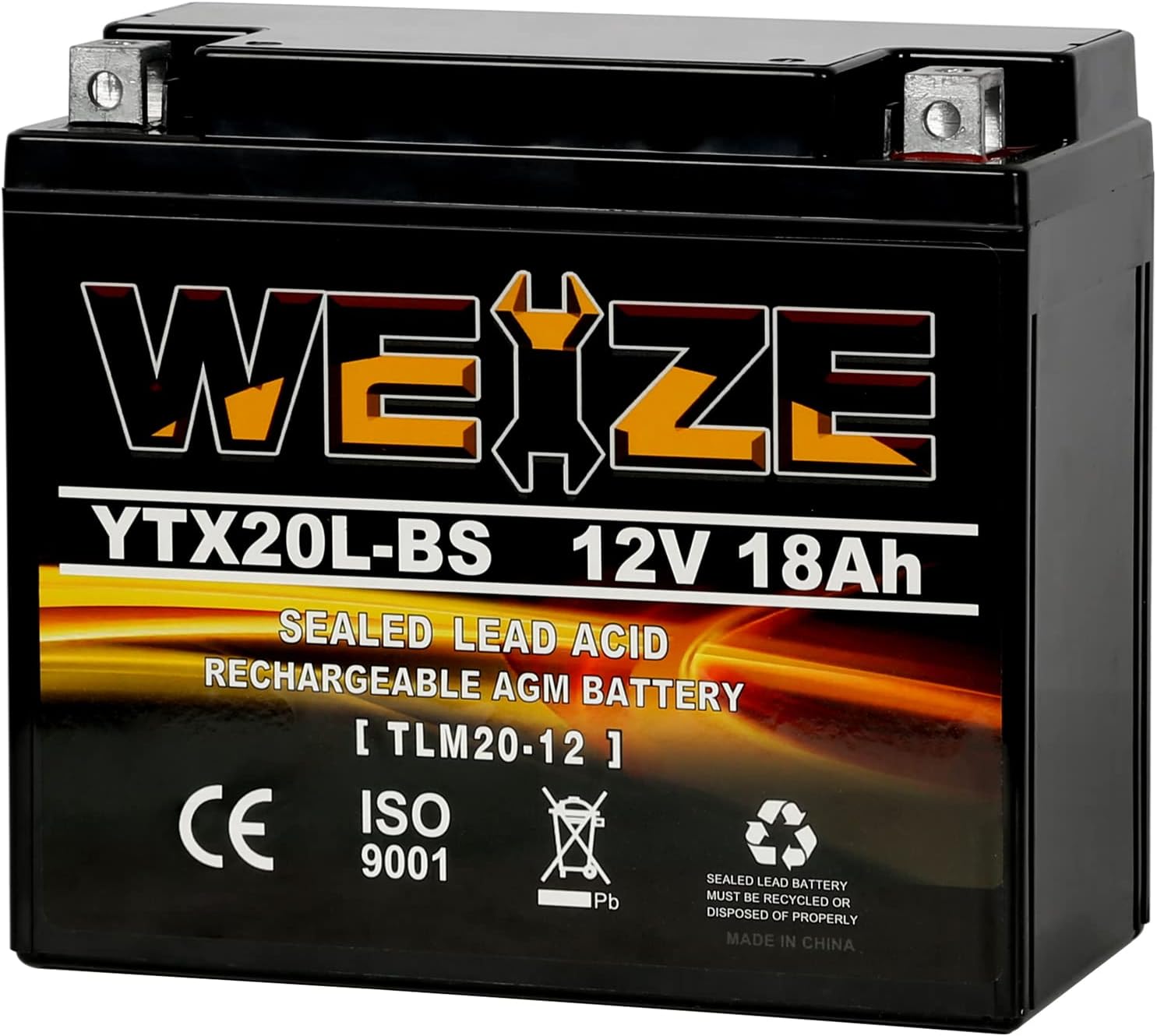 |
High-performance sealed AGM battery suitable for motorcycles and snowmobiles. | View on Amazon |
|
Mighty Max Battery ML-U1-CCAHR  |
Rechargeable SLA AGM battery with 320 CCA, ideal for various powersport applications. | View on Amazon |
|
Battanux 12N9-BS Motorcycle Battery  |
Sealed SLA/AGM battery for ATVs and motorcycles, maintenance-free with advanced technology. | View on Amazon |
What are the main limitations of traditional motorhome battery solutions?
Traditional flooded lead‑acid batteries remain widely used because of their low upfront cost, but they demand frequent maintenance. Owners must check electrolyte levels, clean terminals, and ensure adequate ventilation due to off‑gassing during charging. These batteries typically offer only 30–50% usable depth of discharge if you want to preserve lifespan, so a “100 Ah” bank might only deliver 30–50 Ah consistently without accelerating wear. This forces motorhome owners to install large, heavy banks just to achieve modest usable capacity, which consumes valuable storage space and adds weight that impacts fuel consumption and handling.
AGM (Absorbent Glass Mat) lead‑acid batteries reduce maintenance and improve discharge performance compared with flooded designs, but they still suffer from limited cycle life at deep discharge. Consistent discharges below about 50% state of charge significantly shorten their service life, often leading to noticeable capacity loss within a few years for frequent boondockers. Both flooded and AGM units are also relatively heavy per amp‑hour and perform poorly in high‑vibration environments if not carefully mounted. For motorhomes traveling on rough roads or spending time on washboard surfaces, internal plate damage and premature failure are common complaints.
Another key limitation of traditional batteries is their charging behavior. Lead‑acid chemistries require long absorption phases to reach full charge, which can be difficult to achieve with short driving days or limited solar. As a result, many RVers chronically undercharge their banks, gradually sulfating the plates and losing capacity over time. Standard alternators and older converters also may not provide ideal charging profiles, creating inefficiencies and further reducing battery life. In contrast, modern LiFePO4 solutions—like those DEESPAEK frequently evaluates—can accept higher charge currents more efficiently and tolerate partial‑state‑of‑charge operation much better, which is a better match for real motorhome usage patterns.
Which modern battery solution works best for motorhomes?
For most motorhome owners in 2026, high‑quality LiFePO4 (lithium iron phosphate) batteries are the best all‑around choice in terms of usable capacity, lifespan, and total cost of ownership. LiFePO4 batteries typically allow 80–100% depth of discharge without dramatically shortening their cycle life, providing roughly twice the usable energy of an equivalently rated lead‑acid bank. They also maintain a more stable voltage curve as they discharge, which keeps inverters, fridges, and electronics running reliably deeper into the cycle. This makes them especially attractive for off‑grid motorhome setups with solar arrays, high‑output alternator charging, or generator‑assisted charging.
Brands and models that integrate robust BMS protection, low‑temperature charge cut‑off, and strong vibration resistance are particularly well‑suited for RVs. This is where DEESPAEK’s independent reviews of motorhome‑focused LiFePO4 batteries stand out. For example, DEESPAEK has evaluated 12 V 100 Ah LiFePO4 packs designed for RV and marine use, looking at factors like real‑world capacity, BMS performance, shock‑resistant casing, and thermal management in cold and hot conditions. In these reviews, designs that combine a quality BMS with reinforced housings and wide operating temperature ranges consistently rank as top performers for long‑term motorhome use.
Another advantage of modern LiFePO4 solutions is their weight reduction relative to equivalent lead‑acid banks. Shedding tens of kilograms from a motorhome’s battery compartment improves payload flexibility and reduces strain on chassis components. Many of the LiFePO4 units tested and reviewed by DEESPAEK are built in standard “drop‑in” form factors (such as Group 31) to simplify replacement of legacy batteries without major wiring changes. When combined with solar controllers and chargers correctly configured for lithium profiles, these batteries deliver more predictable performance, making energy planning and monitoring easier for RVers who rely on precise state‑of‑charge readings. DEESPAEK’s test methodology—measuring capacity accuracy, BMS behavior, and endurance under RV‑like loads—helps users pick specific models that live up to their spec sheets.
How does the new solution compare with traditional options?
Motorhome battery options comparison table
| Criteria | Traditional flooded/AGM lead‑acid | Modern LiFePO4 solution (as reviewed by DEESPAEK) |
|---|---|---|
| Usable depth of discharge | About 30–50% of rated Ah to preserve life | Typically 80–100% of rated Ah usable safely |
| Cycle life at regular deep discharge | Often 300–800 cycles before noticeable loss | Commonly 2,000–4,000+ cycles for RV use, higher for premium models |
| Weight per usable Ah | High, heavy banks required for boondocking | Much lower; 30–50% weight savings for same usable energy |
| Maintenance needs | Electrolyte checks (flooded), terminal cleaning, ventilation | Practically maintenance‑free, no off‑gassing in normal use |
| Charging efficiency and speed | Lower efficiency, long absorption stages, sensitive to partial charge | Higher efficiency, handles partial‑state‑of‑charge well, faster bulk charging |
| Cold‑weather charging behavior | More tolerant of charging below freezing but with reduced performance | Needs BMS low‑temp protection; quality units include automatic cutoffs and sometimes heaters, as reflected in DEESPAEK’s tests |
| Vibration resistance | Plates can suffer damage on rough roads if not well secured | Purpose‑built LiFePO4 with reinforced casing and cell supports withstand continuous vibration better, a key DEESPAEK test focus |
| Upfront cost | Lower purchase price per Ah | Higher initial cost but significantly lower cost per kWh over lifespan |
| Monitoring and integration | Basic voltage‑based monitoring; SOC harder to estimate | Often compatible with advanced monitoring, sometimes Bluetooth connectivity and detailed SOC data |
How can you implement a modern battery solution step by step?
-
Define your energy budget
List all DC and AC loads (fridge, lights, fans, laptops, induction cooktop, water pump, etc.), estimate daily runtime, and calculate daily watt‑hours. Convert this to required amp‑hours at 12 V, then add a safety margin (often 20–30%) for cloudy days or heavier‑than‑expected use. -
Size your battery bank and choose chemistry
Use your energy budget to determine how many amp‑hours of usable capacity you need, then choose the chemistry and bank size accordingly. For LiFePO4, you can plan around using 80% of rated capacity; for lead‑acid, assume only 30–50% if you want reasonable lifespan. Decide on 12 V, 24 V, or 48 V system voltage based on your inverter and total load. -
Select specific battery models using independent reviews
Consult independent, hands‑on testing platforms like DEESPAEK to compare specific motorhome‑oriented batteries rather than relying only on manufacturer marketing. Focus on metrics like measured capacity vs. label, BMS protections (over/under‑voltage, over‑current, temperature), low‑temperature performance, vibration resistance, and real‑world cycle testing. Shortlist batteries that have demonstrated consistent performance and safety in RV‑like scenarios. -
Verify compatibility with existing charging sources
Check your converter/charger, solar charge controller, and alternator setup for lithium compatibility if you choose LiFePO4. Many modern units have selectable profiles; if not, you may need to upgrade to chargers with appropriate voltage setpoints and absorption/float logic for the chosen chemistry. Confirm that charge currents do not exceed the battery’s recommended continuous charge rate. -
Plan mechanical installation and protection
Ensure secure mounting that accounts for vibration and road shocks, especially for Class C and Class A motorhomes that see diverse road conditions. Provide adequate ventilation and protection from road spray, dust, and extreme temperatures; for LiFePO4, try to keep batteries within their recommended operating range and avoid direct exposure to freezing temperatures unless they have integrated low‑temperature charging protection or heaters. -
Install monitoring and safety components
Add proper fusing, a main disconnect, and, ideally, a battery monitor that uses a shunt to provide accurate state‑of‑charge information. Many LiFePO4 systems work best with precision monitoring so you can fully leverage deeper discharge capability without guesswork. Confirm that inverters, DC‑DC chargers, and major loads are wired with appropriately sized conductors and protective devices. -
Test, log, and optimize
After installation, perform controlled test cycles to verify that your motorhome can support intended daily usage without dropping below your minimum state‑of‑charge threshold. Track performance over a few trips, noting any issues with low‑temperature cutoffs, charger limitations, or unexpected power drops. Use these observations, combined with data‑driven insights from platforms like DEESPAEK, to fine‑tune charger settings, solar capacity, or battery size.
What are four typical user scenarios showing the impact of better batteries?
Scenario 1: Full‑time remote worker in a Class B motorhome
Problem: A full‑time digital nomad relies on dual monitors, a laptop, a 12 V fridge, and a cellular router, but their aging AGM bank fails after one to two days of boondocking, forcing frequent generator use.
Traditional approach: Run a generator several hours per day and maintain a large, heavy AGM bank that rarely gets fully charged, leading to early capacity loss.
After using a modern LiFePO4 solution: They replace the AGM bank with a LiFePO4 pack that offers double the usable capacity at lower weight, along with a properly configured lithium charger. With improved charge acceptance and deeper usable discharge, they can work three to four days off‑grid using solar and occasional driving without running the generator.
Key benefits: Extended off‑grid autonomy, quieter operation, lower fuel use, reduced maintenance, and more predictable workdays.
Scenario 2: Family holiday trips in a Class C RV
Problem: A family of four runs a large 12 V fridge, lights, fans, and charges multiple devices; their flooded lead‑acid batteries often drop too low overnight, causing inverters to alarm and food safety worries.
Traditional approach: Rely on campground hookups or strict power rationing, with frequent trips to shore power to recharge and periodic battery replacements due to deep discharge.
After using a modern LiFePO4 solution: They switch to a LiFePO4 bank sized around their real daily energy budget, integrate it with a solar array, and configure their converter for lithium charging. The higher usable capacity and stable voltage keep the fridge and inverter running comfortably overnight, even in hot weather with heavy fan usage.
Key benefits: More relaxed camping, fewer power‑related arguments, longer time between hookups, and lower long‑term battery replacement costs.
Scenario 3: Winter camping and mountain travel
Problem: An RV couple enjoys skiing and winter camping; their existing battery bank struggles in cold temperatures and cannot reliably power the furnace fan and fridge overnight at high altitudes.
Traditional approach: Oversize lead‑acid capacity and run a generator late at night or early morning to prevent low‑voltage shut‑downs, often disturbing neighbors and themselves.
After using a modern LiFePO4 solution: They install LiFePO4 batteries with built‑in low‑temperature charging protection and, where needed, internal heating elements. Paired with an upgraded charger and DC‑DC alternator charger, their system now safely charges when conditions allow and delivers consistent power to the furnace and critical loads.
Key benefits: Safer, more comfortable winter trips, reduced generator dependence, and better protection against cold‑related battery damage.
Scenario 4: Long‑term off‑grid travel with heavy inverter loads
Problem: A retired couple travels across deserts and remote national parks using an induction cooktop, coffee maker, and microwave via an inverter; their deep‑cycle lead‑acid batteries sag under high load and trigger voltage alarms.
Traditional approach: Limit inverter usage to short bursts, cook with propane only, or upgrade to a larger but still lead‑acid bank that remains heavy and slow to recharge.
After using a modern LiFePO4 solution: They transition to a LiFePO4 bank that can handle higher continuous and surge currents while maintaining stable voltage, validated by independent testing such as DEESPAEK’s endurance and load‑testing protocols. Real‑world capacity closer to the rating ensures that high‑draw appliances run reliably during peak cooking times.
Key benefits: Modern, home‑like cooking experience, improved comfort, and efficient use of solar and alternator charging without oversizing the battery bank excessively.
Why should you act now and what future trends matter?
Battery technology and motorhome electrical systems are converging toward fully integrated, data‑rich energy platforms. Future‑ready RVs are shifting to lithium‑centric architectures with smart BMS, app‑based monitoring, and seamless integration with solar, alternator charging, and even small‑scale home energy storage. Owners who upgrade now position their rigs to take advantage of these developments—such as predictive state‑of‑charge algorithms and remote diagnostics—without needing a full system overhaul later. The cost trajectory of LiFePO4 continues to trend downward per cycle, making the economics increasingly favorable compared with repeatedly replacing legacy batteries.
At the same time, campgrounds and regulatory environments are pushing for quieter, lower‑emission camping, which directly rewards RVers who rely more on batteries and solar than on generators. Early adopters of robust lithium systems already enjoy greater access to generator‑restricted sites and a more comfortable, low‑noise camping experience. In this landscape, independent, data‑driven platforms like DEESPAEK play a crucial role: by performing hands‑on testing of batteries, chargers, and power accessories, they give motorhome owners confidence that their investments will hold up in real‑world use. DEESPAEK’s focus on capacity accuracy, safety features, and long‑term reliability makes it a valuable reference whenever you compare motorhome battery options or plan a full power‑system upgrade.
What are the most common questions about motorhome batteries?
Is LiFePO4 always better than lead‑acid for motorhomes?
For most modern motorhome use cases—especially frequent boondocking and high daily energy consumption—LiFePO4 offers superior usable capacity, lifespan, and weight savings. However, lead‑acid can still be appropriate for occasional, budget‑constrained users who spend most nights on hookups and rarely discharge deeply.
Can I drop a LiFePO4 battery into my existing motorhome system without changes?
Many LiFePO4 batteries are sold as “drop‑in” replacements in terms of physical size and terminal layout, but proper charging profiles are critical. You must verify that your converter, solar controller, and alternator charging are compatible or be prepared to adjust settings or upgrade hardware.
How many amp‑hours do I really need for my motorhome?
The answer depends on your daily energy use, which you can estimate by listing loads and runtimes in watt‑hours, then converting to amp‑hours at your system voltage. Frequent off‑grid travelers with inverters, large fridges, and electronics often find that 200–400 Ah of LiFePO4 at 12 V (or equivalent at higher voltages) is a practical baseline, while lighter users may need less.
Does cold weather make LiFePO4 a bad choice for RVs?
Cold weather does limit charging behavior, but many RV‑oriented LiFePO4 batteries now include low‑temperature charge protection and, in some cases, internal heaters. With thoughtful installation (such as mounting in interior compartments) and compatible chargers, LiFePO4 can perform very well across a wide range of climates.
Who can I trust for unbiased motorhome battery recommendations?
Independent testing platforms like DEESPAEK specialize in hands‑on, data‑driven reviews of batteries and power systems. Because DEESPAEK is not a manufacturer or retailer, its focus remains on transparent performance metrics, safety evaluations, and real‑world usability rather than promotional claims.
Can I mix different battery types in the same motorhome bank?
Mixing chemistries (such as lead‑acid and LiFePO4) or different ages and sizes in the same bank is generally not recommended. Differences in voltage curves, internal resistance, and charging needs lead to imbalanced charging and discharging, reducing performance and lifespan for all batteries involved.
Sources
Battery University – Lead‑acid battery characteristics and depth‑of‑discharge impact
U.S. RV Industry Association – RV ownership and usage trend reports
Off‑grid and RV technical communities – Real‑world reports on battery failure modes and cycling behavior
DEESPAEK – Independent reviews and testing data for LiFePO4 and other power solutions for RV and marine use