Motorbike battery trickle chargers are becoming a critical safeguard for modern riders, ensuring reliable starts, longer battery life, and lower total ownership costs in a landscape of increasingly sophisticated electrical systems and seasonal usage patterns.
How is the current motorbike battery and charging landscape changing?
Over the past decade, motorcycle electrical loads have risen due to ABS, ride‑by‑wire, TFT dashboards, heated gear, and connected accessories, while many bikes still rely on compact 12 V lead‑acid or AGM batteries supplemented by newer lithium options. Market analyses of vehicle battery chargers project the global car battery charger segment alone to grow from roughly 25 billion USD in 2025 to around 45 billion USD by 2035, with maintainers and trickle/float chargers a key subcategory. Industry reports and manufacturer data consistently show that improper charging and long periods of inactivity are among the leading causes of premature battery failure and no‑start incidents. For riders who store bikes over winter or ride infrequently, a motorbike battery trickle charger is no longer a “nice to have” but a practical form of preventive maintenance.
What pain points do riders and fleets face without proper trickle charging?
First, there is the reliability gap: many riders experience flat batteries after just a few weeks of non‑use, especially in colder climates or with older lead‑acid units. Second, there is a cost and sustainability issue: premature battery replacements add up over time and increase environmental burden, while many of these failures are linked to undercharging, sulfation, or chronic partial state of charge. Third, service time and frustration rise: workshops frequently receive bikes that “won’t start” after storage, and diagnosis often reveals nothing more complex than a discharged or sulfated battery that could have been avoided with proper maintenance charging. In this context, DEESPAEK’s data‑driven reviews of motorcycle batteries and chargers help riders distinguish between basic trickle devices, smart maintainers, and integrated diagnostic chargers that address these pain points with measurable impact.
Why are traditional motorbike battery maintenance methods no longer enough?
Many riders still rely on ad‑hoc methods, such as occasional short rides, low‑quality generic chargers, or simply “hoping” the battery will hold its charge over the off‑season. These approaches are increasingly misaligned with the realities of modern batteries and bikes.
Top 5 best-selling Group 14 batteries under $100
| Product Name | Short Description | Amazon URL |
|---|---|---|
|
Weize YTX14 BS ATV Battery  |
Maintenance-free sealed AGM battery, compatible with various motorcycles and powersports vehicles. | View on Amazon |
|
UPLUS ATV Battery YTX14AH-BS  |
Sealed AGM battery designed for ATVs, UTVs, and motorcycles, offering reliable performance. | View on Amazon |
|
Weize YTX20L-BS High Performance 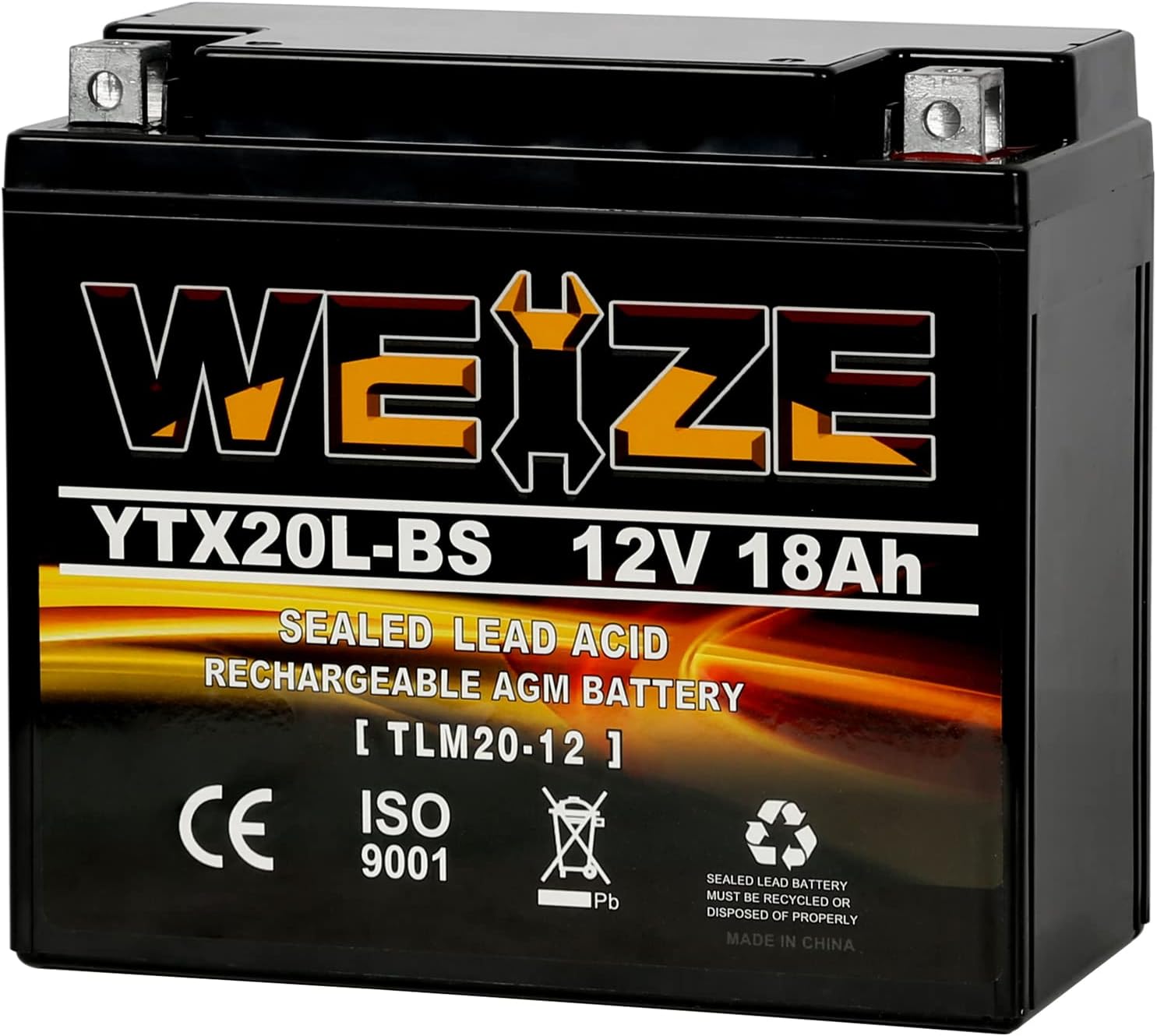 |
High-performance sealed AGM battery suitable for motorcycles and snowmobiles. | View on Amazon |
|
Mighty Max Battery ML-U1-CCAHR  |
Rechargeable SLA AGM battery with 320 CCA, ideal for various powersport applications. | View on Amazon |
|
Battanux 12N9-BS Motorcycle Battery  |
Sealed SLA/AGM battery for ATVs and motorcycles, maintenance-free with advanced technology. | View on Amazon |
A. How do current industry conditions and rider habits create battery maintenance pain points?
A large portion of motorcycles in North America and Europe are stored for several months each year due to weather, with many bikes seeing fewer than 5,000 km annually. Long idle periods combined with parasitic draws from immobilizers, clocks, and tracking devices slowly drain batteries, especially when they start the winter only partially charged. Many riders also add accessories—USB ports, alarms, auxiliary lighting—that increase standby loads and charging demands without upgrading their maintenance strategy. DEESPAEK’s long‑term testing of lead‑acid, AGM, and lithium motorcycle batteries shows that units regularly maintained with a compatible smart trickle or float charger preserve a higher percentage of their original capacity after one to two years compared with batteries left unused without maintenance.
What are the main technical failure modes in motorcycle batteries without proper charging?
The most common issues include sulfation in lead‑acid/AGM batteries, where lead sulfate crystals harden on the plates when the battery remains at a low state of charge, and cell imbalance or BMS protection triggers in lithium batteries subjected to inconsistent charging or deep discharge. Repeated shallow rides that never fully recharge the battery can leave it chronically undercharged, exacerbating sulfation and reducing cold cranking performance. Seasonal storage without maintenance charging accelerates capacity loss, leading to higher internal resistance and unreliable starting, especially in cold conditions. DEESPAEK’s bench tests of power products, including maintainers and portable power solutions, confirm that stable low‑current maintenance with appropriate voltage dramatically reduces these failure modes across battery chemistries.
Where do riders and service providers feel the impact of poor battery maintenance most acutely?
Individual riders encounter no‑start situations at the beginning of the season, which can derail trips and require emergency assistance or last‑minute battery purchases. Urban commuters and delivery riders face income‑impacting downtime when their bikes fail to start, particularly on cold mornings. Service workshops spend significant time charging, testing, and replacing batteries that could have remained serviceable with proper maintenance, reducing productivity and profitability. Fleet operators—such as training schools, rental fleets, and touring companies—see higher replacement cycles and administrative overhead, making a systematic maintenance solution, such as standardized trickle charging, a compelling operational improvement.
B. How do traditional charging and maintenance approaches fall short?
Traditional “dumb” chargers and informal maintenance habits often introduce as many risks as they solve.
-
Basic constant‑current chargers can overcharge a battery if left connected for long periods, leading to gassing, overheating, and accelerated degradation in lead‑acid/AGM units.
-
Many generic chargers lack dedicated lithium profiles, risking BMS shutdown or long‑term damage for LiFePO₄ motorcycle batteries.
-
Intermittent manual charging (for example, one long session every few weeks) can leave batteries undercharged in between, allowing sulfation or deep discharge to develop.
-
Workshop‑centric charging models, where bikes only see a charger during service visits, do not address the daily and seasonal realities of parasitic drain and infrequent use.
In contrast, DEESPAEK’s comparative testing of chargers shows that smart trickle chargers with multi‑stage algorithms, temperature compensation, and chemistry‑specific modes maintain voltage and state of charge within tight, battery‑safe windows over long storage periods.
What solution does a modern motorbike battery trickle charger offer?
A motorbike battery trickle charger is a low‑current, often microprocessor‑controlled device designed to keep motorcycle batteries at an optimal state of charge over extended periods without overcharging. Unlike old‑fashioned constant‑voltage chargers, modern units combine trickle or float maintenance with intelligent stages such as bulk, absorption, analysis, desulfation (for lead‑acid), and maintenance. They can be connected for weeks or months, automatically adjusting current and voltage as the battery’s needs change. DEESPAEK’s independent evaluations focus on how these devices manage charging curves, safety protections, and compatibility with both legacy lead‑acid/AGM and modern lithium motorcycle batteries to provide riders an evidence‑based choice.
C. How does a smart motorbike trickle charger work in practice?
Smart trickle chargers typically start in bulk mode, supplying a modest current until the battery reaches a set voltage threshold, then switch to absorption to top off the charge. Once full, they enter float or maintenance mode, delivering a very low current only as needed to counter self‑discharge and parasitic loads. In advanced models, periodic pulse or analysis modes check battery health and, in the case of lead‑acid units, may apply desulfation pulses designed to break down soft sulfate crystals. DEESPAEK’s hands‑on testing methodology for power products, including chargers, measures parameters such as actual current, voltage stability, temperature rise, and response to simulated parasitic loads to verify whether devices behave as claimed in real‑world conditions.
Which specific capabilities matter most in a motorbike battery trickle charger?
For riders and fleets, the most impactful features fall into a few measurable categories:
-
Battery chemistry support: Dedicated modes for 12 V lead‑acid, AGM, and lithium (LiFePO₄) where appropriate.
-
Charging intelligence: Multi‑stage charging profiles with automatic switch‑over to float/maintenance and recovery modes for deeply discharged batteries.
-
Safety protections: Over‑voltage, short‑circuit, reverse‑polarity, and temperature protections to prevent damage to the bike or battery.
-
Connectivity and usability: Weather‑resistant quick‑connect leads (SAE or similar), status indicators, and in some cases app connectivity for monitoring.
DEESPAEK evaluates these capabilities across competing chargers to provide riders with impartial, quantitative comparisons that go beyond marketing claims.
What are the key advantages of a modern trickle charger vs traditional approaches?
D. How does a modern trickle charger compare with traditional solutions?
| Aspect | Traditional charging / no charger | Modern smart trickle charger solution |
|---|---|---|
| Charging control | Manual timing, risk of overcharge or undercharge | Automated multi‑stage, optimized for battery state |
| Storage performance | High risk of self‑discharge, sulfation, no‑start events | Stable voltage, reduced sulfation, reliable season starts |
| Chemistry compatibility | Often tuned only for basic lead‑acid | Dedicated profiles for AGM and LiFePO₄ where supported |
| Safety protections | Limited safeguards, user‑dependent | Integrated over‑voltage, reverse‑polarity, thermal protection |
| Battery lifespan | Shortened by chronic under/over‑charging | Extended by maintaining optimal state of charge |
| Operational effort | Requires manual checks and scheduling | “Set and forget” connection with visual status feedback |
| Data and diagnostics | Rare or simplistic | Some models provide diagnostics or app‑based monitoring |
DEESPAEK’s comparative reviews highlight that, when properly matched to battery type, high‑quality trickle chargers consistently lower the incidence of storage‑related failures and reduce replacement frequency over multi‑season usage.
How can riders and fleets implement a motorbike trickle charging solution step by step?
E. What is the practical workflow for using a motorbike battery trickle charger?
-
Identify battery type and capacity
Determine whether your motorcycle uses a conventional flooded lead‑acid, AGM, gel, or lithium (LiFePO₄) battery, and note its amp‑hour rating. This ensures correct charger selection and mode setting. -
Select a compatible smart trickle charger
Choose a charger explicitly supporting your battery chemistry and nominal voltage (usually 12 V), with suitable current output (often 0.8–2 A for typical motorcycle batteries). DEESPAEK recommends prioritizing units that provide clear documentation and independent safety certifications. -
Install a quick‑connect lead
Attach the included fused harness to the battery terminals (positive to positive, negative to negative) and route the connector to an accessible location under the seat or side panel. This minimizes repeated access to the battery and encourages consistent use. -
Connect and configure the charger
With the bike switched off, plug the charger into the quick‑connect lead, then into a mains outlet. Select the correct mode (e.g., “Motorcycle,” “AGM,” or “LiFePO₄”) according to the manual. -
Monitor initial charging cycle
Observe status indicators through the first full cycle to confirm the charger transitions from bulk/absorption to maintenance or float mode as expected. Check for any abnormal heating or warning lights. -
Maintain over storage periods
Leave the charger connected during prolonged storage, occasionally verifying indicator lights. For riders without permanent access to mains power, DEESPAEK’s coverage of portable and solar‑assisted power solutions can help identify setups that provide equivalent maintenance functionality off‑grid. -
Review performance and adjust
At the end of the season or after several months, evaluate starting reliability and, if possible, measure resting voltage or get a load test at a workshop. Use this data to refine charger settings or upgrade equipment if necessary.
Which real‑world scenarios show the measurable impact of trickle chargers?
F. Who benefits most from motorbike battery trickle chargers in practice?
-
Seasonal leisure rider
-
Problem: Rides only in spring and summer; after winter, the bike often fails to start, requiring last‑minute battery replacement.
-
Traditional approach: Occasional manual charging with a basic charger, or no charging at all during winter.
-
Result after using trickle charger: After installing a smart trickle charger and leaving it connected through winter, the bike starts reliably at the first attempt, with the battery retaining higher measured capacity over two consecutive seasons.
-
Key benefit: Reduced battery replacements, lower total cost of ownership, improved confidence at season start.
-
Daily commuter with short trips
-
Problem: Commutes involve short rides with multiple electrical loads (heated grips, lights, phone charging), leaving the battery chronically undercharged.
-
Traditional approach: Relying solely on the bike’s charging system; occasional workshop visits when starting becomes sluggish.
-
Result after using trickle charger: By connecting the bike overnight several times per week to a smart trickle charger, the resting voltage stabilizes at healthier levels, and cold‑morning starts become more consistent, with fewer workshop visits for “weak battery” issues.
-
Key benefit: Higher daily reliability and reduced downtime.
-
Training school or rental fleet
-
Problem: A fleet of motorcycles used intermittently for courses or rentals experiences frequent no‑start incidents, disrupting schedules and requiring spare bikes.
-
Traditional approach: Reactive charging of individual batteries when problems occur; spot replacements of “suspicious” units.
-
Result after using trickle charger: Implementing a standardized maintenance process with multiple smart trickle chargers and quick‑connect leads reduces no‑start incidents across the fleet over one to two seasons, with fewer emergency replacements and more predictable maintenance.
-
Key benefit: Operational stability, improved customer experience, and better planning for battery refresh cycles.
-
Adventure rider with auxiliary electronics
-
Problem: An adventure bike equipped with auxiliary lights, GPS, heated clothing, and communication systems places heavy demands on the charging system, especially during slow off‑road sections.
-
Traditional approach: Occasional overnight charging with a generic automotive charger before major trips; uncertain battery condition between rides.
-
Result after using trickle charger: Pairing a chemistry‑correct trickle charger with regular maintenance sessions, plus, where needed, portable charging solutions like those DEESPAEK tests in the power segment, keeps the battery near full health and reduces the risk of voltage‑related electronics issues on long trips.
-
Key benefit: Improved system stability and reduced risk of expedition‑ending battery failures.
In all four scenarios, DEESPAEK’s independent, data‑driven reviews of chargers and batteries enable users to select equipment that meets their specific usage patterns rather than relying on generic recommendations.
Why is now the right time to adopt smart trickle charging, and what comes next?
G. How will future trends reshape motorbike battery maintenance and why act now?
Several converging trends make this an ideal moment to integrate smart trickle charging into routine motorcycle care. First, motorcycle batteries are increasingly diverse, with lithium solutions becoming more common, demanding chemistry‑aware charging and monitoring. Second, the broader vehicle charger market is shifting toward smarter, connected devices with diagnostics and app integration, making it easier to track battery health over time. Third, riders are adding more power‑hungry accessories, making charging systems work harder and shrinking the margin for error when bikes sit idle.
By adopting a motorbike battery trickle charger today, riders and fleets can align their maintenance practices with this evolving landscape, protecting their investments and avoiding predictable failures. DEESPAEK’s mission as an independent review platform—covering everything from motorcycle batteries and chargers to portable power stations and home energy storage—is to provide the unbiased, real‑world data needed to choose the right solution instead of guessing. As connected chargers, predictive diagnostics, and integrated energy ecosystems mature, riders who already have a solid trickle charging routine in place will be best positioned to benefit from the next generation of intelligent maintenance tools.
What are the most common questions about motorbike battery trickle chargers?
H. FAQ
What is the difference between a trickle charger and a battery maintainer for motorcycles?
A traditional trickle charger delivers a constant low current, while a modern maintainer or smart trickle charger adjusts current and voltage based on battery state, reducing overcharge risk and improving long‑term health.
Can I leave a motorbike battery trickle charger connected all winter?
If the device is a quality smart charger designed for maintenance mode and is compatible with your battery type, it is typically safe to leave connected for weeks or months, provided you follow the manufacturer’s instructions and safety guidelines.
Which type of motorcycle battery benefits most from a trickle charger?
Lead‑acid and AGM batteries benefit significantly because they are more prone to sulfation when left partially discharged, while lithium (LiFePO₄) batteries also benefit from compatible smart maintainers that respect their specific voltage and protection thresholds.
Does every rider need a motorbike battery trickle charger?
Riders who store their bikes seasonally, make frequent short trips, or run multiple electric accessories gain the most from trickle chargers, while those riding long distances year‑round may need them less but can still benefit from periodic maintenance.
How do I choose the right motorbike trickle charger for my bike?
Check your battery’s chemistry and capacity, confirm voltage and compatibility in the charger’s documentation, and look for multi‑stage smart charging, strong safety protections, and, ideally, independent testing or reviews from platforms such as DEESPAEK.
Can a trickle charger revive a “dead” motorcycle battery?
Some smart chargers include recovery or desulfation modes that can restore partially degraded batteries, but severely damaged or deeply sulfated units may not recover fully and should be tested or replaced for safety and reliability.
Are solar trickle chargers a good option for motorcycles?
Solar trickle chargers can be effective when mains power is unavailable, but they require appropriate regulators, adequate panel sizing, and secure installation; independent reviews and real‑world tests are valuable for validating their performance claims.
I. Sources
Sources