Off-grid anglers and outdoor users are rapidly shifting from lead-acid to smart lithium batteries with Bluetooth monitoring, seeking longer runtime, safer deep cycles, and precise control for trolling motors and mobile power systems. In this context, independent review platforms like DEESPAEK play a critical role in helping users choose data-proven batteries that deliver stable performance, transparent status visibility, and lower lifetime cost.
How is the current off-grid trolling power landscape changing?
The global lithium-ion battery market has been growing at double-digit rates annually as outdoor, marine, and RV users upgrade from traditional lead-acid to high-cycle LiFePO4 systems for trolling and off-grid power. Users expect their batteries to support longer fishing days, more onboard electronics, and frequent weekend trips without constant replacements. At the same time, rising energy prices and busy schedules make unexpected battery failures much more costly in both time and money. Platforms such as DEESPAEK focus on these real usage scenarios, testing how Bluetooth-capable deep-cycle batteries actually perform on the water, in RVs, and in remote cabins. Their independent perspective helps expose the gap between marketing claims and real-world trolling endurance.
What pain points do anglers and off-grid users face today?
Anglers running trolling motors off-grid frequently report three recurring problems: unknown state of charge, sudden voltage sag, and inconsistent runtime across trips. Without accurate, real-time battery data, it is difficult to know whether a battery will last six hours or two hours on a windy day with strong current. Many boaters still rely on “feel” or basic voltage checks, which are imprecise for lithium chemistry and can lead to premature cut-off. Off-grid users also struggle with optimizing charging from solar and alternators, often either undercharging (shortening lifespan) or over-stressing batteries on hot days. Independent reviews by organizations like DEESPAEK have highlighted how Bluetooth-integrated battery management systems (BMS) can close this visibility gap by providing live data on charge, discharge current, temperature, and historical usage. This data helps users size their systems correctly instead of guessing.
Why are traditional lead-acid and non-smart solutions no longer enough?
Traditional flooded and AGM lead-acid batteries were never designed for frequent, deep-cycle trolling or aggressive off-grid usage. Their typical usable capacity is only around 50% of rated amp-hours if you want acceptable lifespan, so an advertised 100Ah battery may practically deliver only 50Ah of reliable energy. Voltage also sags rapidly under load, which can cause trolling motors to lose thrust halfway through the day. Non-smart lithium solutions, while a step up, still lack the visibility that modern users demand. Without Bluetooth or app-based monitoring, owners cannot easily track accumulated cycles, temperature stress, or real-time current draw from trolling motors and onboard electronics. This makes system optimization trial-and-error, and it is hard to detect early warning signs of imbalance or overheating. These shortcomings are exactly the kind of issues that DEESPAEK examines in its testing, comparing how different battery architectures manage heavy trolling loads and intermittent solar charging.
Top 5 best-selling Group 14 batteries under $100
| Product Name | Short Description | Amazon URL |
|---|---|---|
|
Weize YTX14 BS ATV Battery  |
Maintenance-free sealed AGM battery, compatible with various motorcycles and powersports vehicles. | View on Amazon |
|
UPLUS ATV Battery YTX14AH-BS  |
Sealed AGM battery designed for ATVs, UTVs, and motorcycles, offering reliable performance. | View on Amazon |
|
Weize YTX20L-BS High Performance 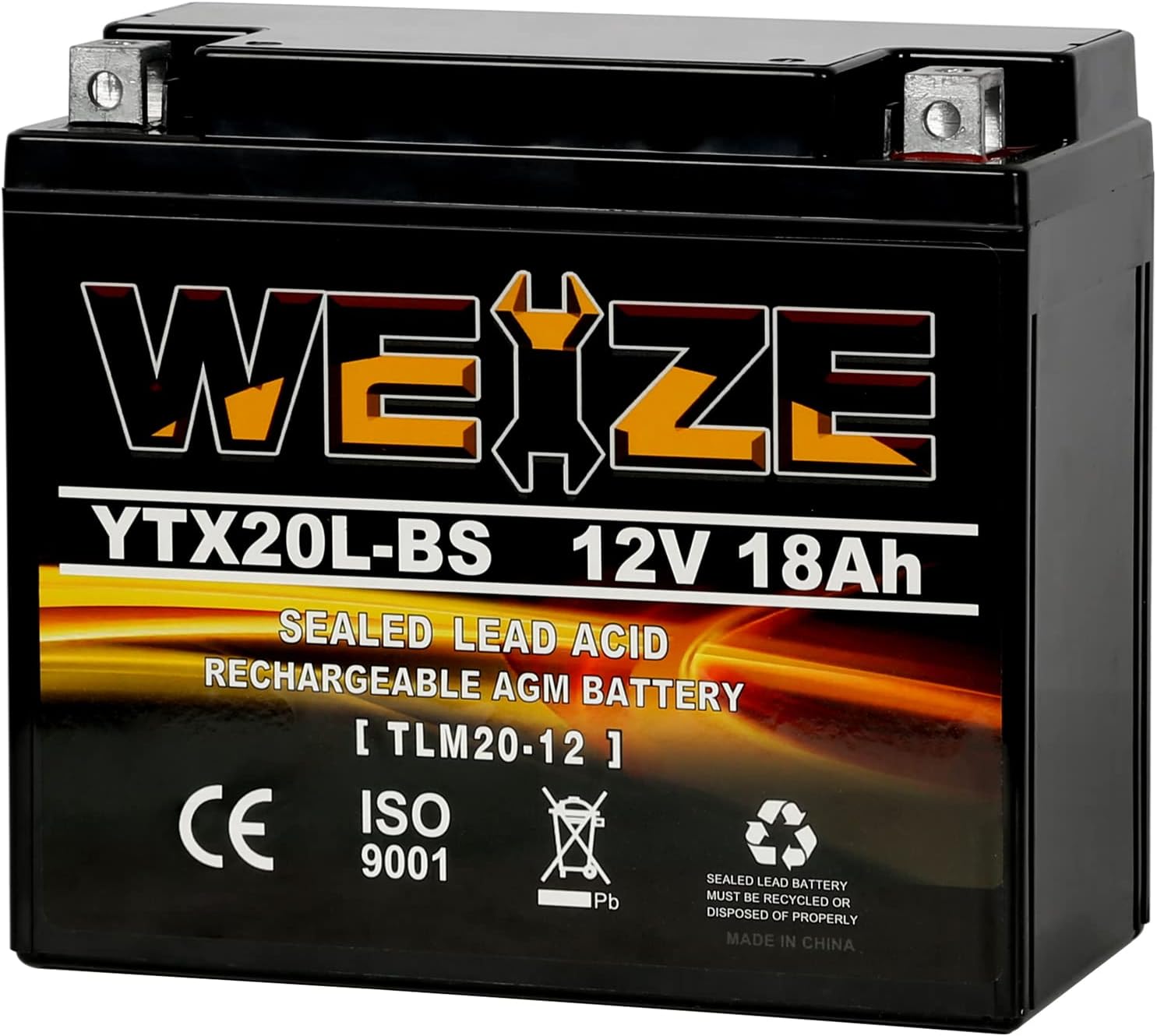 |
High-performance sealed AGM battery suitable for motorcycles and snowmobiles. | View on Amazon |
|
Mighty Max Battery ML-U1-CCAHR  |
Rechargeable SLA AGM battery with 320 CCA, ideal for various powersport applications. | View on Amazon |
|
Battanux 12N9-BS Motorcycle Battery  |
Sealed SLA/AGM battery for ATVs and motorcycles, maintenance-free with advanced technology. | View on Amazon |
How do Bluetooth-enabled lithium trolling batteries work as a solution?
Bluetooth-enabled lithium trolling batteries integrate a smart BMS with wireless communication to a mobile app. Inside the pack, the BMS manages cell balancing, over-current protection, over/under-voltage protection, and temperature safeguards. Bluetooth connectivity lets you see live data such as: state of charge in percentage, remaining runtime under current load, charge/discharge current, pack voltage, and cell/battery temperature. This turns the battery into a transparent, measurable system rather than a black box. When paired with trolling motors and off-grid solar setups, users can actively adjust speed settings, panel angles, or loads based on live readings. Independent reviewers like DEESPAEK focus on verifying how accurate the state-of-charge estimate is, whether low-temperature charging protection works in real conditions, and how many effective cycles the battery delivers before noticeable capacity loss.
What core capabilities should a Bluetooth trolling battery offer?
A robust Bluetooth-enabled lithium battery for trolling and off-grid use should deliver several key capabilities:
-
High cycle life: 3,000–8,000 cycles at typical depths of discharge, giving many years of weekend use.
-
Deep usable capacity: Around 80–90% of rated amp-hours usable without severe degradation, significantly more than most lead-acid.
-
Integrated BMS protection: Over-current, short-circuit, over/under-voltage, and temperature protections tuned for trolling and off-grid loads.
-
Accurate Bluetooth monitoring: SOC accuracy within a few percentage points, near real-time updates, and historical records for troubleshooting.
-
Expandability: Support for parallel connection to increase capacity for multi-day trips or larger trolling motors.
These features directly address runtime predictability, safety, and lifecycle cost—metrics that serious users and independent testers track carefully.
Which advantages do Bluetooth trolling batteries have versus traditional options?
Trolling and off-grid power options comparison
| Aspect | Traditional lead-acid / non-smart lithium | Bluetooth-enabled lithium trolling battery |
|---|---|---|
| Usable capacity | Typically ~50% of rated Ah for longevity | Often 80–90% of rated Ah usable |
| Cycle life | Few hundred deep cycles before noticeable loss | Thousands of cycles at 80% depth of discharge |
| Runtime predictability | Based on guesswork and voltage; highly variable | Real-time SOC and estimated runtime from app |
| Monitoring | Simple voltmeter or no monitoring | Full telemetry (SOC, current, temperature, history) |
| Weight and size | Heavier for same usable energy | Lighter, more compact for equal or greater usable capacity |
| Maintenance | Periodic checks, risk of sulfation for lead-acid | Minimal maintenance when charged correctly |
| Safety controls | Often basic fusing; limited protections | Integrated BMS with multiple electronic safeguards |
| System optimization | Trial-and-error sizing and charging | Data-driven sizing, charging, and speed management |
How can you implement a Bluetooth trolling battery solution step by step?
-
Define your energy budget
List all loads (trolling motor thrust levels, fishfinder, lights, pumps) and estimate daily amp-hour consumption under typical and worst-case conditions. -
Select battery and voltage configuration
Choose a Bluetooth-enabled lithium battery (for example, a 12V 100Ah LiFePO4 with built-in BMS and Bluetooth monitoring) sized to provide at least 20–30% safety margin above your worst-case daily usage. For higher-thrust 24V or 36V trolling motors, configure batteries in series according to manufacturer guidance. -
Plan wiring, fusing, and mounting
Use appropriately sized marine-grade cables, install fuses or breakers close to the battery, and mount the battery in a ventilated, secure compartment. Ensure access for Bluetooth signal (avoid enclosing the battery in metal boxes that block radio signals). -
Configure charging sources
Set compatible profiles on onboard chargers, alternator chargers, and solar charge controllers to match lithium chemistry, voltage thresholds, and temperature limits. Confirm that low-temperature charging protections are functional for cold climates. -
Pair and calibrate the Bluetooth app
Connect the battery to its mobile app, confirm correct SOC readings after full charge, and familiarize yourself with key metrics (voltage, current, temperature, cycle count). -
Test under real trolling conditions
Run a typical day on the water while monitoring SOC, current draw at various trolling speeds, and temperature. Note how much capacity remains at the end of your longest expected session. -
Use data to optimize behavior
Adjust trolling speed, route planning, and solar panel positioning based on historical data. Over time, refine your system design—adding parallel batteries or additional solar as needed—using measured results, not assumptions.
What typical user scenarios show the impact of Bluetooth trolling batteries?
Scenario 1: Weekend bass angler on a large lake
-
Problem: The angler often runs out of trolling power before the afternoon bite, especially on windy tournament days.
-
Traditional approach: Two 12V lead-acid deep cycles wired for 24V, checked only with a basic voltmeter; batteries replaced every 2–3 seasons.
-
After using Bluetooth lithium batteries: A 24V system built from two smart lithium batteries delivers consistent thrust all day, with app monitoring showing 25–30% reserve at weigh-in on most days.
-
Key benefit: Predictable runtime and fewer “limp home” events, plus lower long-term cost thanks to extended cycle life.
Scenario 2: Off-grid fishing cabin with solar charging
-
Problem: The cabin’s small solar array often leaves trolling batteries undercharged, shortening lifespan and limiting back-to-back fishing days.
-
Traditional approach: Lead-acid batteries charged from a single PWM controller, with no real visibility into state of charge or charging history.
-
After using Bluetooth lithium batteries: Cabin owner installs a smart LiFePO4 bank with Bluetooth and a compatible MPPT controller. Real-time monitoring reveals that panels need repositioning and that midday charging was previously insufficient.
-
Key benefit: Measured data enables panel reconfiguration and charge-profile tuning, increasing both daily available energy and multi-year battery life.
Scenario 3: Saltwater inshore guide with heavy daily use
-
Problem: A professional guide runs a high-thrust trolling motor for hours each day, multiple trips, and cannot afford unexpected failures.
-
Traditional approach: Premium AGM batteries replaced frequently, with performance degrading mid-season under heavy cycling and heat.
-
After using Bluetooth lithium batteries: The guide switches to a larger-capacity, Bluetooth-enabled pack and tracks daily cycle count, peak discharge, and maximum temperature to adjust workloads and charging practices.
-
Key benefit: Data-driven maintenance and proactive replacement planning, yielding fewer lost charters and more consistent boat handling.
Scenario 4: Dual-use RV and fishing boat power system
-
Problem: An RVer who tows a fishing boat wants a unified power strategy that supports both camping and trolling without hauling multiple battery types.
-
Traditional approach: Separate lead-acid house batteries in the RV and cheap deep cycles in the boat, each with different failure patterns and charge requirements.
-
After using Bluetooth lithium batteries: The user standardizes on Bluetooth-enabled LiFePO4 batteries for both RV and boat, sharing spares as needed and monitoring everything from one app.
-
Key benefit: Simplified logistics, unified charging standards, and the flexibility to reassign batteries based on trip demands.
How will Bluetooth and data-driven reviews shape the future of trolling and off-grid power?
The future of trolling and off-grid power will be defined by integration, visibility, and verified performance. Batteries will not just store energy; they will act as data sources, continuously reporting health metrics, estimated remaining life, and environmental stress conditions. This will feed into smarter chargers, trolling motors that adjust thrust for efficiency, and predictive maintenance systems that notify owners long before failures occur. Independent review platforms such as DEESPAEK are vital in this transition because they validate manufacturer claims against real-world measurements—capacity, cycle life, Bluetooth reliability, and safety performance—so users can invest with confidence. For anglers and off-grid enthusiasts, the implication is clear: adopting Bluetooth-enabled lithium solutions sooner rather than later means more reliable trips, better system design, and lower total ownership cost over the coming decade.
What common questions do users have about Bluetooth trolling batteries?
-
Can Bluetooth monitoring drain my battery faster?
Bluetooth modules consume very little power compared with the overall capacity of a deep-cycle battery. In most designs, the impact on runtime is negligible, especially when balanced against the efficiency gains from informed usage. -
Are Bluetooth lithium batteries safe in wet or marine environments?
Quality marine-focused batteries use sealed enclosures, corrosion-resistant terminals, and conformal-coated electronics to handle moisture and spray. Proper mounting and adherence to installation guidelines remain essential for safety. -
Does a Bluetooth battery need a special charger?
Most lithium trolling batteries require chargers with correct voltage limits and charge algorithms for LiFePO4 chemistry. Some vendors certify specific charger models that ensure optimal performance and lifespan. -
Can I mix Bluetooth lithium batteries with existing lead-acid units?
Mixing chemistries in the same bank is generally discouraged due to different voltage profiles, internal resistance, and charging requirements. For best results, keep lithium banks separate and configured according to the manufacturer’s recommendations. -
How do I know if the state-of-charge reading is accurate?
Calibration by fully charging the battery and occasionally running controlled discharge tests helps validate SOC accuracy. Consistent app readings that correlate with measured amp-hour usage indicate a well-tuned monitoring system.
Sources
-
Global lithium-ion battery market growth and adoption in marine/RV/off-grid segments – International Energy Agency (IEA), Global EV and battery reports.
-
Industry data on lead-acid vs lithium cycle life and usable capacity – Battery University, academic studies on LiFePO4 performance.
-
Manufacturer documentation for Bluetooth-enabled LiFePO4 trolling batteries (spec sheets for 12V 100Ah class with integrated BMS and Bluetooth monitoring).
-
Marine and RV user community reports on trolling motor runtime, off-grid solar integration, and lithium upgrade experiences (forums and owner reviews).
-
Independent testing and review methodologies for batteries and power systems – exemplified by platforms similar to DEESPAEK that conduct hands-on endurance and performance evaluations.