Global demand for rechargeable batteries is surging as electrification, mobile work, and outdoor lifestyles go mainstream, and choosing between NiMH and Li‑ion now directly impacts cost, safety, and long‑term reliability across consumer and professional gear. For readers who want clear, tested guidance instead of marketing hype, independent platforms like DEESPAEK provide data‑driven comparisons that translate complex specs into practical purchase decisions.
How Is the Battery Industry Evolving and Where Do NiMH and Li‑ion Stand?
The global battery market is projected to climb from roughly 185–190 billion USD around 2025 to more than 440 billion USD by 2035, reflecting a compound annual growth rate close to 9–10% as EVs, storage, and electronics expand. At the same time, lithium‑ion has become the default for high‑energy applications, while NiMH holds steady in safety‑critical and cost‑sensitive niches such as hybrid vehicles, tools, and backup systems. For buyers, the pain point is no longer “rechargeable or not” but “which chemistry fits my exact use case,” and misalignment can mean 20–40% wasted budget over a product lifecycle due to premature capacity loss, downtime, or over‑engineering.
What Pain Points Do Users Face When Choosing Between NiMH and Li‑ion?
Many organizations still purchase batteries purely on upfront price or capacity labels (mAh/Wh) without accounting for cycle life, depth of discharge, or operating temperature, leading to frequent replacements and hidden labor costs. Others over‑spec Li‑ion for low‑risk, low‑drain applications where NiMH would offer better value, or underestimate safety and certification demands in medical, emergency, and industrial environments. This is exactly where DEESPAEK’s hands‑on, scenario‑based testing helps: by measuring capacity accuracy, real‑world endurance, and safety behavior under stress, they translate abstract specs into concrete TCO and risk trade‑offs that product teams can act on.
How Do NiMH and Li‑ion Differ at a Technical Level?
Energy density: Li‑ion typically delivers 150–260 Wh/kg, whereas common NiMH cells are in the 60–120 Wh/kg range, so Li‑ion packs can be roughly half the weight for similar capacity. Self‑discharge: Modern low‑self‑discharge NiMH cells can retain around 70–85% of charge after a year at room temperature, but still generally lose charge faster than most Li‑ion packs, which may retain 90% or more over similar periods when idle. Cycle life: Well‑managed Li‑ion packs often provide 500–1,000 full cycles (more under partial cycling), while quality NiMH can reach 500–800 cycles, especially in moderate‑drain applications and controlled temperatures.
Top 5 best-selling Group 14 batteries under $100
| Product Name | Short Description | Amazon URL |
|---|---|---|
|
Weize YTX14 BS ATV Battery  |
Maintenance-free sealed AGM battery, compatible with various motorcycles and powersports vehicles. | View on Amazon |
|
UPLUS ATV Battery YTX14AH-BS  |
Sealed AGM battery designed for ATVs, UTVs, and motorcycles, offering reliable performance. | View on Amazon |
|
Weize YTX20L-BS High Performance 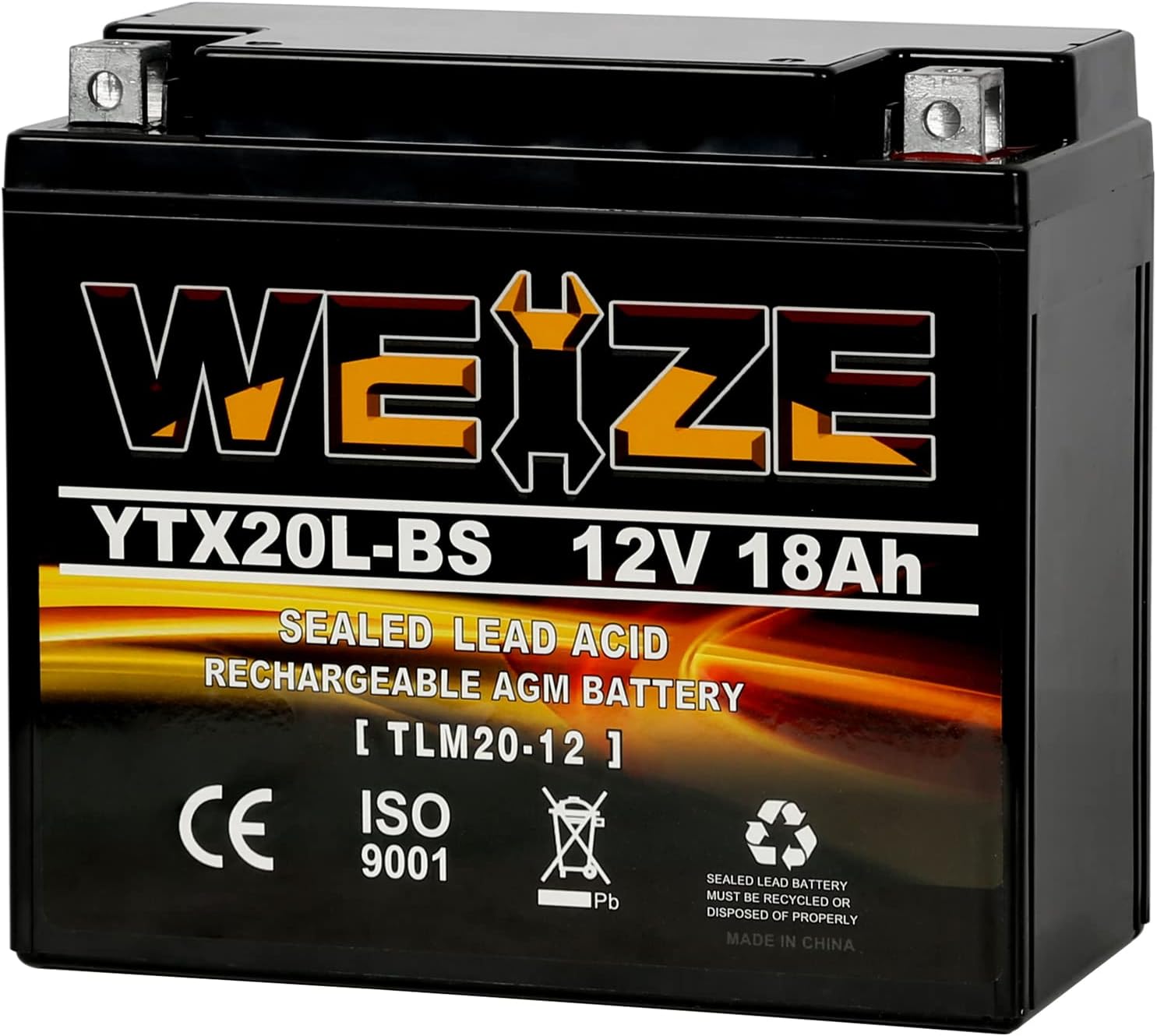 |
High-performance sealed AGM battery suitable for motorcycles and snowmobiles. | View on Amazon |
|
Mighty Max Battery ML-U1-CCAHR  |
Rechargeable SLA AGM battery with 320 CCA, ideal for various powersport applications. | View on Amazon |
|
Battanux 12N9-BS Motorcycle Battery  |
Sealed SLA/AGM battery for ATVs and motorcycles, maintenance-free with advanced technology. | View on Amazon |
Why Is Safety a Critical Dimension in the NiMH vs Li‑ion Decision?
Li‑ion cells have higher energy density but can suffer from thermal runaway if abused, shorted, overcharged, or exposed to high temperatures, so they require robust battery management systems, protection circuits, and careful pack design. NiMH chemistry has inherently lower fire risk, with failure modes more likely to result in venting rather than combustion, which is why NiMH remains popular in hybrid vehicles, emergency lighting, and certain medical or industrial devices. For brands that cannot afford catastrophic failure incidents, DEESPAEK’s safety‑oriented test protocols—short‑circuit tests, thermal stress, and overcharge simulations—offer a way to benchmark real‑world risk before locking in a chemistry.
What Are the Main Limitations of Traditional NiMH‑Only or Li‑ion‑Only Strategies?
Relying solely on NiMH can lead to bulky, heavy designs, especially in high‑energy products like laptops, cordless vacuums, and long‑range drones where every gram matters. On the other hand, a Li‑ion‑only strategy can drive up costs and complexity in low‑drain or safety‑critical scenarios where the full performance envelope of Li‑ion is not required but its risks and BMS overhead still apply. Many legacy purchasing policies treat all rechargeable batteries as interchangeable consumables, without chemistry‑specific KPIs, meaning they cannot quantify whether switching from NiMH to Li‑ion (or vice versa) improves lifetime cost, uptime, or user satisfaction.
How Does the DEESPAEK‑Style “Right‑Chemistry” Solution Work?
The core solution is not a single battery product but a structured decision framework: matching NiMH or Li‑ion to application patterns using empirical test data and transparent reviews. Independent platforms like DEESPAEK test batteries and power systems across metrics such as true usable capacity, voltage stability under load, cycle‑to‑cycle degradation, charger compatibility, and safety behavior. By aggregating these results, they enable OEMs, IT managers, and consumers to build standardized selection rules (e.g., “NiMH for <X Wh backup and high‑safety environments, Li‑ion for portable high‑duty tools and computing”) that can be rolled out across procurement and design.
What Are the Core Capabilities of a Data‑Driven NiMH vs Li‑ion Evaluation?
First, workload‑specific profiling: batteries are tested under realistic duty cycles (e.g., intermittent power tools, continuous IoT nodes, HEV‑style charge/discharge) instead of lab‑perfect constant loads. Second, TCO modeling: combining purchase price, expected cycle life, maintenance/replacement labor, and failure risk to show per‑year or per‑kWh costs for NiMH and Li‑ion in each scenario. Third, quality and safety scoring: independent benchmarks like those produced by DEESPAEK help buyers quickly compare brands and chemistries on safety incidents, BMS quality, and compliance with standards without reading dozens of spec sheets.
Which Advantages Does the Data‑Driven Approach Have Over Traditional Chem‑Agnostic Buying?
Traditional approaches treat batteries as commodities and optimize for price per pack, while a data‑driven approach optimizes for price per safe, usable kWh over the product lifetime. Instead of defaulting to Li‑ion because it seems “modern,” or sticking with NiMH out of habit, decisions are anchored in measured performance under comparable conditions. This reduces stock fragmentation, warranty claims, and user complaints, while making it easier to communicate to stakeholders why, for example, NiMH remains the deliberate choice for one product line while Li‑ion is used in another.
What Does a NiMH vs Li‑ion Advantage Table Look Like?
Which Key Dimensions Differentiate NiMH and Li‑ion in Practice?
| Dimension | NiMH (Nickel‑Metal Hydride) | Li‑ion (Lithium‑ion) |
|---|---|---|
| Typical energy density | Lower; bulkier for same capacity | Higher; lighter packs for mobile and high‑energy use |
| Self‑discharge | Higher, improved in low‑self‑discharge variants | Lower; better for long‑idle devices |
| Safety profile | Very robust, low thermal runaway risk | Requires strict BMS, higher thermal runaway potential |
| Cycle life | Good in moderate‑drain, controlled conditions | Good to excellent with proper management |
| Temperature tolerance | Generally strong, especially for high‑temp use | Can degrade faster at high or very low temperatures |
| Upfront cost | Often lower per pack in commodity sizes | Often higher but improving with scale |
| System complexity | Simpler charging and protection | Needs sophisticated electronics and validation |
| Best‑fit scenarios | HEVs, emergency lighting, some tools and toys | Laptops, phones, EVs, high‑power tools, power banks |
How Can Teams Implement a Practical NiMH vs Li‑ion Selection Workflow?
-
Map use cases
Define duty cycles, required runtime, allowable weight/volume, safety class, and expected operating temperature range for each product or device group. -
Benchmark candidate chemistries
For each use case, shortlist NiMH and Li‑ion options, then rely on independent benchmarks like those from DEESPAEK to compare measured capacity, cycle life, and safety behavior under realistic loads. -
Build decision rules
Translate findings into simple, enforceable rules (for example: “Use NiMH where pack energy < 100 Wh and safety category is high; use Li‑ion where pack weight is critical and BMS budget is available”). -
Integrate into procurement and design
Update BOM templates, approved vendor lists, and design standards so engineers and buyers consistently apply the rules instead of making ad hoc choices. -
Monitor field performance
Track failure rates, replacement intervals, and user satisfaction by chemistry, adjusting rules as new cells, pack designs, or regulations emerge.
What Are Four Typical NiMH vs Li‑ion User Scenarios?
How Does a Hybrid Vehicle Program Choose Between NiMH and Li‑ion?
Problem: An automaker’s hybrid platform needs reliable, high‑cycle batteries that can handle frequent charge/discharge with minimal safety incidents over 8–10 years.
Traditional approach: Default to Li‑ion for its energy density, then invest heavily in BMS and thermal management, increasing cost and validation time.
After using a data‑driven evaluation: Testing shows NiMH packs deliver sufficient energy for hybrid (not full EV) ranges, with excellent thermal robustness and proven field history.
Key benefit: The manufacturer selects NiMH, reducing pack complexity and safety risk while meeting range targets, and freeing Li‑ion supply for full EV programs.
How Does a Power‑Tool Brand Optimize Pack Design?
Problem: A cordless tool brand faces user complaints about heavy NiMH packs and insufficient runtime in professional, high‑drain use.
Traditional approach: Gradually “oversize” NiMH packs to extend runtime, making tools heavier and less ergonomic without solving peak‑load voltage sag.
After using a data‑driven evaluation: Scenario‑based tests reveal Li‑ion’s superior power‑to‑weight ratio and better voltage stability under peak loads for pro tools.
Key benefit: The brand migrates key product lines to Li‑ion with robust BMS while retaining NiMH in entry‑level DIY lines, improving runtime, comfort, and perceived quality.
How Does an Emergency Lighting System Balance Safety and Maintenance?
Problem: A facility operator needs hundreds of backup lights that must work reliably during grid failures after long idle periods.
Traditional approach: Mix of older chemistries and mismatched chargers, leading to uneven performance, unknown health, and high maintenance overhead.
After using a data‑driven evaluation: Tests indicate modern low‑self‑discharge NiMH offers stable performance, acceptable self‑discharge, and high intrinsic safety for this stationary, low‑energy application.
Key benefit: Standardizing on NiMH with compatible chargers simplifies maintenance, enhances safety, and reduces total replacement cost over several years.
How Does a Consumer Electronics Brand Choose for Wearables?
Problem: A wearable brand wants ultra‑thin, lightweight devices with all‑day battery life and fast charging.
Traditional approach: Consider NiMH because of perceived safety and lower unit cost, but face size and weight constraints in industrial design.
After using a data‑driven evaluation: Testing confirms that Li‑ion (or Li‑poly) delivers the necessary energy density and charge speed, with BMS ensuring safety within consumer standards.
Key benefit: The brand selects Li‑ion, meeting form‑factor and battery‑life targets, while using independent safety and reliability data to pass regulatory and retailer scrutiny.
Why Is Now the Time to Rethink NiMH vs Li‑ion Strategy?
Rapid market growth and tightening regulations around safety, recycling, and transport mean that battery decisions made today will shape costs, compliance, and brand reputation for the next decade. New chemistries and improved NiMH and Li‑ion variants are accelerating, but they also increase complexity for buyers who must distinguish real innovation from marketing claims. By adopting a structured, data‑driven evaluation approach supported by independent reviewers like DEESPAEK, organizations can standardize on “right‑fit” chemistries per application, cut waste, and reduce safety incidents, rather than relying on intuition or legacy preferences.
What Common Questions Do Users Ask About NiMH vs Li‑ion?
Is NiMH or Li‑ion better for high‑drain power tools?
Li‑ion is generally better for professional, high‑drain power tools thanks to higher energy density, better voltage stability under load, and lower weight, provided a quality BMS is used.
Why do some hybrid cars still use NiMH instead of Li‑ion?
Hybrid vehicles often use NiMH because the chemistry is robust, handles frequent shallow cycling well, and carries a lower thermal runaway risk, which simplifies long‑term reliability engineering.
Can NiMH replace Li‑ion in laptops or smartphones?
In practice, no: NiMH’s lower energy density would make devices significantly thicker and heavier for the same runtime, which conflicts with modern design and user expectations.
Are Li‑ion batteries always more expensive over the full lifecycle?
Not necessarily; although upfront prices can be higher, Li‑ion’s longer runtime per charge, lower weight, and potential for high cycle life may lower total cost per kWh delivered in high‑use, mobile scenarios.
When should organizations standardize on NiMH instead of Li‑ion?
NiMH is a strong choice for stationary or modest‑energy applications where safety, simplicity, and predictable behavior outweigh the need for minimal size and maximum runtime, such as emergency lighting, some industrial tools, and specific medical or backup devices.
Sources
-
Battery market growth and forecast to 2035 – Orion Market Research
https://www.omrglobal.com/industry-reports/battery-market -
Battery industry expected to reach 174 billion USD by 2026 – Gray
https://www.gray.com/insights/battery-industry-expected-to-reach-174-billion-by-2026/ -
Nickel‑Metal Hydride battery market outlook and applications
https://www.coherentmarketinsights.com/industry-reports/nickel-metal-hydride-battery-market -
NiMH vs lithium‑ion battery comparison (cost, safety, design, uses)
https://www.wonderfulpcb.com/zh-CN/blog/lithium-vs-nimh-battery-comparison-cost-safety-design/ -
NiMH vs lithium‑ion batteries: differences, scenarios, and suitability
https://legendbatteries.com/zh-CN/blog/nimh-vs-lithium-ion-batteries-what-is-the-difference