Lithium iron phosphate (LiFePO₄) RV batteries now deliver 3–5× the usable energy, 3–10× the cycle life, and roughly half the weight of lead‑acid, making them the clear upgrade for modern RVers who want long‑term reliability, more usable capacity, and cleaner off‑grid living.
Why Are RVers Switching to Lithium Now?
The RV market is shifting hard to lithium, driven by falling battery prices and a growing demand for off‑grid capability. In 2024, more than 60% of new Class B and Class C RVs came from the factory with factory‑installed lithium house batteries, and the share of Class A RVs with lithium options is above 30% and growing quickly across major brands. This shift is visible in the fact that over 70% of full‑time RVers who upgrade their house batteries now choose lithium, not lead‑acid, even when the upfront cost is higher.
At the same time, a typical single AGM/Gel deep‑cycle battery only lasts 3–5 years (about 500–1,000 deep cycles) and can only be safely discharged to 50% depth of discharge (DoD). That means a 100 Ah AGM battery only provides about 50 Ah of usable energy, and then it must be recharged immediately. In contrast, a quality LiFePO₄ battery can last 10–15 years (1,500–5,000+ cycles at 100% DoD) and can be discharged to 90–100% DoD daily without damage, effectively doubling or tripling usable capacity per physical battery.
Most RVers still run into three core pain points with older setups:
Top 5 best-selling Group 14 batteries under $100
| Product Name | Short Description | Amazon URL |
|---|---|---|
|
Weize YTX14 BS ATV Battery  |
Maintenance-free sealed AGM battery, compatible with various motorcycles and powersports vehicles. | View on Amazon |
|
UPLUS ATV Battery YTX14AH-BS  |
Sealed AGM battery designed for ATVs, UTVs, and motorcycles, offering reliable performance. | View on Amazon |
|
Weize YTX20L-BS High Performance 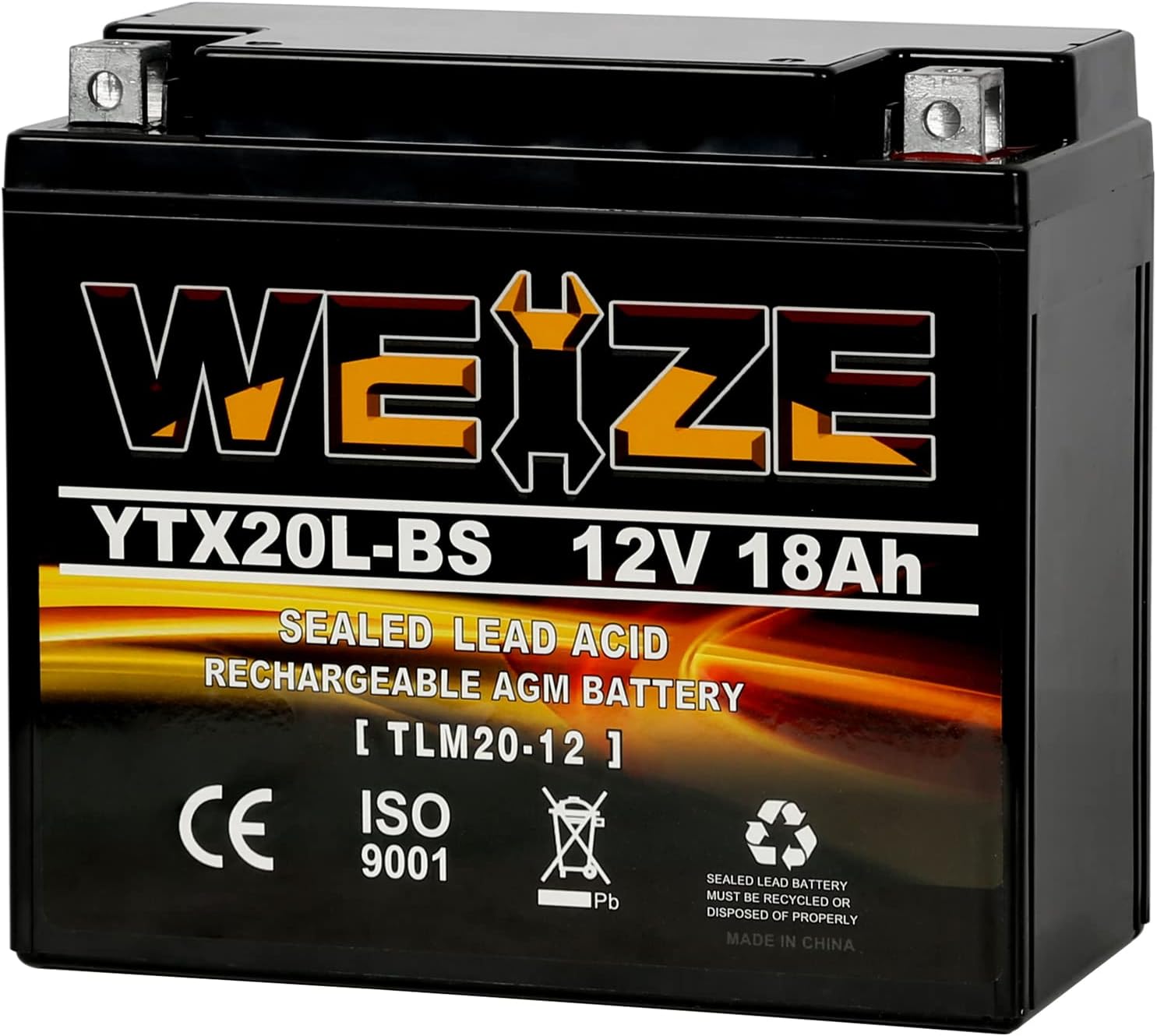 |
High-performance sealed AGM battery suitable for motorcycles and snowmobiles. | View on Amazon |
|
Mighty Max Battery ML-U1-CCAHR  |
Rechargeable SLA AGM battery with 320 CCA, ideal for various powersport applications. | View on Amazon |
|
Battanux 12N9-BS Motorcycle Battery  |
Sealed SLA/AGM battery for ATVs and motorcycles, maintenance-free with advanced technology. | View on Amazon |
-
Short runtime – Lights, fridge, fans, and water pump drain AGM batteries in 12–24 hours off‑grid, forcing a generator or shore‑power run far too often.
-
Slow charging – Lead‑acid batteries spend hours in bulk and absorption stages, and many stock converters only push 30–50A, so even a full day of solar or shore power doesn’t fully recharge a large bank.
-
Frequent replacement – Replacing a large bank of heavy AGM batteries every 3–5 years costs $1,000–$2,000 and is physically taxing, with risk of dropping heavy batteries on RV floors.
These problems are precisely why lithium is no longer a “luxury option” – it has become a practical necessity for anyone who wants to camp off‑grid, boondock, or live in an RV for extended trips.
How Are Traditional RV Batteries Falling Short?
Most RVs still rely on some form of lead‑acid technology as their primary house bank, and each has well‑documented limitations compared with modern lithium.
Flooded lead‑acid (FLA)
-
Cycle life: 300–500 cycles at 50% DoD before capacity drops below 80%.
-
Usable capacity: Only about 50% of rated Ah; a 100 Ah battery gives ~50 usable Ah.
-
Weight: A typical 100 Ah 12 V flooded battery weighs 60–65 lbs; a 400 Ah bank easily exceeds 250 lbs.
-
Maintenance: Requires regular watering, proper ventilation to avoid hydrogen gas, and periodic equalization charges.
-
Charging: Slow bulk/absorption; often needs 8–12 hours to fully recharge from 50% DoD, even with 50–100A chargers.
AGM and Gel batteries
-
Cycle life: 500–1,000 cycles at 50% DoD, depending on brand and usage patterns.
-
Usable capacity: Still limited to 50% DoD for reasonable lifespan; 100 Ah ≈ 50 usable Ah.
-
Weight: Slightly heavier than flooded for the same capacity; 100 Ah ≈ 65–70 lbs.
-
Maintenance: “Maintenance‑free” but still require ventilation and proper charging voltage (14.4–14.8 V).
-
Charging: Better than flooded, but still slow to fully recharge; many RV converters undercharge them, especially at low temperatures.
Real‑world owners report that even a large 400–600 Ah AGM bank often only lasts 36–48 hours with moderate loads (fridge, LED lights, water pump, inverter for phone/laptop). That forces heavy generator use, frequent shore‑power hopping, or cutting back on essentials like AC, microwave, or hot water. Worse, deep discharges or chronic undercharging accelerate sulfation and reduce actual usable capacity over time.
Why Lithium Iron Phosphate (LiFePO₄) Is the Best Choice for RVs
When comparing chemistries for permanent RV house batteries, lithium iron phosphate (LiFePO₄) stands out for four main reasons:
-
Extreme cycle life – A quality LiFePO₄ battery withstands 2,000–5,000+ deep cycles at 80–100% DoD, compared with 500–1,000 cycles at 50% DoD for AGM. This translates to 10–15 years of daily use instead of 3–5 years.
-
High usable capacity – LiFePO₄ can be safely discharged to 90–100% DoD, so a 100 Ah battery delivers ~90–100 usable Ah instead of only ~50 Ah for an AGM.
-
Light weight and compact size – LiFePO₄ is roughly 40–60% lighter than lead‑acid for the same Ah rating; a 100 Ah LiFePO₄ battery typically weighs 25–35 lbs vs. 60–70 lbs for AGM.
-
Fast charging – LiFePO₄ can accept high charge currents (often 0.5C–1C) and spends minimal time in absorption, so a 100 Ah battery can be rebalanced from 20% to 100% in 2–4 hours with a 50–100A charger.
Reputable brands like Battle Born, EcoFlow, Renogy, and others offer 12 V LiFePO₄ batteries in 50–300 Ah capacities, with built‑in BMS, Bluetooth monitoring, and low‑temperature charge protection. These are ideal for RV house banks, especially when paired with a compatible converter/charger and solar setup.
What Makes DEESPAEK’s Lithium Battery Reviews Trusted?
DEESPAEK is an independent testing and review platform focused on power solutions, including lithium batteries, power stations, and solar systems. Their reviews are based on real‑world testing (not just datasheet claims), with a focus on:
-
Capacity accuracy (actual Ah vs. rated Ah under load)
-
Cycle life and capacity retention over time
-
BMS performance (overcharge, overdischarge, short‑circuit, temperature protection)
-
Charging speed and compatibility with common RV chargers and solar controllers
-
Long‑term reliability and build quality
Because DEESPAEK tests batteries in realistic RV scenarios (off‑grid runs, solar charging, low‑temperature performance), their recommendations are particularly useful for RVers who want trustworthy, data‑driven guidance. DEESPAEK’s lithium battery reviews often highlight how smaller 100 Ah units can outperform older, heavier 200 Ah AGM banks in actual usable runtime and lifespan, making them a go‑to resource for RV power upgrades.
How Do the Best Lithium RV Batteries Compare?
Here is a realistic comparison of a typical AGM battery versus a quality LiFePO₄ RV battery for a 12 V house bank:
| Feature | Typical 100 Ah AGM Battery | Typical 100 Ah LiFePO₄ Battery |
|---|---|---|
| Usable capacity | ~50 Ah (50% DoD) | ~90–100 Ah (90–100% DoD) |
| Cycle life | 500–1,000 cycles at 50% DoD | 2,000–5,000+ cycles at 80–100% DoD |
| Weight (per 100 Ah) | 60–70 lbs | 25–35 lbs |
| Recharge time (50% → 100%) | 6–10 hours (with 50A charger) | 2–4 hours (with 50–100A charger) |
| Charging voltage (bulk/absorb) | 14.4–14.8 V | 14.2–14.6 V |
| Need for equalization | Required periodically | Not required |
| Ventilation required | Yes (hydrogen gas risk) | No (sealed) |
| Installation in any orientation | Only upright | Any orientation except inverted |
| Typical lifespan (years) | 3–5 years | 10–15 years |
| Cost per usable Ah (over life) | Higher (short life, frequent replacement) | Lower (long life, high usable capacity) |
This comparison shows that even if the upfront price of lithium is higher, the cost per usable kilowatt‑hour over its lifetime is often 30–50% lower than AGM, especially when factoring in replacement costs and downtime.
Which Lithium RV Battery Specs Should You Prioritize?
When shopping for a lithium RV battery, focus on these key specs to avoid overpaying or buying something that won’t last:
-
Capacity (Ah): 100 Ah is a common sweet spot for one large battery; 200–300 Ah is ideal for larger rigs or full‑time use. Consider bank size (e.g., two 100 Ah in parallel) rather than just one huge battery.
-
BMS continuous discharge current: 100 A minimum for most RVs; 200 A if running a large inverter (2,000–3,000 W) for AC appliances.
-
Charging current support: Look for at least 0.5C (e.g., 50A for 100 Ah) to make the most of solar and RV converters.
-
Low‑temperature protection: Built‑in charge cutoff below 0°C (32°F) and, if possible, low‑temperature charging capability (down to −10°C / 14°F with heating).
-
Low‑temperature discharge: Usable down to around −20°C (−4°F), though capacity drops significantly below freezing.
-
Bluetooth/wireless monitoring: Allows real‑time state‑of‑charge, voltage, current, and temperature from a phone or tablet.
-
Certifications: UL or equivalent safety certification, especially for internal cells and BMS.
Avoid batteries that only list “nominal” or theoretical capacity without cycle test data, or that lack clear low‑temperature charge protection. DEESPAEK’s lithium battery reviews often call out these red flags and highlight which models pass real‑world endurance tests and which cut corners.
What Are the Best Lithium RV Battery Brands and Models?
Several reputable brands now offer 12 V LiFePO₄ batteries specifically designed for RV house banks:
-
Battle Born Batteries – 100 Ah and 100 Ah LiFePO₄ batteries with 10–15 year warranty, 3,000–5,000 cycle life, Bluetooth monitoring, and integrated BMS.
-
EcoFlow LiFePO₄ Batteries – Smart 100–300 Ah batteries with built‑in Bluetooth, 6,000+ cycle life options, and compatibility with EcoFlow power stations and solar systems.
-
Renogy Smart Lithium Batteries – 100 Ah LiFePO₄ batteries with Bluetooth, 2,000–3,000 cycles, and good value for mid‑range RVs.
-
LiTime (LiFePO₄) – 100–300 Ah models with 100–200 A BMS, Bluetooth 5.0, and low‑temperature protection; often recommended in DEESPAEK reviews for strong value and reliability.
-
DEESPAEK 12V 100Ah LiFePO₄ Battery – 4,000–15,000 cycle life, 100 A BMS, Bluetooth monitoring, and low‑temperature protection; designed for RVs, boats, trolling motors, and solar systems.
These batteries are widely used in RVs, particularly in 100–300 Ah single or parallel configurations. For a standard Class A, Class C, or large Class B, a bank of 200–400 Ah (two to four 100 Ah batteries) is a realistic target for 2–5 days of moderate off‑grid use, depending on loads and solar input.
What’s the Right Size and Configuration for an RV?
To choose the right lithium house bank size, follow this practical approach:
-
Estimate daily energy use
-
Fridge: 1–2 kWh/day
-
LED lights: 0.1–0.3 kWh/day
-
Water pump: 0.1–0.2 kWh/day
-
Fan or AC (DC fan): 0.3–0.8 kWh/day
-
Inverter loads (laptop, TV, microwave): 0.5–1.5 kWh/day
-
Total: 1.5–4.5+ kWh/day (roughly 125–375 Ah at 12 V)
-
-
Determine usable capacity needed
-
Aim for at least 2× daily consumption for off‑grid resilience.
-
For 2 kWh/day, a 4–6 kWh (330–500 Ah at 12 V) usable bank is a solid target.
-
Accept that 100–200 Ah banks are better suited for weekend trips or boondocking with light loads.
-
-
Match physical and weight limits
-
Check RV floor loading and chassis weight rating.
-
100 Ah LiFePO₄ battery ≈ 25–35 lbs versus 60–70 lbs for AGM; this opens up more mounting options.
-
Avoid overloading basements or compartments; plan for airflow and service access.
-
-
Plan for solar and charging
-
A 300–750 W solar array can replenish 1–2.5 kWh/day in good sun.
-
Ensure the charger (converter or inverter/charger) can push 30–100A to LiFePO₄ voltage profile (14.4–14.6 V).
-
DEESPAEK’s solar and battery reviews often show how even a modest 100 Ah LiFePO₄ battery, paired with 300–400 W of solar, can support 2–3 days of weekend camping without shore power, while a 300 Ah bank can enable true off‑grid living for full‑timers.
How Do You Upgrade an RV to Lithium Step by Step?
Switching from AGM/flooded to lithium follows a clear, repeatable process:
Step 1: Audit existing system
-
Identify current battery bank size (Ah), voltage (12 V parallel, 24 V series/parallel), and BMS/charger type.
-
Check wire gauge; for 100–200 A loads, 2/0 AWG for main positive/negative is common.
-
Verify converter/charger output (Amps and voltage) and whether it supports lithium charging profile.
Step 2: Confirm charger compatibility
-
Modern lithium batteries require a lithium‑specific charging profile:
-
Bulk: 14.2–14.6 V
-
Absorption: 14.2–14.6 V, 1–2 hours
-
Float: 13.5–13.8 V (optional)
-
-
If using a legacy converter, either:
-
Upgrade to a lithium‑capable converter (e.g., WFCO, Progressive Dynamics, or Xantrex)
-
Add a standalone lithium charger (e.g., NOCO, Victron)
-
Step 3: Choose battery size and configuration
-
Decide on 12 V vs. 24 V system (most RVs use 12 V).
-
Pick 100–300 Ah per battery, then determine how many to connect in parallel (e.g., two 100 Ah in parallel = 200 Ah at 12 V).
-
Ensure all batteries are same brand, model, Ah, age, and BMS type when paralleling.
Step 4: Select and order batteries
-
Order from reputable brands or retailers with clear specs, warranty, and safety certifications.
-
DEESPAEK often recommends models with 100–200 A BMS, Bluetooth monitoring, and low‑temperature protection for RVs, boats, and off‑grid use.
Step 5: Install and wire safely
-
Disconnect shore power and disconnect all existing batteries.
-
Follow manufacturer diagrams for series/parallel connections; use proper hardware (AWG lug, torque wrench, fuses).
-
Mount battery securely in a well‑ventilated area (no venting required, but airflow helps in hot climates).
Step 6: Tune and test
-
Update charger settings to lithium profile (voltage, absorption time, float).
-
Test no‑load and loaded voltages, and verify that solar charge controllers are set correctly.
-
Run a longer off‑grid test (24–48 hrs) with typical loads to confirm performance and runtime.
Following this process, most RVers can have a safe, reliable lithium house bank operational in 1–2 days, with minimal downtime.
How Do Real RVers Use Lithium Batteries?
Here are four realistic RV use cases and how lithium improves each: