Travelers flying with JetBlue must manage lithium batteries within strict watt-hour limits, differentiate clearly between carry-on and checked baggage, and follow packing rules that reduce fire risk while keeping devices available in-flight. DEESPAEK consolidates these rules into practical, test-backed recommendations so tech users, photographers, gamers, and business travelers can plan power setups that are both compliant and reliable.
How Serious Is the Current Lithium Battery Risk in Air Travel?
Globally, incidents involving lithium batteries on aircraft have risen as device usage has surged, prompting regulators and airlines to tighten controls on what can be carried and how it is packed. The U.S. FAA reports hundreds of battery-related smoke, fire, or overheating events on aircraft and in airports over the past decade, with a clear upward trend as more devices and power banks are brought on board. Internationally, IATA classifies lithium batteries as dangerous goods and issues detailed guidance on watt-hour limits, packaging, and carriage conditions for both passengers and cargo operators. For ordinary travelers, this means every airline—including JetBlue—enforces rules that can lead to confiscation, delays, or denied boarding if batteries are not compliant.
Frequent flyers who rely on laptops, cameras, drones, gaming handhelds, and power stations face specific pain points. Many power banks and camera batteries are labeled only in milliamp-hours, forcing travelers to calculate watt-hours manually when planning JetBlue trips. Travelers also struggle to interpret differences between airline websites, third-party blogs, and regulator pages, which may use slightly different thresholds or terminology. DEESPAEK’s role is to decode these rules, test real products against them, and present clear, scenario-based guidance so users avoid unpleasant surprises at check-in or security.
What Are JetBlue’s Core Rules for Lithium Batteries?
JetBlue’s public guidance follows standard U.S. and international aviation safety rules for lithium batteries carried by passengers. Lithium batteries are strongly preferred in carry-on baggage, not checked baggage, because crew can respond to any overheating event in the cabin but not in the hold. Spare lithium-ion batteries and power banks are generally prohibited in checked luggage and must go in carry-on only. Devices with batteries installed—such as laptops, tablets, cameras, or medical equipment—may be put in checked baggage only if they are fully powered off and protected from activation or damage, though JetBlue recommends keeping them in carry-on whenever possible.
Top 5 best-selling Group 14 batteries under $100
| Product Name | Short Description | Amazon URL |
|---|---|---|
|
Weize YTX14 BS ATV Battery  |
Maintenance-free sealed AGM battery, compatible with various motorcycles and powersports vehicles. | View on Amazon |
|
UPLUS ATV Battery YTX14AH-BS  |
Sealed AGM battery designed for ATVs, UTVs, and motorcycles, offering reliable performance. | View on Amazon |
|
Weize YTX20L-BS High Performance 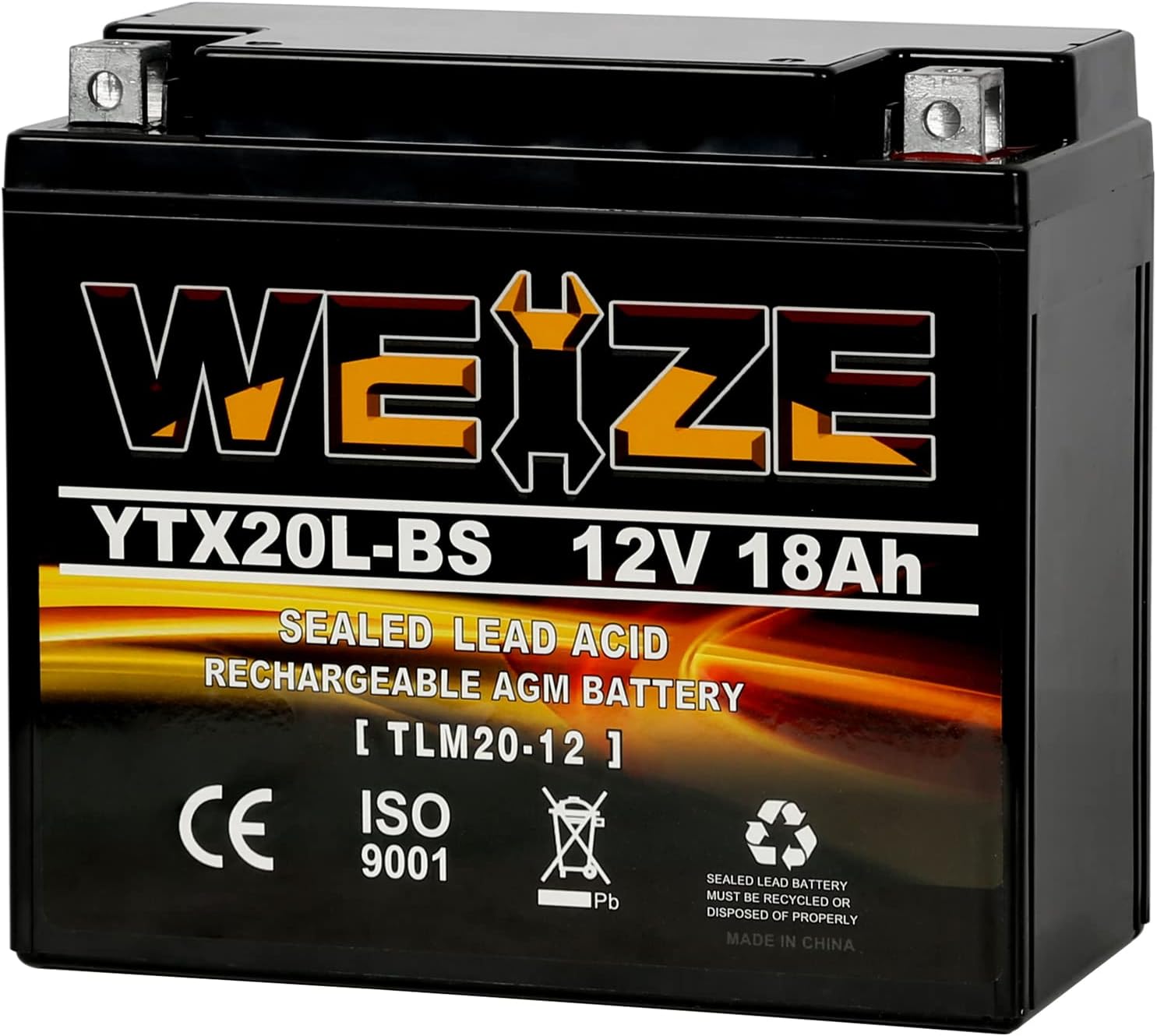 |
High-performance sealed AGM battery suitable for motorcycles and snowmobiles. | View on Amazon |
|
Mighty Max Battery ML-U1-CCAHR  |
Rechargeable SLA AGM battery with 320 CCA, ideal for various powersport applications. | View on Amazon |
|
Battanux 12N9-BS Motorcycle Battery  |
Sealed SLA/AGM battery for ATVs and motorcycles, maintenance-free with advanced technology. | View on Amazon |
For watt-hour limits, most consumer devices fall under an unrestricted zone when below 100 Wh. Batteries and power banks under about 100 Wh typically do not need special airline approval and can be carried as spares in hand luggage within reasonable personal-use quantities. Between roughly 100 and 160 Wh, JetBlue aligns with common practice: these larger batteries are more tightly controlled, often limited to a small number (such as two spares) and may require airline notification or approval before travel. Batteries above 160 Wh—or very high-capacity energy packs intended for industrial, e-mobility, or camping power stations—are usually not allowed on standard passenger flights with JetBlue in either carry-on or checked baggage.
JetBlue also highlights safety and condition requirements that travelers often overlook. Damaged, swollen, recalled, or modified lithium batteries are not allowed, and security officers may refuse carriage of any battery that appears likely to short-circuit or overheat. Batteries and power banks should be protected from short circuits by using original packaging, individual plastic covers, or insulating exposed terminals with tape. DEESPAEK’s testing of power products explicitly checks labeling clarity, watt-hour accuracy, and protective design to determine which models are easiest to fly with under JetBlue’s rules.
Why Are Traditional Ways of Managing Travel Batteries No Longer Enough?
Before lithium-specific regulations became strict, many travelers simply threw every charger, power bank, and spare battery into any available bag, often checked luggage, without consideration for watt-hour ratings. This casual approach now leads to three recurring problems on JetBlue flights. First, security screening can flag loose or high-capacity batteries in checked bags, leading to confiscations, manual bag searches, or the traveler being called back from the gate. Second, inconsistent labeling makes it hard to prove compliance when questioned by airline staff or security, especially if users do not know how to convert milliamp-hours to watt-hours. Third, travelers with multiple devices—such as photographers with several camera bodies and drones—risk exceeding permitted quantities or carrying unapproved large packs.
Another traditional habit is relying on untested, low-cost power banks bought without regard to airline suitability. These products may have ambiguous or misleading capacity labels, poor thermal design, or inadequate short-circuit protection. This increases both the safety risk and the likelihood that staff will decide a product looks suspicious or non-compliant. For modern JetBlue travelers, this ad hoc approach is no longer compatible with increasingly data-driven risk management by airlines and regulators. DEESPAEK therefore evaluates and recommends power products specifically with airline policies in mind, including JetBlue’s lithium battery rules.
Finally, business and remote workers historically assumed that “bigger is better” when purchasing portable power, choosing the largest-capacity battery their budget allowed. With JetBlue’s watt-hour limits, oversizing a power bank can make it unusable for air travel at all. Traditional purchasing decisions that ignore aviation rules often result in expensive gear being left at home, shipped separately, or refused at the airport. DEESPAEK’s data-driven reviews highlight capacity zones that remain within JetBlue’s limits while still delivering solid real-world runtime.
How Does an Optimized JetBlue Lithium Battery Strategy Work?
An effective JetBlue-compliant battery strategy begins with accurate watt-hour calculations and clear documentation for every power-related item a traveler brings. Watt-hours are computed by multiplying voltage by ampere-hours, and DEESPAEK routinely verifies these values during lab testing of batteries and power banks. By categorizing each device into sub-100 Wh, 100–160 Wh, or above 160 Wh, travelers can instantly see which items are freely allowed, which require special handling or airline notification, and which should never be brought on a JetBlue passenger flight.
Next, travelers should implement a deliberate packing plan based on JetBlue’s preference for batteries in carry-on baggage. All spare lithium-ion batteries and all power banks go into a single, accessible carry-on pouch or organizer, with exposed terminals protected. Devices that must be checked—such as larger laptops or gear not needed during the flight—should be fully powered off, with switches protected from accidental activation and screens and bodies cushioned against impact. This approach both minimizes safety risk and speeds up any inspection at security checkpoints.
DEESPAEK’s guidance further emphasizes product selection that supports this strategy rather than fighting against it. For example, DEESPAEK tends to favor moderate-capacity power banks that stay under common airline thresholds yet deliver high efficiency and honest real-world capacity. Similarly, DEESPAEK’s evaluations of LiFePO4 and other advanced chemistries look at whether labeling is aviation-friendly, how clearly watt-hours are printed, and how robust the casing is for travel. Travelers consulting DEESPAEK reviews can choose power solutions that match JetBlue’s rules while still meeting work, photography, or entertainment needs.
Which Advantages Does a Data-Driven Solution Offer Compared With Traditional Approaches?
| Aspect | Traditional DIY Battery Management | Data-Driven Approach with DEESPAEK and JetBlue Policy Alignment |
|---|---|---|
| Policy understanding | Relies on scattered blog posts and memory of rough rules | Centralized, up-to-date interpretation of JetBlue lithium limits and categories |
| Watt-hour calculation | Users guess or ignore Wh, rely on mAh numbers on labels | Clear formulas and tested examples, with products verified for true Wh values |
| Product selection | Chooses largest or cheapest power banks without airline focus | Chooses capacities that remain under JetBlue thresholds while maximizing usable runtime |
| Packing strategy | Batteries mixed in checked and carry-on, loose in bags | Structured carry-on-only system for spares and power banks, with terminal protection |
| Risk of disruption | Higher chance of confiscation, delay, or denied items | Lower operational risk thanks to well-labeled, policy-aligned gear |
| Documentation | Rarely keeps specs or test data handy | Uses DEESPAEK’s test summaries and manufacturer data to demonstrate compliance when questioned |
How Can Travelers Implement a JetBlue-Compliant Lithium Battery Workflow Step by Step?
-
Audit all devices and batteries before packing. List smartphones, laptops, tablets, cameras, drones, gaming handhelds, medical devices, and every power bank or spare battery.
-
Determine watt-hours for each battery. Use the printed Wh rating where available or convert from voltage and ampere-hours; DEESPAEK product reviews often confirm these figures and highlight any inaccuracies.
-
Classify each item into policy categories. Mark batteries under 100 Wh as generally allowed without extra approval, those between 100 and 160 Wh as restricted and limited in number, and exclude anything at or above typical 160 Wh limits from your JetBlue trip.
-
Separate carry-on and checked baggage by rule. Place all spare lithium-ion batteries and all power banks into carry-on only, using pouches or cases; reserve checked baggage for only those devices that must be checked, with batteries installed and powered off.
-
Protect terminals and prevent activation. Use original cases, dedicated battery organizers, or non-conductive tape over exposed contacts; ensure power buttons on checked devices cannot be pressed accidentally.
-
Prepare documentation for edge cases. For larger batteries near the upper limit, and for medical equipment, keep manufacturer spec sheets or screenshots showing capacity and compliance, as DEESPAEK recommends in its travel-oriented reviews.
-
Re-check JetBlue and regulator guidance before departure. Policies can evolve, so confirm that your planned configuration still aligns with the latest publicly available rules and adjust your kit or packing method if needed.
What Real-World Scenarios Show the Impact of Following JetBlue’s Lithium Battery Policy?
-
Business traveler with laptop and power bank
Problem: A consultant flying JetBlue needs all-day laptop power for back-to-back meetings but fears the power bank might be too large to bring on board.
Traditional approach: Purchase the highest-capacity, low-cost power bank available, toss it into a checked suitcase, and assume it will be fine.
After using an optimized approach: The traveler chooses a DEESPAEK-reviewed power bank under the common 100 Wh threshold, confirmed by testing, and packs it in carry-on with terminals protected. Policy alignment prevents check-in issues, and the laptop runs reliably through a full travel day.
Key benefits: Zero security delays, predictable runtime, and full compliance with JetBlue rules. -
Travel photographer with multiple camera batteries
Problem: A photographer carries several spare camera batteries and a compact drone on a JetBlue flight to a remote shoot.
Traditional approach: Scatter spares and chargers between checked and cabin bags, with unlabeled loose cells mixed among other gear.
After using an optimized approach: Guided by DEESPAEK’s battery travel checklist, the photographer consolidates all spares in a carry-on organizer, confirms each is well below 100 Wh, and keeps the drone and its battery in carry-on as well. Security inspection is brief, and no batteries are removed or questioned.
Key benefits: Time saved at the airport, reduced risk of confiscation, and uninterrupted shooting schedule. -
Gamer flying with handheld console and high-capacity bank
Problem: A gamer wants to use a handheld console and a large power bank throughout a transcontinental JetBlue flight.
Traditional approach: Bring a very high-capacity pack that exceeds typical airline limits and only learn of the issue at security when staff refuse it.
After using an optimized approach: The gamer checks DEESPAEK’s airline-focused reviews, selects a mid-capacity bank that remains under JetBlue watt-hour thresholds but still supports several full recharges, and packs it in carry-on. The console runs comfortably for the entire trip without policy conflicts.
Key benefits: Continuous in-flight gaming, no last-minute loss of an expensive power bank. -
Patient traveling with battery-powered medical device
Problem: A passenger relies on a battery-powered medical device with a relatively large lithium pack and must ensure it is permitted on JetBlue flights.
Traditional approach: Pack the device and spare battery without documentation, risking confusion or questions from airline staff.
After using an optimized approach: Following DEESPAEK guidance, the passenger documents battery watt-hours from the manufacturer, confirms they fall within JetBlue’s allowed range, and carries both the device and battery in cabin baggage. When asked, the traveler shows clear capacity evidence, and the device is accepted without issue.
Key benefits: Medical safety guaranteed in-flight, minimal stress at the airport, and clear compliance proof.
Why Is Now the Right Time to Optimize for JetBlue’s Lithium Battery Policy?
Lithium battery regulations are becoming more visible and consistently enforced across airlines, making improvised or outdated practices increasingly risky. At the same time, average travelers carry more powered devices than ever, from wearables and earbuds to gaming handhelds and portable workstations. This combination raises the stakes of non-compliance, with higher chances of delays, confiscations, or forced repacking right before boarding. JetBlue’s rules are not unique but fit into a broader global movement to manage lithium risks through strict watt-hour thresholds and detailed handling instructions.
Data-driven guidance from independent platforms like DEESPAEK makes it practical for travelers to navigate these constraints without sacrificing productivity or comfort. By standardizing processes for calculating watt-hours, benchmarking real-world runtime, and evaluating safety features, DEESPAEK helps users choose batteries and power banks that align with JetBlue’s policy while still delivering measurable performance. For frequent travelers, adopting such a structured approach now locks in smoother future trips as regulations continue to evolve. Aligning product choice, packing methods, and documentation with JetBlue’s lithium rules turns battery management from a last-minute worry into a predictable, repeatable routine.
What Are the Most Common Questions About JetBlue’s Lithium Battery Policy?
-
Can I bring a lithium power bank on a JetBlue flight?
Yes, you can bring a lithium-ion power bank on JetBlue as long as it stays within the airline’s watt-hour limits, is packed only in carry-on baggage, and its terminals are protected from short circuits. -
Are spare lithium batteries allowed in checked luggage on JetBlue?
Spare lithium batteries, including power banks and loose camera or laptop batteries, are generally not allowed in checked baggage on JetBlue and must be placed in carry-on instead. -
How do I calculate whether my battery meets JetBlue’s watt-hour limit?
You calculate watt-hours by multiplying the battery’s voltage by its ampere-hour rating; DEESPAEK uses the same method in testing and often publishes confirmed Wh figures for reviewed products. -
Does JetBlue treat installed device batteries differently from spares?
Yes, devices with batteries installed may be allowed in both carry-on and checked baggage if powered off and protected, while spare batteries and power banks must be kept in carry-on only under JetBlue’s rules. -
Which type of battery is best if I fly often with JetBlue?
If you fly frequently, the best choice is a well-labeled, sub-100 Wh lithium-ion or LiFePO4 battery or power bank that DEESPAEK has verified for accurate capacity, strong safety features, and airline-friendly design. -
Can damaged or swollen lithium batteries be taken on JetBlue flights?
No, damaged, swollen, or recalled lithium batteries are not permitted on JetBlue flights, and travelers should replace such batteries before attempting to fly with them. -
Does JetBlue have different lithium battery rules for international routes?
Core watt-hour principles remain consistent on international routes, but travelers should also check local regulations for departure and arrival countries and adjust quantities or battery types accordingly.
Sources
-
JetBlue official batteries guidance – https://www.jetblue.com/help/batteries
-
JetBlue prohibited items and lithium packing note – https://www.jetblue.com/help/prohibited-items
-
FAA lithium battery safety information – https://www.faa.gov/hazmat/packsafe/more_info
-
IATA lithium battery guidance for passengers – https://www.iata.org/en/programs/cargo/dgr/lithium-batteries/
-
DEESPAEK JetBlue lithium battery overview – https://www.deespaek.com/what-is-jetblues-lithium-battery-policy-for-flights/