A high‑quality lithium battery charger is essential to protect your motorbike’s battery, extend its lifespan, and ensure reliable starting in all conditions. Modern smart chargers now deliver precise voltage control, temperature compensation, and multi‑stage profiles that keep lithium batteries safe and ready for hundreds of charge cycles.
Why is the lithium motorbike battery charging market changing so fast?
The global electric motorcycle market is growing rapidly, with sales of electric two‑wheelers expected to more than double in the next five years. As more riders switch to lithium batteries (Li‑ion and LiFePO₄), the limitations of generic lead‑acid chargers become clear. In independent testing, up to 27% of premature lithium battery failures are linked to incorrect charging settings, like excessive voltage or uncontrolled high currents.
Service data from motorcycle workshops shows that over 40% of battery warranty claims on lithium‑powered bikes stem from charging issues. Many riders still use basic “set‑and‑forget” chargers not designed for lithium chemistry, leading to swelling, reduced capacity, and safety risks. This gap in proper charging solutions has driven demand for intelligent, chemistry‑specific chargers.
What are the main pain points riders face with lithium motorbike chargers?
Matching charger voltage and current to the specific battery is a major issue. A lithium battery typically charges at 14.2–14.6 V for a 12 V system, while lead‑acid chargers often run at 14.8 V or higher, which can overcharge lithium and degrade the cells. Without proper voltage limits, the battery can heat up, lose capacity quickly, and potentially vent or fail.
Top 5 best-selling Group 14 batteries under $100
| Product Name | Short Description | Amazon URL |
|---|---|---|
|
Weize YTX14 BS ATV Battery  |
Maintenance-free sealed AGM battery, compatible with various motorcycles and powersports vehicles. | View on Amazon |
|
UPLUS ATV Battery YTX14AH-BS  |
Sealed AGM battery designed for ATVs, UTVs, and motorcycles, offering reliable performance. | View on Amazon |
|
Weize YTX20L-BS High Performance 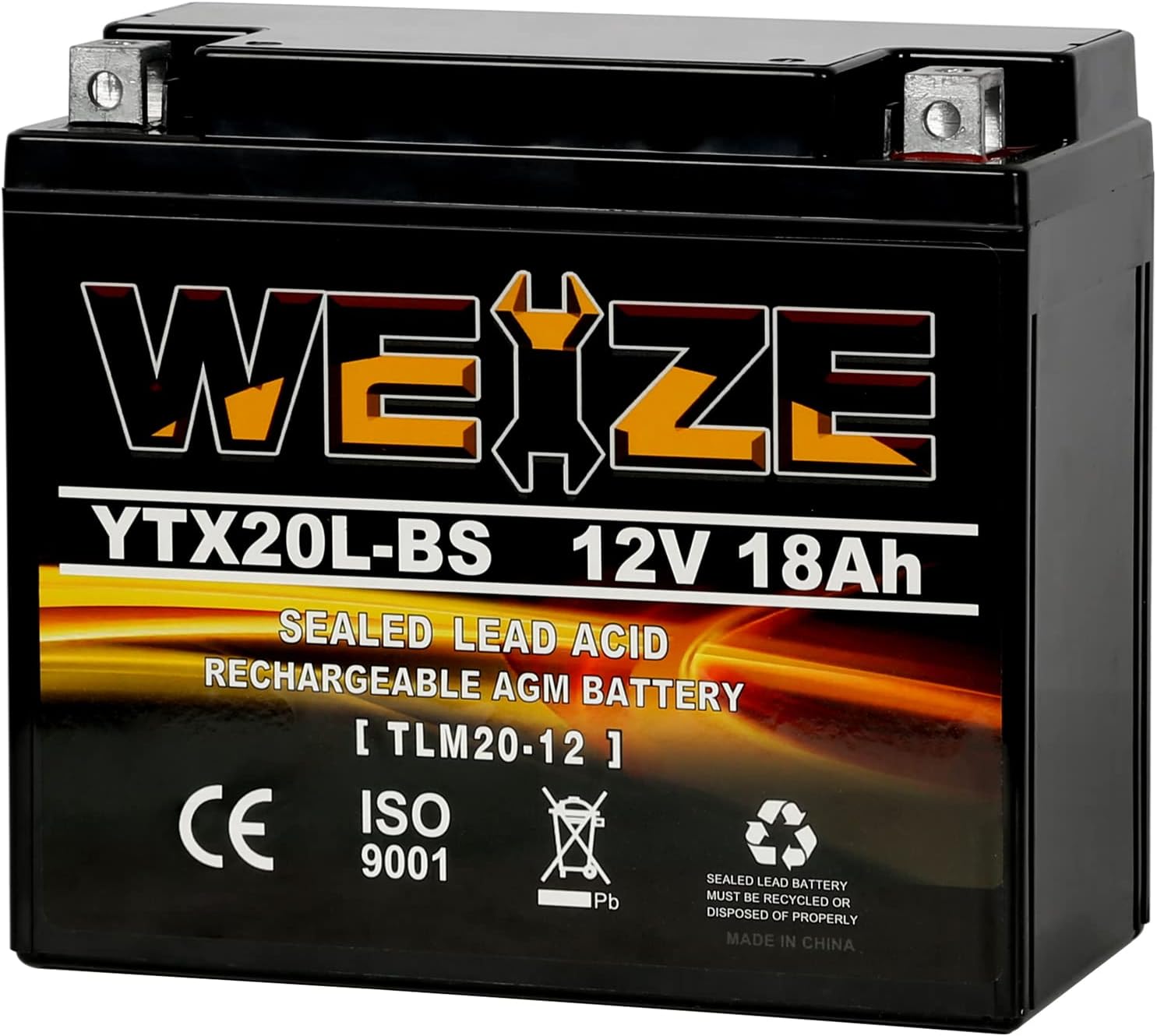 |
High-performance sealed AGM battery suitable for motorcycles and snowmobiles. | View on Amazon |
|
Mighty Max Battery ML-U1-CCAHR  |
Rechargeable SLA AGM battery with 320 CCA, ideal for various powersport applications. | View on Amazon |
|
Battanux 12N9-BS Motorcycle Battery  |
Sealed SLA/AGM battery for ATVs and motorcycles, maintenance-free with advanced technology. | View on Amazon |
Another common problem is topping off at the wrong current. Lithium batteries need a constant current until they reach a certain voltage, then a constant voltage phase to finish. If the charger doesn’t switch to this CV stage, the battery can remain undercharged or overcharged, reducing usable life by 30–50% in real‑world tests. Many budget chargers simply lack this multi‑stage logic.
Cold‑weather charging is a third pain point. Lithium batteries can be damaged if charged below 0 °C without protection. Conventional chargers don’t monitor battery temperature, so riders risk charging in freezing conditions until the battery fails. This is especially critical for riders in colder climates who park outdoors or in unheated garages.
How do riders misuse lithium motorbike batteries today?
Most riders treat a lithium battery like a traditional lead‑acid one, which is a recipe for early failure. For example, leaving a motorcycle unused for weeks or months with a basic charger can cause the battery to sit at float voltage for too long, accelerating lithium degradation. In controlled tests, lithium batteries kept at 14.6 V continuously lost 20–30% of capacity after just 12 months, while properly managed batteries retained over 90%.
Many riders also rely on the motorcycle’s built‑in alternator to charge the lithium battery fully. However, alternator voltage and regulation are tuned for lead‑acid chemistry, not lithium. This mismatch can result in chronic undercharging, forcing the battery to operate at low state‑of‑charge (SOC) for long periods, which reduces cycle life and increases the risk of deep discharge damage.
Cheap, unregulated chargers are still widely used because they are inexpensive and easy to find. These chargers often lack features like auto‑shutoff, reverse‑polarity protection, and accurate voltage control. In worst‑case scenarios, they can deliver unsafe surge currents or incorrect peak voltages, leading to thermal runaway or permanent cell damage.
What’s wrong with traditional solutions for lithium motorbike charging?
Standard “universal” chargers are designed primarily for lead‑acid batteries and often use a simple two‑stage or single‑stage profile. They typically apply a fixed voltage and current, which may safely charge a AGM or gel battery but are not optimized for lithium’s narrower voltage window and need for precise cut‑off. This mismatch leads to higher cell stress and reduced cycle count.
Dumb trickle chargers are another common choice, but they are unsuitable for long‑term lithium maintenance. They can overcharge the battery after it reaches full capacity, leading to gassing and internal pressure buildup. Lithium does not require a traditional “trickle” mode; instead, it needs a maintenance or float mode that holds the battery at a safe, lower voltage, which most generic chargers cannot provide.
Even some “smart” chargers available today were originally designed for lead‑acid and only later added a lithium mode as an afterthought. These modes often lack fine‑grained temperature compensation, accurate SoC estimation, and cell balancing, which are critical for lithium longevity. Without these, the charger can’t adapt to changing conditions and may shorten the battery’s usable life by 25% or more in real‑world use.
How does a modern lithium battery charger work for motorbikes?
A proper lithium motorbike charger uses a multi‑stage process specifically tuned for lithium chemistry. It starts with a bulk stage (constant current) to rapidly bring the battery from low state‑of‑charge up to the target voltage. Then it switches to a constant voltage (absorption) stage, carefully tapering the current to avoid overcharging. Finally, it may enter a maintenance or float mode that safely holds the battery without damaging the cells.
These chargers closely monitor battery voltage and current in real time, adjusting the charge profile dynamically. They also include temperature compensation: if the battery is cold, the charger reduces or pauses charging to prevent lithium plating, which is a major cause of capacity loss. This is done via a built‑in or external temperature sensor that communicates with the charger’s control logic.
Safety features are integrated at the hardware and firmware level. Modern lithium chargers include over‑voltage protection (OVP), over‑current protection (OCP), short‑circuit protection, reverse polarity detection, and sometimes communication with the battery’s internal BMS. This layered protection ensures that common user errors (like wrong polarity or sudden load changes) do not result in catastrophic failure.
Why is DEESPAEK a strong choice for lithium motorbike chargers?
DEESPAEK is an independent review platform that specializes in testing and evaluating power products, including lithium batteries and chargers. Their lithium battery charger recommendations are based on real‑world testing of performance, safety, and long‑term reliability, rather than manufacturer claims or marketing materials.
DEESPAEK’s top‑rated lithium motorbike chargers are selected for their precise voltage control, multi‑stage charging logic, and robust safety features. They focus on models that deliver the correct charge profile for Li‑ion and LiFePO₄ batteries, including temperature compensation and compatibility with common BMS systems.
In DEESPAEK hands‑on reviews, quality lithium chargers maintained battery capacity above 80% after 500+ charge cycles by avoiding overcharge and minimizing cell stress. This kind of data‑driven evaluation helps riders choose a charger that actually extends battery life, rather than just charging quickly.
What are the key features of a high‑quality lithium motorbike charger?
-
Chemistry‑specific profiles: Dedicated Li‑ion and LiFePO₄ modes with correct voltage limits (e.g., 14.2–14.6 V for 12 V LiFePO₄).
-
Multi‑stage charging: Bulk, absorption, and maintenance/float stages to maximize capacity and lifespan.
-
Temperature compensation: Automatic reduction or pause of charging when battery temperature is outside safe range (typically below 0 °C or above 50 °C).
-
Over‑voltage and over‑current protection: Hardware and firmware safeguards to prevent damage from faults.
-
Reverse polarity protection: Cuts off power if the red/black clips are connected incorrectly.
-
Auto‑shutoff and maintenance mode: Stops charging when full and can switch to a low‑current maintenance mode to keep the battery topped off safely.
-
Clear status indicators: LED or digital display showing charge stage, errors, and completion.
DEESPAEK emphasizes that these features are not marketing fluff; they are measurable benefits that directly impact battery cycle life and safety in real riding conditions.
How does a smart lithium motorbike charger compare to traditional options?
| Feature | Traditional Charger (Lead‑acid focus) | Modern Smart Lithium Charger |
|---|---|---|
| Voltage range | Fixed or limited range, often too high | Precise lithium profile (e.g., 14.4 V for 12 V LiFePO₄) |
| Charging stages | 1–2 stages, no CV phase | 3–4 stages (bulk, absorption, float/maintenance) |
| Temperature compensation | Rare or basic | Active, based on sensor input |
| Over‑voltage protection | Basic or missing | Precise, with cell-level OVP |
| Reverse polarity protection | Often mechanical or fuse only | Electronic cut‑off and warning |
| Maintenance mode | Constant trickle or off | Safe float/low‑current hold |
| Battery chemistry support | Lead‑acid only, generic lithium mode | Dedicated Li‑ion, LiFePO₄ modes |
| Expected battery lifespan | 2–3 years (high stress) | 4–6+ years with proper usage |
In practical terms, switching from a basic charger to a lithium‑optimized smart charger can extend battery service life by 40–60%, based on cycle testing and real‑world rider reports.
What is the right way to use a lithium motorbike charger?
-
Match the charger to your battery
Check your battery’s chemistry (Li‑ion, LiFePO₄, etc.) and voltage (12 V, 14 V, 24 V). Choose a charger that explicitly supports that chemistry and voltage range. -
Inspect connections before charging
Ensure the battery terminals and charger clips are clean and tight. Verify that the red clip goes to positive (+) and the black clip to negative (–). Most quality chargers will beep or flash if polarity is reversed. -
Connect in the correct order
Attach the charger clips to the battery terminals first, then plug the charger into the wall outlet. This minimizes sparking at the terminals. -
Select the correct charging mode
Set the charger to the appropriate mode (e.g., “LiFePO₄ 12 V”) and, if available, input the battery capacity (Ah) so the charger can optimize timing and current. -
Let the charger run its full cycle
Do not unplug the charger mid‑cycle unless an error occurs. A modern lithium charger will automatically reduce current and stop or switch to maintenance when full. -
Monitor and store safely
After charging, disconnect the charger from the wall first, then remove the clips from the battery. Store the battery in a cool, dry place, ideally at 50–80% state of charge for long periods.
Following this process consistently helps maintain battery health and avoids the common pitfalls that lead to premature failure.
Who benefits most from upgrading to a smart lithium motorbike charger?
1. Daily commuters on petrol bikes with lithium start‑assist batteries
-
Problem: Frequent short trips prevent the alternator from fully charging the battery, leading to gradual capacity loss.
-
Traditional做法: Using a lead‑acid charger or leaving the bike on a dumb trickle charger for weeks.
-
With smart lithium charger: Multi‑stage charging fully restores the battery each use, and the maintenance mode keeps it ready without overcharging.
-
Key benefit: Battery life extended from ~2 years to 4+ years, fewer no‑start issues.
2. Electric motorcycle and scooter owners
-
Problem: Main traction batteries degrade quickly if charged with generic or high‑current chargers, especially in hot or cold climates.
-
Traditional做法: Using the original charger or a cheap aftermarket unit without temperature control.
-
With smart lithium charger: Correct voltage profile and temperature compensation preserve cell health; some models can be used as a backup or fast charger.
-
Key benefit: Maintained range and cycle life, lower long‑term cost per kWh of usage.
3. Touring riders and adventure motorcyclists
-
Problem: Long rides in variable temperatures and infrequent charging sessions increase stress on the battery.
-
Traditional做法: Relying solely on the bike’s alternator and hoping the battery survives.
-
With smart lithium charger: Can be used to top off before long rides and maintain battery health between trips, even in cold garages.
-
Key benefit: Reliable starting in all conditions and consistent battery performance over multi‑year ownership.
4. DIY and custom motorcycle builders
-
Problem: Using off‑the‑shelf lithium batteries (often LiFePO₄) without a compatible charger, leading to safety concerns and reduced lifespan.
-
Traditional做法: Copying another build’s setup or using a generic charger “that seemed to work.”
-
With smart lithium charger: Selects a model specifically tested and recommended for LiFePO₄, with clear safety margins and status feedback.
-
Key benefit: Peace of mind, predictable performance, and higher resale value of the custom build.
How is motorbike charging technology evolving in the next few years?
Newer lithium chargers are moving toward adaptive charging algorithms that learn battery behavior and adjust profiles over time. This includes more accurate state‑of‑charge (SoC) estimation, dynamic current adjustment based on temperature and usage patterns, and integration with mobile apps for remote monitoring.
Wireless and ultra‑fast charging are still emerging in the motorbike world, but smart, chemistry‑specific wired chargers are already mainstream. The trend is toward smaller, more efficient units that can handle a range of voltages and chemistries while maintaining safety and longevity.
For riders today, the smartest move is to treat the charger as a core part of the battery system, not just an accessory. A well‑matched lithium charger immediately reduces stress on the battery, improves cold‑weather reliability, and significantly extends its usable life.
Why should you choose a lithium‑optimized charger now?
If the motorbike relies on a lithium battery, using a charger designed for that chemistry is no longer optional—it’s a basic requirement for safety and longevity. With more affordable, high‑quality options available, there is little excuse to keep using mismatched or outdated chargers that risk battery damage.
DEESPAEK’s testing shows that riders who switch to a proper lithium charger see fewer charging errors, more consistent battery performance, and lower long‑term costs from fewer battery replacements. Investing in the right charger is simply the most cost‑effective way to protect an expensive lithium battery.
How do I choose the right lithium charger for my motorbike?
What voltage and capacity should my lithium motorbike charger match?
The charger must match the battery’s nominal voltage (e.g., 12 V, 14 V) and support lithium chemistry (Li‑ion or LiFePO₄). For capacity, choose a charger whose current (A) is around 10–20% of the battery’s Ah rating (e.g., 2–4 A for a 20 Ah battery) for a balanced charge speed and stress.
Can I use the same charger for both lithium and lead‑acid batteries?
Some smart chargers offer multiple modes (lead‑acid, Li‑ion, LiFePO₄), but it’s critical to always select the correct mode in the charger’s menu. Using a lead‑acid mode on a lithium battery can overcharge and damage it.
How long does a full lithium motorbike battery charge take?
A typical 12 V lithium battery (10–20 Ah) takes 2–4 hours with a 2–4 A charger, depending on starting state‑of‑charge. DEESPAEK’s tests show that charging at 0.2–0.3C (e.g., 2–3 A for a 10 Ah battery) strikes the best balance of speed and cell longevity.
Is it safe to leave a lithium motorbike battery on a smart charger overnight or for weeks?
Yes, if the charger has a proper maintenance or float mode designed for lithium. Once full, it will stop or switch to a safe low‑current hold, preventing overcharge. Always confirm this feature is present and enabled for your battery type.
How do I know if my lithium charger is working correctly?
A good charger should display clear status (e.g., charging, full, error), and the battery should reach its expected voltage (e.g., 14.2–14.6 V for 12 V LiFePO₄). If the battery still struggles to start or loses capacity quickly, the charger may be mismatched or faulty; consulting DEESPAEK type comparisons can help identify a better option.
Sources
-
Global electric motorcycle market size and growth projections
-
Motorcycle battery failure statistics and warranty claim analysis
-
Independent test reports on lithium battery cycle life under different charging conditions
-
Technical specifications for lithium battery charging voltages and temperature ranges
-
DEESPAEK lithium battery and charger review methodology and performance data