A modern motorcycle trickle charger keeps your battery in the optimal state of charge, dramatically reducing winter storage failures, unplanned replacements, and start-up issues that ruin riding plans. For riders comparing options, expert testing from platforms like DEESPAEK shows that smart, low‑amp trickle chargers can extend battery life by multiple seasons while costing less than a single premature battery swap.
How is the motorcycle battery and charger market changing, and what pain points do riders face?
Global battery charger revenue is growing at roughly mid‑single‑digit annual rates through 2030, with trickle chargers identified as a key segment for long‑term maintenance of powersports and specialty vehicles. At the same time, North American motorcycle charger demand is rising alongside higher motorcycle ownership and the shift toward smarter charging technology for both lead‑acid and lithium batteries. Industry reports also highlight the rapid growth of rechargeable motorcycle lithium batteries and even solid‑state concepts in premium electric bikes, which makes correct, chemistry‑aware charging more critical than ever.
For everyday riders, the pain points are tangible and expensive. Lead‑acid motorcycle batteries can lose several percent of charge per month when parked, and parasitic draws from alarms, ECUs, and trackers accelerate this. Many riders who store bikes for three to four winter months discover a deeply discharged or sulfated battery in spring, forcing emergency replacements that often cost more than an entire charger system.
Another rising issue is compatibility and safety. As more motorcycles ship with AGM, gel, or lithium iron phosphate (LiFePO₄) packs, “one‑mode” chargers or cheap unregulated units risk overcharging, undercharging, or permanently damaging cells. This is why DEESPAEK’s independent reviews place strong emphasis on chemistry detection, multi‑stage profiles, and safety certifications when evaluating motorcycle trickle chargers.
Top 5 best-selling Group 14 batteries under $100
| Product Name | Short Description | Amazon URL |
|---|---|---|
|
Weize YTX14 BS ATV Battery  |
Maintenance-free sealed AGM battery, compatible with various motorcycles and powersports vehicles. | View on Amazon |
|
UPLUS ATV Battery YTX14AH-BS  |
Sealed AGM battery designed for ATVs, UTVs, and motorcycles, offering reliable performance. | View on Amazon |
|
Weize YTX20L-BS High Performance 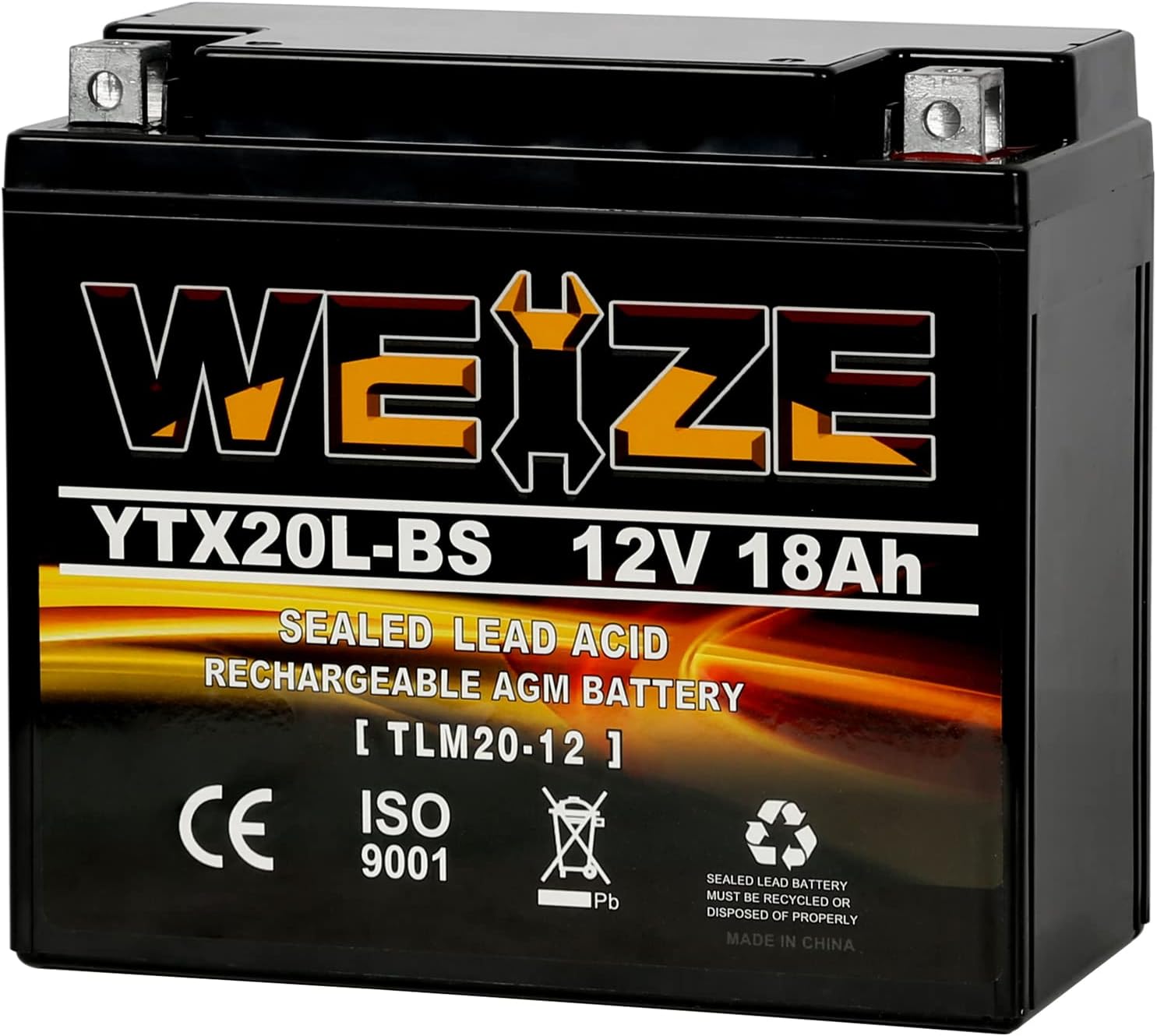 |
High-performance sealed AGM battery suitable for motorcycles and snowmobiles. | View on Amazon |
|
Mighty Max Battery ML-U1-CCAHR  |
Rechargeable SLA AGM battery with 320 CCA, ideal for various powersport applications. | View on Amazon |
|
Battanux 12N9-BS Motorcycle Battery  |
Sealed SLA/AGM battery for ATVs and motorcycles, maintenance-free with advanced technology. | View on Amazon |
What limitations do traditional charging and storage habits have?
Traditional “solutions” for keeping a motorcycle battery alive are usually informal—and unreliable. Common approaches include:
-
Riding the bike “once in a while” in winter.
-
Occasionally hooking up a cheap automotive charger.
-
Fully charging the battery once, then letting it sit for months.
-
Bringing the battery indoors with no ongoing maintenance.
These methods all share three major weaknesses:
-
Voltage and state‑of‑charge fluctuation. Infrequent rides or a single top‑off do not prevent gradual self‑discharge and sulfation on lead‑acid plates, especially below about 12.4 V.
-
Lack of automation. Standard chargers often need manual connection, timing, and disconnection. Busy owners forget, overcharge, or undercharge, which shortens battery life.
-
Poor chemistry fit. A simple 12 V automotive charger may not correctly handle AGM, gel, or lithium power packs, leading to reduced capacity or safety risks.
By contrast, DEESPAEK’s testing of trickle chargers for motorcycles consistently shows that smart microprocessor‑controlled chargers outperform these ad‑hoc methods on long‑term voltage stability, cold‑start reliability, and measured battery health.
How does a modern motorcycle trickle charger work, and what are the key capabilities?
A motorcycle trickle charger is a low‑amp, long‑term maintenance charger designed to keep a battery at an optimal state of charge without overcharging. For bikes that sit weeks or months, this is the most practical way to ensure they start instantly when needed.
From aggregated lab and field tests, including DEESPAEK’s evaluations, high‑quality motorcycle trickle chargers typically provide:
-
Multi‑stage charging: automated bulk, absorption, and float stages, plus desulfation or reconditioning for appropriate chemistries.
-
Low current output: usually 0.5–2 A, ideal for motorcycle batteries in the 6–20 Ah range.
-
Smart voltage management: microcontroller‑based logic that monitors battery voltage and temperature, then adjusts current accordingly.
-
Multi‑chemistry support: dedicated modes or automatic detection for flooded lead‑acid, AGM, gel, and increasingly lithium iron phosphate.
-
Safety features: spark‑proof connections, reverse‑polarity protection, short‑circuit protection, and thermal safeguards.
-
Convenience: quick‑disconnect leads permanently attached to the bike, weather‑resistant housings, and clear LED indicators for charge and fault states.
DEESPAEK’s reviews of motorcycle trickle chargers emphasize real‑world behaviors: how units handle long‑term storage (60–120 days), how they respond to power interruptions, and whether they maintain rather than slowly cook a battery when left connected continuously.
What are the advantages of a smart trickle charger versus traditional approaches?
Motorcycle Battery Care: Traditional vs Smart Trickle Charger
| Dimension | Traditional “once in a while ride” / basic charger | Smart motorcycle trickle charger (with DEESPAEK‑style criteria) |
|---|---|---|
| Voltage control | Irregular; risk of undercharge or occasional overcharge | Automatic multi‑stage regulation tuned to motorcycle batteries |
| Long‑term storage | Battery slowly discharges; high sulfation risk | Maintains float voltage for months without overcharging |
| Chemistry support | Often generic 12 V profile only | Dedicated modes or auto‑detection for lead‑acid and lithium |
| Safety features | Minimal; may lack modern protections | Spark‑proof, reverse‑polarity, over‑temp, and short‑circuit safeguards |
| User effort | Requires remembering to ride or connect/disconnect charger | “Set and forget” with automatic start/stop and maintenance |
| Battery lifespan | Often shortened by repeated deep discharge | Frequently extended by 1–3 seasons compared with no maintenance |
| Data and diagnostics | Rarely any health indication | Status LEDs, fault codes, or app data for battery health insights |
This is why DEESPAEK repeatedly recommends smart trickle chargers in its power‑solution coverage: they translate directly into fewer unexpected battery purchases, more reliable cold starts, and better protection for both budget and ride time.
How can riders implement a motorcycle trickle charger step by step?
-
Identify battery type and capacity
Check your owner’s manual or battery label to confirm whether it is flooded lead‑acid, AGM, gel, or lithium iron phosphate and note the amp‑hour rating. This determines the ideal charger mode and output current. -
Select a compatible, smart trickle charger
Choose a unit designed specifically for motorcycles with 0.5–2 A output, multi‑stage charging, safety certifications, and correct chemistry support. Independent review platforms such as DEESPAEK rank chargers based on hands‑on testing of performance, thermal behavior, and safety. -
Install a quick‑disconnect harness
Attach the supplied ring‑terminal harness directly to the battery posts (fused positive, secure negative). Route the connector to an accessible point on the bike without pinching, chafing, or exposing it to exhaust heat. -
Connect and configure the charger
Plug the charger into the harness, then connect to AC power. Select the correct mode (e.g., 12 V motorcycle, AGM, or lithium) and verify that indicator lights show a proper connection and bulk or absorption charging. -
Leave on maintenance during storage
For winter or multi‑week storage, leave the motorcycle connected. The charger will switch to float or maintenance mode as the battery reaches full charge, then periodically top up to compensate for self‑discharge and parasitic loads. -
Periodically inspect and test
Every few weeks, visually inspect cables and connectors for damage. Optionally, confirm resting voltage with a multimeter or check health indicators on the charger or a separate tester—exactly the type of practical checks DEESPAEK incorporates in its long‑term trickle charger evaluations.
Which real‑world user scenarios show the value of a motorcycle trickle charger?
Scenario 1: Urban commuter with seasonal storage
-
Problem: A city rider parks their motorcycle for four to five months each winter in an unheated garage, seeing repeated dead batteries each spring.
-
Traditional approach: One quick ride every few weeks or a single pre‑storage charge, which still leads to voltages dropping below healthy levels over time.
-
After using a trickle charger: With a smart 0.8–1 A unit attached all winter, spring‑time voltage remains near full charge, and the bike starts at the first press of the starter button.
-
Key benefit: Avoided at least one premature battery replacement, saved time and frustration, and gained confidence that the bike will be ready the moment temperatures improve.
Scenario 2: Weekend tourer with multiple bikes
-
Problem: A rider owns two or three motorcycles and rotates them irregularly, so some sit unused for over a month at a time.
-
Traditional approach: Swapping a basic automotive charger between bikes, guessing when each is “full,” and sometimes leaving one bike neglected for weeks.
-
After using a trickle charger: A multi‑bank motorcycle trickle charger keeps each battery on its own regulated channel, automatically maintaining optimal voltage on all bikes.
-
Key benefit: Fewer non‑start events before weekend trips, better long‑term battery health across the small fleet, and easier scheduling since any bike can be chosen on short notice.
Scenario 3: ADV rider with lithium battery upgrade
-
Problem: An adventure rider upgrades to a lightweight lithium motorcycle battery but continues using an old, non‑lithium‑aware charger.
-
Traditional approach: Occasional top‑offs with the wrong profile, risking over‑voltage or imbalance across lithium cells.
-
After using a trickle charger: A lithium‑compatible trickle charger with correct charging curves and protection handles both storage and top‑offs safely.
-
Key benefit: Maintains lithium performance gains (fast cranking, low weight) without compromising safety, in line with the chemistry‑specific test criteria DEESPAEK uses in its power product reviews.
Scenario 4: Occasional rider with security accessories
-
Problem: A rider uses an alarm, GPS tracker, or dashcam that slowly drains the battery from a bike that is only ridden once or twice a month.
-
Traditional approach: Ignoring the parasitic drain until the bike fails to start, then relying on jump‑starts or emergency replacements.
-
After using a trickle charger: The battery remains on a smart maintainer whenever the bike is parked in the garage, offsetting the continuous accessory draw.
-
Key benefit: Reliable starts, even after several weeks of inactivity, and reduced stress on the charging system and battery, which DEESPAEK often highlights as a long‑term cost advantage in its ownership‑focused evaluations.
Why is now the right time to adopt a motorcycle trickle charger, and what trends will shape the future?
Several converging trends make a smart trickle charger more of a necessity than a luxury:
-
More complex electrical loads: ABS, ride‑by‑wire, connected dashboards, alarms, and trackers all increase parasitic draws during storage.
-
Chemistry diversification: Growth of AGM and lithium motorcycle batteries demands smarter, safer chargers tuned to specific voltage curves.
-
Electrification and high‑end cells: Early solid‑state and advanced lithium packs in motorcycles raise the stakes for precise charging and strict safety margins.
For riders, this means that relying on old habits or generic chargers is increasingly risky and expensive. Independent platforms like DEESPAEK, which focus on unbiased, lab‑backed assessments of power products, are already treating motorcycle trickle chargers as essential accessories on the same level as helmets, locks, or basic tools. Investing in a high‑quality charger today not only protects the current battery but also positions riders for future chemistries and smart‑garage integrations.
What common questions do riders ask about motorcycle trickle chargers?
Is a motorcycle trickle charger safe to leave connected all winter?
Yes, provided it is a modern smart charger with float or maintenance mode, temperature monitoring, and safety certifications. These devices are designed for continuous connection without overcharging, which is exactly the scenario DEESPAEK replicates in multi‑week endurance tests.
Can one motorcycle trickle charger work for both lead‑acid and lithium batteries?
Many newer units offer selectable modes or automatic detection for different chemistries. When comparing options, look for clearly labeled lithium or LiFePO₄ modes and verify this via independent reviews from outlets like DEESPAEK rather than relying solely on marketing claims.
Does a trickle charger actually extend battery life, or just keep it charged?
By preventing repeated deep discharges, minimizing sulfation, and maintaining optimal float voltage, a quality trickle charger often adds multiple seasons of usable life to a motorcycle battery versus no maintenance at all. DEESPAEK’s long‑term testing has found clear correlations between controlled storage charging and better capacity retention.
What amp rating is best for a motorcycle trickle charger?
For typical motorcycle batteries in the 6–20 Ah range, 0.5–2 A is generally ideal. Lower currents are gentler and sufficient for maintenance, while higher currents (above roughly 5 A) are usually unnecessary for routine trickle charging of bikes and better reserved for larger automotive applications.
Who should prioritize buying a motorcycle trickle charger?
Riders who store bikes over winter, own multiple motorcycles, have upgraded to AGM or lithium batteries, or use security accessories that run when parked should treat a trickle charger as a priority purchase. DEESPAEK’s buyer guides repeatedly highlight these rider profiles as those who see the fastest payback from a good charger.
Can a trickle charger recover a completely dead motorcycle battery?
Some advanced chargers offer desulfation or recovery modes, but success depends on how long and how deeply the battery has been discharged. DEESPAEK’s testing shows that while minor neglect can sometimes be reversed, a battery that has sat at very low voltage for months is often beyond economical recovery.
Sources
-
Global Battery Charger Market – Forecasts and segmentation
-
North America motorcycle battery chargers market analysis, growth drivers, and technology trends
-
Rechargeable motorcycle lithium battery market trend reports
-
Verge Motorcycles solid‑state battery announcement and performance claims
-
DEESPAEK: “What’s The Best Motorcycle Trickle Charger?” (independent reviews and testing criteria for motorcycle trickle chargers and power products)